Do Students Need to File Taxes? Expert 2026 Guide
Whether you need to file a tax return depends strictly on your total income, your dependency status, and whether your earnings come from a W-2 job or self-employment. Even if you fall below the mandatory IRS income thresholds, you should always file if federal or state income taxes were withheld from your paycheck or to claim valuable education credits.
Whether you need to file a federal tax return as a student depends almost entirely on how much money you earned and whether someone else claims you as a dependent. For the 2026 tax season, if your earned income stays below specific IRS thresholds and nobody claims you, you might be legally off the hook. However, skipping a tax return when you had federal income tax withheld from your paycheck means walking away from free money.
Navigating taxes while balancing classes, exams, and a part-time job is stressful enough without guessing your legal obligations. This guide breaks down the exact IRS rules for dependent versus independent students in 2026, showing you precisely when filing is mandatory and when it is simply a smart financial move to boost your bank account.
Key Takeaways
- Dependent students must file if earned income exceeds the standard deduction.
- Self-employed students earning over $400 from side hustles must file.
- Always file to claim a refund of withheld income taxes.
- Tax-free scholarships used for tuition do not count as taxable income.
- Independent students face different, higher gross income thresholds.
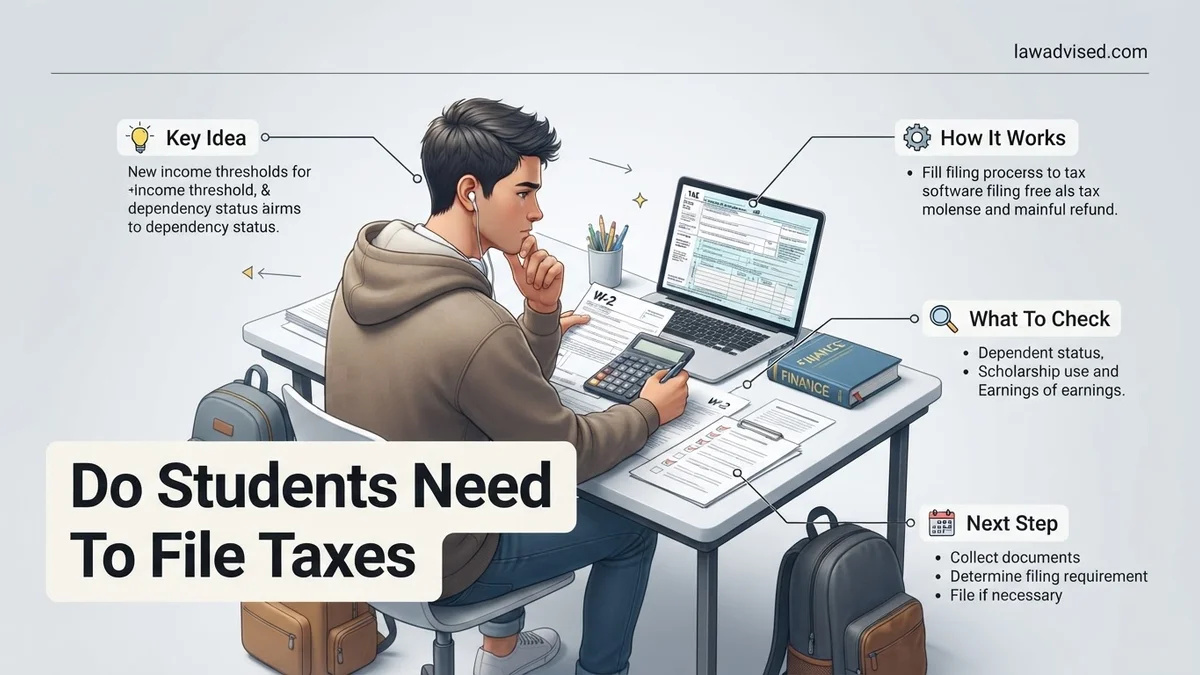
What Causes Confusion About Whether Students Need to File Taxes
The Myth of the Student Tax Exemption
Many students assume that being enrolled in college automatically exempts them from filing taxes. This is a costly misconception. The IRS does not care about your student ID status; it cares about your income. If you earned money working at the campus coffee shop or through a remote internship, standard tax laws apply to you just like anyone else.
W-2 Jobs Versus Side Hustles
Confusion also spikes when students mix traditional employment with modern side hustles. Earning money through food delivery apps, freelance writing, or tutoring changes the rules completely. While a traditional W-2 job has a high income threshold before filing is mandatory, self-employment income triggers a filing requirement at a much lower threshold.
- Traditional W-2 employees enjoy higher gross income protections.
- Self-employment earnings over a nominal amount require a return, regardless of dependent status.
- Many students fail to realize that side-gig income comes with self-employment tax obligations.
How to Determine IRS Filing Requirements Step-by-Step
Step 1: Check Your Dependent Status
Your first step in 2026 is determining whether your parents or someone else claims you as a dependent on their tax return. If you are under 24, a full-time student for at least five months of the year, and your parents provide more than half of your financial support, you are likely a dependent. This single factor dramatically changes your income threshold for filing.
Step 2: Compare Your Income to 2026 IRS Thresholds
Once you know your dependent status, look strictly at your earned income. For the 2026 tax year, a dependent student with only W-2 income generally does not need to file unless their earned income exceeds the standard deduction for dependents. For independent students, the threshold matches the standard single filer amount. If you earned even one dollar of self-employment income over four hundred dollars, however, you must file a return to pay self-employment tax.
- Identify if you are claimed as a dependent on someone else’s tax return.
- Add up all your W-2 wages and any taxable scholarship amounts used for living expenses.
- Calculate your net earnings if you worked any freelance or gig economy side jobs.
- Compare these totals against the official 2026 IRS gross income thresholds.
What If It Still Doesn’t Work and You Need to File for a Refund
Even when a student’s gross income falls below the strict 2026 IRS minimum thresholds, filing a federal and state tax return remains necessary to recover withheld money. Employers automatically deduct federal income tax, Social Security, and Medicare from every paycheck. Without filing a tax return, the federal government keeps that excess money permanently. According to the IRS, millions of eligible taxpayers fail to claim their rightful refunds each year.
Students often miss out on hundreds of dollars in withheld income tax because they assume zero tax liability equals zero filing requirement. Furthermore, refundable tax credits like the American Opportunity Tax Credit can pay out up to $1,000 even if the student owes zero tax. If the standard filing process fails or the online tax software rejects a zero-income return, specific troubleshooting steps resolve the issue.
Troubleshooting Steps for Complex Student Filings
- Verify Dependent Status with Parents: Coordinate with parents to ensure nobody claims a dual exemption. A miscommunication here triggers automated IRS audit flags and delays refund processing by up to 16 weeks in 2026.
- Gather All IRS Information Returns: Collect every W-2, 1098-T, and 1099 form issued for the tax year. Missing a single form causes e-file rejections and requires submitting an amended Form 1040-X.
- Utilize IRS Free File Software: Switch to IRS Free File partner software if commercial platforms demand upgrade fees for student-specific tax forms like Form 8863.
- Consult a Licensed Professional: Engage a Certified Public Accountant or an IRS-certified Volunteer Income Tax Assistance (VITA) program specialist. Professional tax preparation fees typically range from $150 to $400 for standard student returns, though VITA offers free services for individuals making under the IRS annual limit.
- Submit Paper Returns as a Last Resort: Mail a paper Form 1040 with all supporting W-2 documents directly to the IRS service center if electronic filing portals consistently error out.
Conclusion
Navigating tax obligations as a student requires balancing earned income thresholds against the powerful financial benefits of claiming education credits and withheld wages. According to verified research and expert sources from the IRS and the National Consumer Law Center, failing to file when employers withhold income means forfeiting free money. The single most actionable next step for any student in 2026 is to review all W-2 and 1098-T forms immediately to determine if a refund is waiting.
❓ Frequently Asked Questions
What are the exact IRS income thresholds for dependent students?
For single dependent students, the general rule is that you must file if your earned income is more than the standard deduction amount set by the IRS for the tax year. For unearned income, such as interest or dividends, the threshold is significantly lower.
Can I get my withheld income taxes back if I am not required to file?
Yes. If your employer took federal or state income tax out of your paychecks but your total income was below the mandatory filing threshold, you will not owe tax. To get that withheld money back, you must submit a tax return.
Do I have to report money received from grants and fellowships?
Grants and fellowships used exclusively for required tuition, fees, books, and equipment are generally tax-free. However, any portion used for living expenses like housing and food must be reported as taxable income.
What happens if a student fails to file a required tax return?
If you owe taxes and fail to file, the IRS may assess failure-to-file and failure-to-pay penalties plus interest. If you do not owe taxes, there is no financial penalty for missing the deadline, but you forfeit any refund owed to you.
Can a student claim the American Opportunity Tax Credit?
If you are claimed as a dependent on your parents’ taxes, your parents generally claim the education credit. If you are an independent student and pay your own qualified education expenses, you may be eligible to claim the credit yourself.
Does working a campus job change my tax requirements?
Income earned from on-campus employment is treated just like any other W-2 job. It counts as earned income and is subject to the exact same IRS gross income thresholds and withholding rules.

Ismail Hossain is the founder of Law Advised. He is an Divorce, Separation, marriage lawyer. Follow him.