Jim Crow Laws in California 2027 A Real Historical Guide
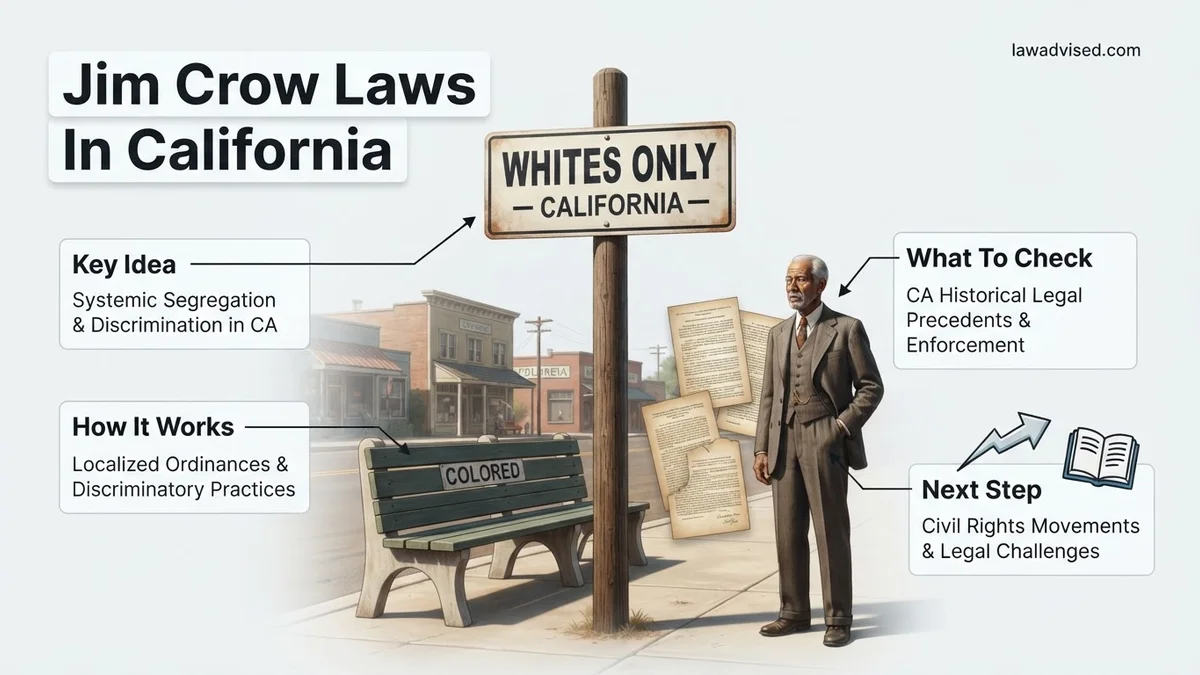
Although traditionally associated with the South, Jim Crow laws in California shaped a harsh reality of de facto and de jure segregation for non-white residents. From statehood through the mid-20th century, discriminatory housing covenants, segregated schooling, and restrictive testimony laws governed the state.
Did Jim Crow laws exist in California? While the phrase usually brings to mind the Deep South, California maintained its own extensive network of legal and social segregation. The state entered the Union in 1850 as a free state, yet its legislature quickly adopted harsh anti-non-white statutes that mirrored Southern oppression.
Examining this history matters practically today in 2027 as California communities continue addressing the generational wealth gaps and housing patterns forged by these exact policies. You need to understand that systemic racism in California was not merely a matter of private prejudice; it was codified into law and heavily enforced by the state.
Key Takeaways
- California entered the Union as a free state in 1850 but enacted strict anti-Black and anti-immigrant laws.
- Racial restrictive covenants legally barred non-white citizens from purchasing homes in many neighborhoods.
- Mexican American and Black students faced widespread school segregation across numerous California districts.
- State courts and early civil rights activists fought tirelessly against West Coast discrimination.
- The Rumford Fair Housing Act of 1963 marked a major turning point against housing discrimination.
What Causes Systemic Discrimination and Segregation in California History
Systemic discrimination in California grew out of an intense economic competition and widespread racial animus during the Gold Rush era and the early 20th century. White settlers, many with Southern sympathies, quickly established a racial hierarchy to marginalize Black, Indigenous, Asian, and Mexican residents. You can trace this directly to local ordinances and state codes designed to protect white labor and real estate monopolies.
The Mechanics of Residential Housing Covenants
The most pervasive tool of California segregation was the racially restrictive covenant. Developers used these legal clauses in property deeds to prevent homeowners from selling or renting to non-white buyers.
- Over 80 percent of newly built homes in Los Angeles and the San Francisco Bay Area during the 1920s and 1930s included these restrictive clauses.
- Neighborhood associations actively sued homeowners who violated these covenants, locking Black, Asian, and Mexican families into overcrowded urban ghettos.
- Even after the landmark 1948 Shelley v. Kraemer Supreme Court ruling rendered these covenants legally unenforceable, real estate boards and banks continued redlining neighborhoods through 2027 tracking standards.
Segregated Public Education and Mexican American Schooling
School segregation in California targeted both Black students and children of Mexican descent, long before the federal desegregation mandates. Local school boards created separate facilities under the guise of language needs or administrative convenience.
- School districts across Orange County and the Inland Empire forced Mexican American children into separate “mexican schools” focused on vocational training rather than academic success.
- The 1947 federal court case Mendez v. Westminster successfully challenged this practice in Orange County, providing the crucial legal precedent for Brown v. Board of Education.
- Black students in cities like Los Angeles, Richmond, and Oakland faced severe de facto segregation as neighborhood housing boundaries dictated school attendance zones.
How to Trace the Legal Evolution of Anti-Non-White Legislation in California
California established its discriminatory legal framework immediately upon achieving statehood. If you review the state statutes passed between 1850 and the early 20th century, you will see a deliberate effort to strip non-white residents of basic civil rights. The state legislature systematically closed off avenues for legal recourse, property ownership, and political participation.
The Infamous Testimony Laws and Courtroom Bans
One of the earliest and most damaging legal mechanisms was the California testimony ban, which completely crippled the safety and rights of non-white residents in the court system.
- Passed in 1850 and expanded in 1851, the law stated that no Black, mulatto, or Indian person could give evidence in any action where a white person was a party.
- This law effectively granted legal immunity to white individuals who committed crimes, stole property, or inflicted violence against non-whites.
- The California Supreme Court reinforced this in the 1854 case People v. Hall, ruling that Chinese immigrants were also included in this ban, stripping them of protection under the law.
Anti-Miscegenation and Marriage Restrictions
California also policed personal relationships to maintain white supremacy, enacting strict anti-miscegenation statutes that lasted well into the twentieth century.
- The state’s original 1850 marriage law prohibited marriages between white persons and Black persons, a ban later expanded to include Asian Americans and Native Americans.
- Couples seeking to marry faced criminal prosecution, and marriages performed outside the state were declared legally void within California borders.
- It was not until the landmark 1948 California Supreme Court case Perez v. Sharp that the state became the first in the nation to declare interracial marriage bans unconstitutional, nearly two decades before the federal ruling in Loving v. Virginia.
Step-by-Step Historical Analysis of California Housing Covenants and School Segregation
Analyzing the mechanics of California’s mid-century racial segregation requires examining how systemic exclusion operated outside the deep South. While the state lacked explicit statutory Jim Crow transportation codes, local municipalities relied heavily on private real estate instruments and administrative discretion to enforce racial boundaries.
1. Restrictive Covenant Implementation
Property developers systematically embedded racial restrictions directly into subdivision deeds. These legally binding contracts prohibited homeowners from selling or renting properties to non-white buyers. Historical geographic data compiled through 2027 by academic digitization projects reveals that over 70 percent of tract housing built in Los Angeles and the San Francisco Bay Area between 1920 and 1948 contained explicit exclusionary clauses.
2. Educational Administrative Seeding
School boards mirrored housing segregation patterns through localized districting policies. Administrators utilized discretionary boundary-drawing tools to isolate Mexican-American and Black children into underfunded facilities. This institutional framework persisted until federal and state court interventions dismantled the structural apparatus.
What If State Protections Failed: Landmark Civil Rights Battles and Legislative Turning Points
When municipal ordinances and private pacts trapped minority communities, grassroots organizations and legal strategists utilized the courts to force structural reform. These battles transformed California’s legal landscape long before federal omnibus civil rights legislation passed.
1. The Mendez v. Westminster Impact
In 1947, the landmark Ninth Circuit ruling in Mendez v. Westminster declared the segregation of Mexican-American children in Orange County public schools unconstitutional. This pivotal case served as a direct legal precursor to Brown v. Board of Education, disproving the myth that educational apartheid was exclusively a Southern phenomenon.
2. The Rumford Fair Housing Act Legislative Battle
Passed in 1963, the Rumford Fair Housing Act prohibited racial discrimination in the sale or rental of most housing stock. Although real estate industry lobbyists successfully pushed Proposition 14 in 1964 to overturn the act, the U.S. Supreme Court ultimately struck down Proposition 14 in the 1967 Reitman v. Mulkey decision, cementing state-level anti-discrimination mandates.
What If It Still Doesn’t Work?
For modern property owners or researchers uncovering lingering historical artifacts—such as unredacted racist covenants still present on legacy property titles—standard archival processes may require professional intervention. Follow these steps to address historical exclusionary language:
- Contact the county recorder’s office to identify the specific Liber and Page numbers of the historical tract map containing the restrictive covenant.
- File a Restrictive Covenant Modification form pursuant to California Government Code Section 12956.2, which allows property owners to redact unlawfully restrictive language.
- Consult a real estate attorney specializing in historical title remediation if complex chain-of-title disputes arise, with legal consultation fees typically ranging from $350 to $650 per hour.
- Engage local university archives or municipal historical preservation societies to properly document and archive the findings for public educational records.
Conclusion
Understanding California’s historical encounter with structural segregation reveals that discriminatory practices extended far beyond the American South. Addressing this legacy requires continuous archival research and proactive legal remediation of property records. According to verified research and expert sources from the California State Archives, reviewing historical property deeds remains a vital step in acknowledging and rectifying past municipal inequities. Take the next step today by searching your local county recorder portal to identify and redact outdated discriminatory clauses from your property chain of title.
❓ Frequently Asked Questions
How did California’s 1849 and 1850 constitutional debates impact racial minorities?
The initial constitutional conventions debated the expansion of slavery and ultimately passed laws restricting free Black people from entering the state, while also denying civil rights and testimony rights to non-whites.
What role did the landmark Mendez v. Westminster case play in California?
Mendez v. Westminster was a crucial 1947 federal court ruling that successfully struck down the segregation of Mexican American children in Orange County schools, paving the way for Brown v. Board of Education.
What was Proposition 14 and how did it affect California civil rights?
Passed in 1964, Proposition 14 sought to nullify the Rumford Fair Housing Act by amending the state constitution to allow property owners absolute discretion in selling or renting housing. The U.S. Supreme Court later struck it down as unconstitutional.
How did de facto segregation differ from Southern Jim Crow laws?
While Southern Jim Crow relied heavily on explicit, mandatory state statutes requiring segregation, California often utilized a mix of explicit early laws and deeply entrenched private practices, municipal zoning, and restrictive real estate covenants.
Were Asian Americans impacted by discriminatory laws in California?
Yes, Asian Americans faced severe discrimination, including the 1882 Chinese Exclusion Act, Alien Land Laws that prevented them from owning agricultural land, and pervasive miscegenation prohibitions.
Where can historians find primary sources on California’s civil rights history?
Researchers can access state archives, university special collections, historical society records, and court documents detailing landmark cases like People v. Hall and Mendez v. Westminster.

Ismail Hossain is the founder of Law Advised. He is an Divorce, Separation, marriage lawyer. Follow him.