Stun Gun Laws in California 2027 Expert Legal Guide
Stun guns and tasers are generally legal for civilian purchase and possession in California under Penal Code 24410. However, strict regulations dictate who can own them, where they can be carried, and what local ordinances apply.
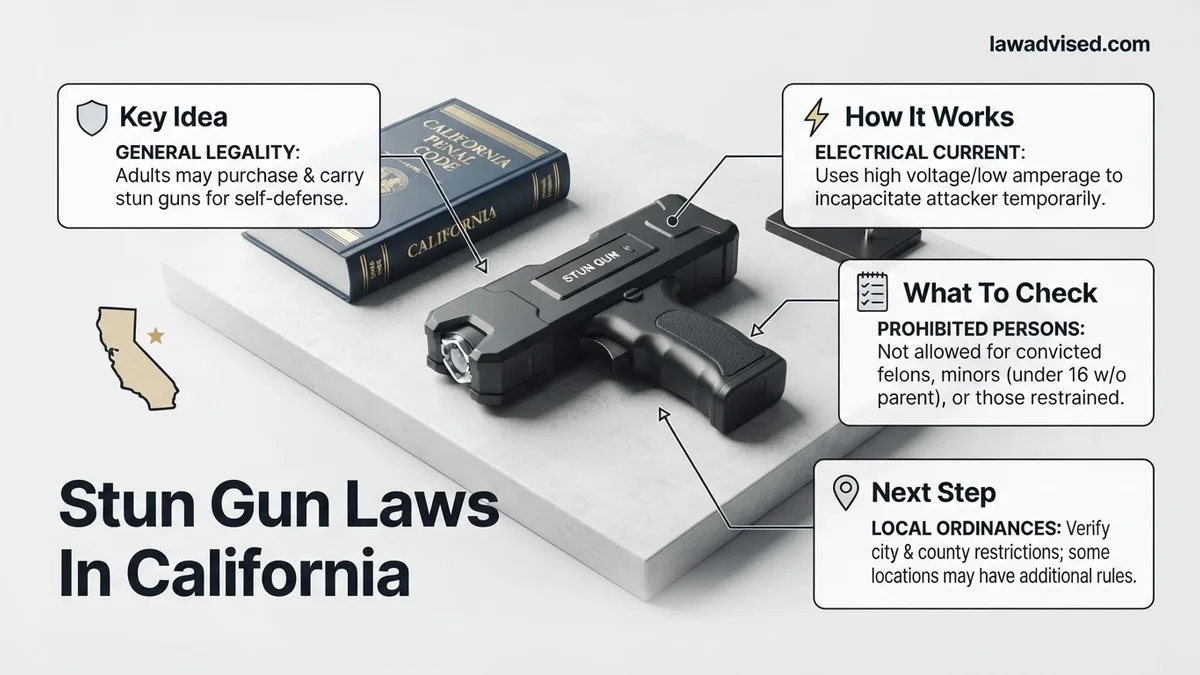
Stun guns and Tasers are completely legal to purchase, own, and carry in California for most adult citizens. Under California Penal Code 24410, you do not need a concealed carry permit or any special background check to buy or possess a standard electronic defense weapon in your home, business, or vehicle. However, strict state regulations dictate who can own them and exactly where you can carry them.
Navigating California self-defense laws in 2027 requires absolute clarity. While the state is notoriously restrictive regarding firearms and standard switchblades, the legal framework for non-lethal stun technology grants citizens broad defensive rights—provided you follow specific statutory guidelines.
Key Takeaways
- Adults legally allowed to own firearms may purchase and possess stun guns.
- Felons, narcotics addicts, and minors are strictly prohibited from owning stun guns.
- Concealed and open carry of stun guns is legal in most public spaces.
- Stun guns are strictly banned in schools, government buildings, and airports.
- Local city or county ordinances may impose stricter rules than state law.
What Causes Legal Confusion Around Stun Gun Laws in California
The primary source of confusion stems from overlapping weapon statutes and a historical ban that was overturned. Many residents still believe stun guns are classified the same as firearms or prohibited weapons, leading to widespread hesitation.
The Overturned Ban and Penal Code 24410
California completely banned stun guns until a federal court ruling struck down the restriction in 2014. Since then, California Penal Code 24410 has governed these devices. Because older news articles and outdated internet forums still reference the historic ban, buyers frequently assume electronic weapons remain illegal today.
Confusion with Concealed Carry Weapon (CCW) Permits
Another major misconception involves carry permits. Because you need a CCW to carry a concealed firearm in public, people incorrectly assume the same rule applies to Tasers and stun guns. In reality, carrying a stun gun does not require a traditional firearm permit, though certain location restrictions still apply.
How to Legally Purchase and Possess a Stun Gun Step-by-Step
Buying a stun gun in California is straightforward, but you must clear specific state-mandated hurdles regarding your age, background, and weapon specifications to remain fully compliant with the law.
Age and Background Restrictions
While you do not need a permit to purchase, California law explicitly prohibits certain populations from owning stun guns or Tasers. You must meet the following baseline requirements to make a legal purchase:
- You must be at least 18 years of age.
- You must not have any felony convictions on your record.
- You must not be addicted to any narcotic drug.
- You must not have active domestic violence restraining orders against you.
Prohibited Locations and Transport Rules
Even though ownership is legal, California strictly restricts where you can bring your electronic defense device. Carrying a stun gun into sensitive public infrastructure can result in misdemeanor or felony charges depending on the zone:
- Schools and Universities: Bringing a stun gun onto any K-12 campus, college, or university grounds is strictly illegal without written institutional permission.
- Government and Courthouse Buildings: State and federal buildings, jails, and courthouses prohibit all self-defense electronics.
- Airports and Secure Areas: You cannot carry stun guns past TSA security checkpoints in California airports, though they are generally permitted in checked luggage under specific airline guidelines.
How to Safely Carry Your Stun Gun Without Breaking Restrictions
Navigating California carrying restrictions requires strict adherence to state transport regulations, even with the legalization of civilian ownership. According to California Penal Code guidance, self-defense tools must be transported in a manner that prevents accidental discharge while inside a motor vehicle. Law enforcement experts advise keeping the device securely holstered or locked in a dedicated storage compartment during transit.
Recommended Transport Procedures
- Ensure the safety switch is engaged and locked into position before placing the device into any bag, purse, or vehicle console.
- Keep the stun gun out of plain view within a vehicle to avoid unnecessary panic or unwanted law enforcement interactions during routine traffic stops.
- Verify that your device does not feature any illegal modifications, such as integrated lasers or flashlight attachments that breach specific municipal guidelines.
- Store the device away from minor children and unauthorized users by utilizing a lockable security box inside your primary residence.
What If Local Ordinances Are Stricter Than California State Law
State preemption laws generally govern weapons ownership in California, but specific municipalities enforce localized restrictions that complicate compliance. Cities such as Los Angeles and San Francisco historically maintained strict municipal codes regarding electronic defense weapons. Legal analysts warn that local city councils occasionally attempt to pass ordinances banning concealed carry of non-lethal tools in public government buildings and municipal parks.
Handling Municipal Compliance Discrepancies
- Review the municipal code of your specific city or county before purchasing or carrying an electronic self-defense device in 2027.
- Contact local law enforcement public information officers to clarify any ambiguous local statutes regarding non-lethal public carry.
- Avoid carrying your device into federally or locally restricted zones, including public schools, government courthouses, and designated transit hubs.
- Consult with a licensed California criminal defense attorney if you face conflicting legal advice between state allowances and local ordinances.
What If It Still Doesn’t Work?
If your stun gun fails to operate properly during a routine test or an emergency scenario, standard troubleshooting may not resolve the underlying electronic failure. Attempting to repair high-voltage circuitry yourself can void warranties or cause severe personal injury. Follow these essential fallback steps if your device malfunctions:
- Cease all usage immediately and remove the rechargeable battery pack or disposable lithium cells if the manufacturer design permits safe extraction.
- Inspect the contact prongs for accumulated debris, corrosion, or physical damage that prevents proper electrical arcing.
- Contact the original equipment manufacturer customer support department to inquire about warranty repairs or factory diagnostic testing.
- Seek professional inspection services from a licensed security equipment retailer, with diagnostic fees typically ranging from $45 to $95.
- Recycle the malfunctioning unit at a certified electronic waste facility if repair costs exceed the standard retail replacement value of $80 to $200.
Conclusion
Understanding stun gun laws in California requires continuous vigilance regarding state regulations, prohibited categories, and localized municipal restrictions. By verifying device compliance and following strict transport protocols, residents can legally utilize these tools for personal protection. According to verified research and legal expert sources, staying informed about evolving 2027 legislation is the best defense against accidental legal violations. Review your local municipal codes today to ensure absolute compliance before carrying your self-defense device in public.
❓ Frequently Asked Questions
What is California Penal Code 24410 regarding stun guns?
Penal Code 24410 governs the legal ownership, purchase, and possession of stun guns and tasers for California residents, outlining the general right of civilians to own them for self-defense.
Can minors purchase or possess a stun gun in California?
No, minors under the age of 18 are prohibited from purchasing or possessing stun guns or tasers within the state of California.
Are there specific locations where stun guns are completely banned?
Yes, stun guns are strictly prohibited in K-12 schools, community colleges, university campuses, state government buildings, and commercial airport sterile areas.
Can cities in California enact stricter stun gun laws than the state?
Yes, local municipalities and counties can pass specific ordinances that regulate or restrict the carrying of stun guns more severely than state law.
Do stun guns require a concealed carry weapon (CCW) permit in California?
No, carrying a stun gun concealed does not require a CCW permit, unlike traditional firearms, provided you meet all general eligibility requirements.
What happens if a prohibited person is caught with a stun gun?
Possession of a stun gun by a felon or prohibited person is treated as a wobbler offense, which can be charged as either a misdemeanor or a felony depending on the circumstances.

Ismail Hossain is the founder of Law Advised. He is an Divorce, Separation, marriage lawyer. Follow him.