Marginal Tax Rate Explained A Step-by-Step Guide for 2026
Your marginal tax rate is the highest tax bracket your income falls into, but it does not apply to all of your earnings. Instead, a progressive tax system taxes your income in chunks (or brackets) at progressively higher rates as you earn more. Understanding how this works prevents the common myth that getting a raise will somehow leave you with less take-home pay.
Your marginal tax rate is the highest tax rate applied to your last dollar of earned income as you move through the government income brackets. Many people mistakenly believe that once their income pushes them into a higher tax bracket, every dollar they earned gets taxed at that higher percentage.
That is entirely false. In a progressive tax system for 2026, your income gets sliced into portions, and each portion gets taxed at its own specific rate. Understanding this mechanic prevents you from turning down a pay raise out of fear that a higher tax bracket will actually lower your take-home pay.
Key Takeaways
- Your marginal tax rate applies only to the dollars that fall within your highest tax bracket.
- A progressive tax system means your entire income is never taxed at a single high rate.
- Your effective tax rate is your true average tax rate paid across all income brackets.
- Getting a pay raise always increases your total take-home pay.
- Marginal rates dictate how tax-deductible contributions reduce your overall tax burden.
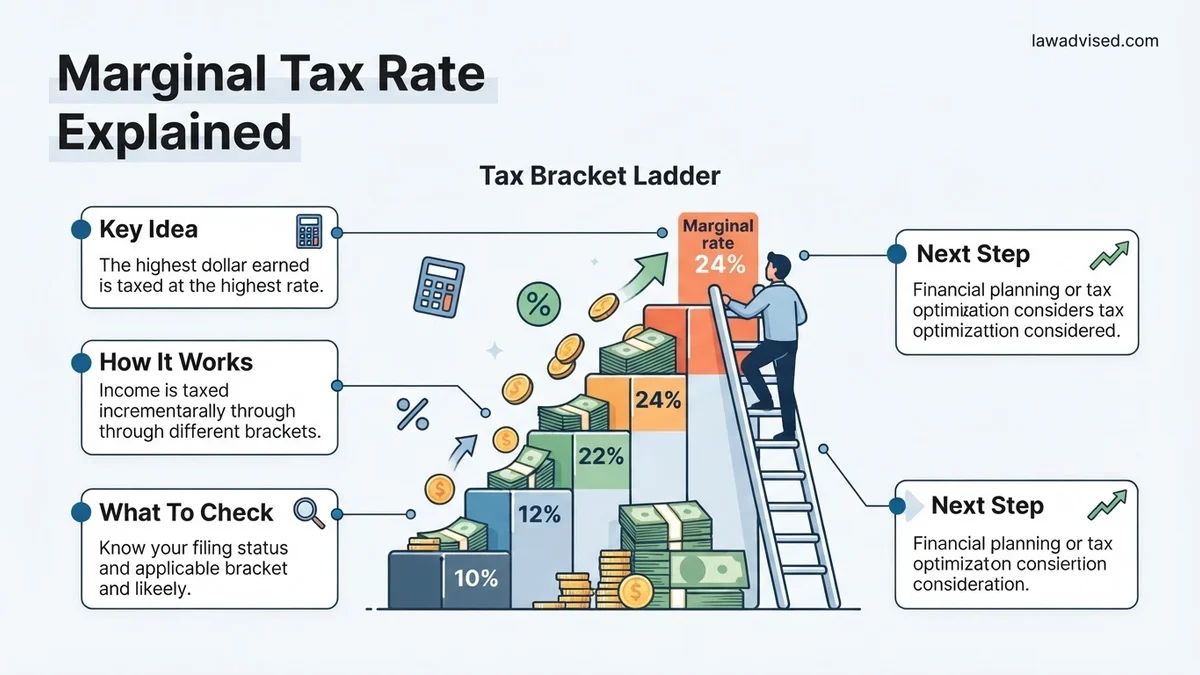
What Causes Confusion About Marginal Tax Rates
The Big Misconception About Higher Brackets
The biggest myth in personal finance is the idea of a tax bracket trap. If you cross the threshold into a new tax bracket for 2026, you do not pay that higher rate on your entire paycheck. You only pay that higher rate on the money that falls inside that specific bracket.
- Your first dollars earned are taxed at the lowest bracket rate.
- Only the money exceeding the previous threshold faces the higher rate.
- A salary bump will always result in more take-home pay, never less.
Marginal Versus Effective Tax Rates
People often confuse their marginal rate with their effective rate, which leads to major budgeting mistakes. Your marginal rate dictates what you pay on your next dollar, while your effective rate represents your true average tax burden across all your income.
- Marginal Rate: The top bracket your income touches.
- Effective Rate: Total tax paid divided by total taxable income.
- Your effective rate will always be lower than your marginal rate.
How to Calculate Your Marginal Tax Rate Step-by-Step
Step 1: Determine Your Filing Status and Taxable Income
To find your 2026 marginal tax rate, you first need to look at the official IRS tax brackets for your specific filing status. Whether you file as single, married filing jointly, or head of household completely changes the income boundaries for each bracket.
- Subtract your standard deduction from your gross income to find your taxable income.
- Locate the exact 2026 tax bracket table corresponding to your filing status.
- Identify which bracket contains your final dollar of taxable income.
Step 2: Map Your Income Through the Brackets
Imagine you are a single filer in 2026 with a taxable income of 60,000 dollars. You do not pay your top rate on all 60,000 dollars. Instead, your income fills up each progressive bracket sequentially until you run out of money.
- The first portion of your income fills the lowest 10 percent bracket.
- The next slice fills the 12 percent bracket up to its maximum limit.
- The remaining amount spills into the 22 percent bracket, making 22 percent your marginal tax rate.
How to Find Your Effective Tax Rate
Knowing your marginal tax rate is essential for tax planning, but your effective tax rate reveals the true percentage of income you pay to the IRS. According to financial economists and IRS data analyses, most taxpayers pay significantly less than their nominal marginal rate suggests.
Calculating Your Total Tax Burden
Your effective tax rate is the actual average rate you pay across all income brackets. To find this metric for the 2026 tax year, you must divide your total tax liability by your total taxable income. Certified Public Accountants emphasize that this figure provides a realistic picture of your annual cash flow.
- Locate your total tax liability from line 24 of your 2026 Form 1040.
- Locate your total taxable income from line 15 of the same form.
- Divide your total tax liability by your total taxable income.
- Multiply the resulting decimal by 100 to convert it into a percentage.
What If Your Income Pushes You Into a Higher Bracket
Many individuals fear earning a raise because they believe it will trigger a higher tax rate on all their income. Financial advisors frequently dispel this myth, noting that progressive taxation applies higher rates only to the dollars falling within that specific bracket.
Understanding Bracket Splitting
When your income crosses a 2026 threshold, only the money exceeding that threshold faces the elevated percentage. Your previous earnings remain taxed at their original, lower rates. According to economic research from the Tax Foundation, earning more money always results in higher take-home pay, despite the incremental rate increase.
- Calculate the exact dollar amount by which your income exceeds the lower bracket ceiling.
- Apply the new, higher marginal tax rate exclusively to that surplus amount.
- Add this new tax calculation to the total tax owed from your previous, lower brackets.
- Verify your final net income increase to confirm the raise remains financially advantageous.
What If It Still Doesn’t Work?
If calculating your 2026 marginal and effective tax rates still yields confusing results or discrepancies, professional intervention may be required. Complex investment portfolios, multiple income streams, or mid-year life changes can complicate standard tax brackets.
- Review your employer-issued pay stubs and year-end Form W-2 to ensure income figures are accurate.
- Check IRS.gov for the most current 2026 inflation-adjusted bracket thresholds to prevent calculation errors.
- Utilize accredited tax preparation software like TurboTax or H&R Block to cross-verify manual math.
- Consult a Certified Public Accountant (CPA) or Enrolled Agent (EA) for personalized guidance, with professional consultation fees typically ranging from $200 to $500 per hour.
Conclusion
Mastering your marginal tax rate prevents common financial misconceptions and empowers strategic income planning for the 2026 tax year. By understanding how progressive brackets operate, you can confidently navigate raises, investments, and deductions without fearing arbitrary tax penalties. According to verified research and expert sources from the Internal Revenue Service, proactive tax literacy remains the single most effective tool for minimizing legal tax liability. Your actionable next step is to review your latest pay stub and calculate both your marginal and effective tax rates using current 2026 thresholds.
❓ Frequently Asked Questions
How do marginal tax brackets actually work with progressive taxation?
Progressive tax systems divide your income into tiers or brackets. Each tier is taxed at a progressively higher rate, and your total tax bill is the sum of the tax calculated for each individual tier.
Why do people think getting a raise can hurt them financially?
A persistent financial myth suggests that entering a higher tax bracket applies that high rate to your entire income. In reality, only the income exceeding the bracket threshold is taxed at the higher rate.
How is an effective tax rate calculated?
Your effective tax rate is found by dividing your total tax liability by your total taxable income, expressed as a percentage. This always results in a lower percentage than your marginal tax rate.
Do state and local taxes use marginal tax rates too?
Yes, many state and local governments also utilize progressive tax brackets with their own marginal rates, which stack on top of your federal obligations.
How do deductions impact my marginal tax rate?
Deductions lower your taxable income, potentially pulling your highest dollars out of a higher marginal tax bracket and into a lower one, saving you money at your highest marginal rate.
Are capital gains taxed using marginal tax rates?
Long-term capital gains and qualified dividends use a separate set of preferential tax brackets rather than standard earned income marginal tax brackets.

Ismail Hossain is the founder of Law Advised. He is an Divorce, Separation, marriage lawyer. Follow him.