Overpayment of Estimated Taxes 2026 A Step-by-Step Guide
When you experience an overpayment of estimated taxes, you must decide whether to request a direct financial refund or apply the excess balance toward next year’s tax obligations. Making this choice requires specific entries on IRS Form 1040, and opting to roll the funds over is generally irreversible once filed. Understanding the mechanics ensures you recover your funds or credit them efficiently without triggering processing delays.
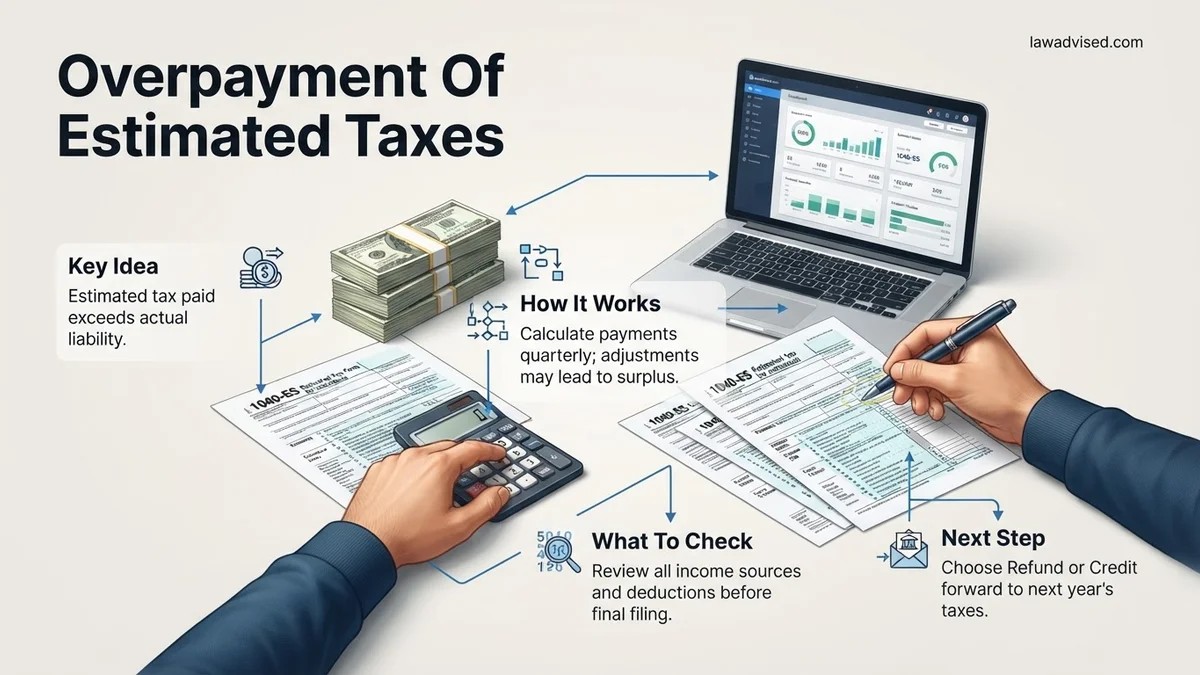
When you overpay your estimated taxes for the 2026 tax year, you face two primary choices: request a direct cash refund from the IRS or roll the extra money over as a credit toward your next year’s tax liability. Neither option is permanently locked in once you file, but making the right choice upfront saves you from cash flow pinches or unnecessary administrative delays.
Managing this extra payment correctly ensures your money works for you rather than sitting idly in the government’s account. This guide walks you through the exact mechanism of what happens next and how to execute your choice on your federal return.
Key Takeaways
- Choose between receiving a direct cash refund or applying the overpayment to next year’s taxes.
- Designate your choice clearly on Form 1040 by filling out the designated refund or rollover lines.
- Applying your overpayment to the following year’s estimated tax is an irrevocable election once filed.
- The IRS generally does not pay interest on overpaid estimated tax amounts refunded to you.
- Check state tax implications, as state overpayment rules often differ from federal guidelines.
What Causes Overpayment of Estimated Taxes and Why It Happens
Estimated taxes require you to guess your annual income, deductions, and credits quarterly. When your actual 2026 numbers shift dramatically, an overpayment naturally occurs.
Income Fluctuations and Deductions
If your freelance income drops in the third or fourth quarter, your initial quarterly estimates based on a stronger Q1 and Q2 might leave you with a surplus. Similarly, finding unexpected deductions or tax credits late in the year can reduce your overall tax liability below what you already paid in.
-
Common triggers for a 2026 overpayment include:
- A sudden drop in freelance or self-employment revenue during the back half of the year.
- Qualifying for large business write-offs or energy credits late in December 2026.
- Calculating your quarterly payments based on the safe harbor rule using the previous year’s higher income, but earning significantly less in the current tax year.
The Impact of Quarterly Estimations
Because the quarterly tax system operates on projections, paying too much is common for independent contractors and small business owners. When you submit your quarterly vouchers via IRS Direct Pay or EFTPS, you are essentially making good-faith deposits. If those cumulative deposits exceed your final calculated tax on your 2026 Form 1040, the IRS treats that difference as an overpayment.
-
Key realities of quarterly overpayments:
- The IRS does not automatically refund the money unless you instruct them to do so on your tax return.
- Overpaying does not incur penalties, unlike underpaying, but it temporarily restricts your access to your own capital.
- You must file your return to formally claim or allocate the funds.
How to Fix Overpayment of Estimated Taxes Using Form 1040
Your federal tax return is the official vehicle for telling the IRS what to do with your 2026 tax overpayment. You will make this crucial election directly on Form 1040.
Navigating Lines 35 and 36 on Form 1040
When you or your tax professional complete your 2026 Form 1040, the math will naturally reveal whether you have an overpayment on line 34. The very next lines give you the exact mechanism to resolve the balance.
-
Your choices on the form include:
- Line 35: This line lets you request a direct refund of the overpayment. You can have the IRS deposit the funds directly into your checking or savings account by providing your routing and account numbers.
- Line 36: This line allows you to apply all or a portion of your overpayment as a credit toward your estimated tax for the 2027 tax year.
Electing Refund Versus Credit Rollover
Choosing between a cash refund and a credit rollover depends on your immediate financial strategy. If you need cash flow for your business operations in early 2027, taking the direct refund to your bank account is the smartest move. Direct deposits typically arrive within 21 days of e-filing an error-free return.
-
Strategic considerations for your 2026 overpayment:
- If you know your 2027 tax liability will be similar or higher, rolling the overpayment over via Line 36 skips the step of writing a check for your first quarter 2027 estimate.
- Be aware that once you elect on Line 36 to apply the overpayment to next year’s taxes, you generally cannot ask the IRS to change it to a cash refund later.
- Double-check your bank routing numbers on Line 35 if you choose a refund to avoid months of processing delays caused by a simple typo.
Step-by-Step Guide to Choosing Between a Refund and a Tax Credit Rollover
When facing an overpayment of estimated taxes on your 2026 return, you must explicitly instruct the IRS on how to handle the excess funds. According to the IRS Instructions for Form 1040, you can elect to receive a direct cash refund or apply the overpayment toward your estimated tax liability for the 2027 tax year.
Option 1: Requesting a Direct Cash Refund
Choosing a refund sends the money back to your bank account or delivers a paper check. Financial experts recommend this option if you need the liquidity for immediate expenses. Follow these procedural steps to ensure proper processing:
- Locate the designated overpayment line on your 2026 Form 1040 (typically Line 34).
- Enter the specific portion of your overpayment that you want refunded to you in cash.
- Provide your accurate routing and checking or savings account numbers on the direct deposit lines to receive the funds within 21 days.
Option 2: Applying the Rollover to Next Year
Applying the credit to your 2027 estimated taxes lowers your future quarterly payment burdens. Tax advisors often suggest this route for self-employed individuals with consistent income projections. Execute this choice through these steps:
- Navigate to the estimated tax application line on your 2026 Form 1040 (typically Line 36).
- Designate the exact dollar amount you wish to transfer to your 2027 account.
- Verify that your Social Security Number matches across both tax years to prevent misapplied payment errors.
What If It Still Doesn’t Work and How to Resolve IRS Application Errors
Sometimes the IRS misapplies an overpayment rollover or delays a refund check due to processing backlogs. If your 2026 account adjustment fails or you receive a notice stating your credit was denied, do not panic. Implement these authoritative fallback steps to correct the record:
- Review your 2025 and 2026 tax transcripts through the official online IRS portal to verify that the overpayment amount was formally recorded by the agency.
- Call the IRS customer service line for individual taxpayers at 1-800-829-1040 to speak with a representative about the misplaced credit.
- Submit Form 3911, Tax Refund Statement, if a direct deposit or paper check was issued but never arrived or was improperly cashed.
- Engage a certified public accountant (CPA) or an Enrolled Agent if the discrepancy involves thousands of dollars or triggers an unjustified underpayment penalty for 2027. Professional fees for resolving IRS application errors typically range from $250 to $750 depending on complexity.
Conclusion
Overpaying your estimated taxes can disrupt your cash flow, but utilizing the refund or tax credit rollover options on your Form 1040 resolves the issue efficiently. According to verified research and expert sources from the National Taxpayer Advocate, proactive communication and accurate tax form reporting prevent most processing delays. Your immediate next step is to review your 2026 return drafts and clearly designate whether your excess payments belong in your bank account or your 2027 tax ledger.
❓ Frequently Asked Questions
How do I designate my overpayment on Form 1040?
On Form 1040, you specify whether you want your overpayment refunded or applied to next year’s estimated tax by entering the amount on the designated lines in the tax and credits section. Ensure you double-check these entries, as incorrect figures can trigger processing holds.
What are the risks of rolling my overpayment over to the next tax year?
The primary risk is that the election is completely irrevocable once your tax return is submitted. If your financial situation changes and you suddenly need that cash, you cannot call the IRS to reverse the rollover into a cash refund.
Will an overpayment of estimated taxes trigger an IRS audit?
Simply overpaying your estimated taxes and requesting a refund or credit does not automatically trigger an audit. However, large discrepancies between reported income and estimated payments can occasionally prompt a manual review.
How do state tax authorities handle estimated tax overpayments?
State tax agencies maintain their own rules regarding overpayments, which often mirror federal options allowing a refund or credit carryforward. You must file the specific state reconciliation forms to manage state-level overpayments properly.
Can I split my overpayment between a refund and next year’s credit?
IRS forms generally require you to choose one option for the total overpayment amount rather than splitting a single lump sum between a refund and a future credit.
What should I do if my expected overpayment refund is reduced by the IRS?
If the IRS reduces your refund, they typically issue a formal notice explaining the adjustment, such as an offset for past-due federal or state debts. Review the notice carefully and contact the agency listed if you believe an error occurred.

Ismail Hossain is the founder of Law Advised. He is an Divorce, Separation, marriage lawyer. Follow him.