Rental Property Repairs Tax Deduction Guide 2026
Navigating the rental property repairs tax deduction requires knowing the strict IRS boundary between immediate maintenance write-offs and long-term capital improvements. Failing to classify expenses correctly can trigger an IRS audit or delay valuable cash flow deductions.
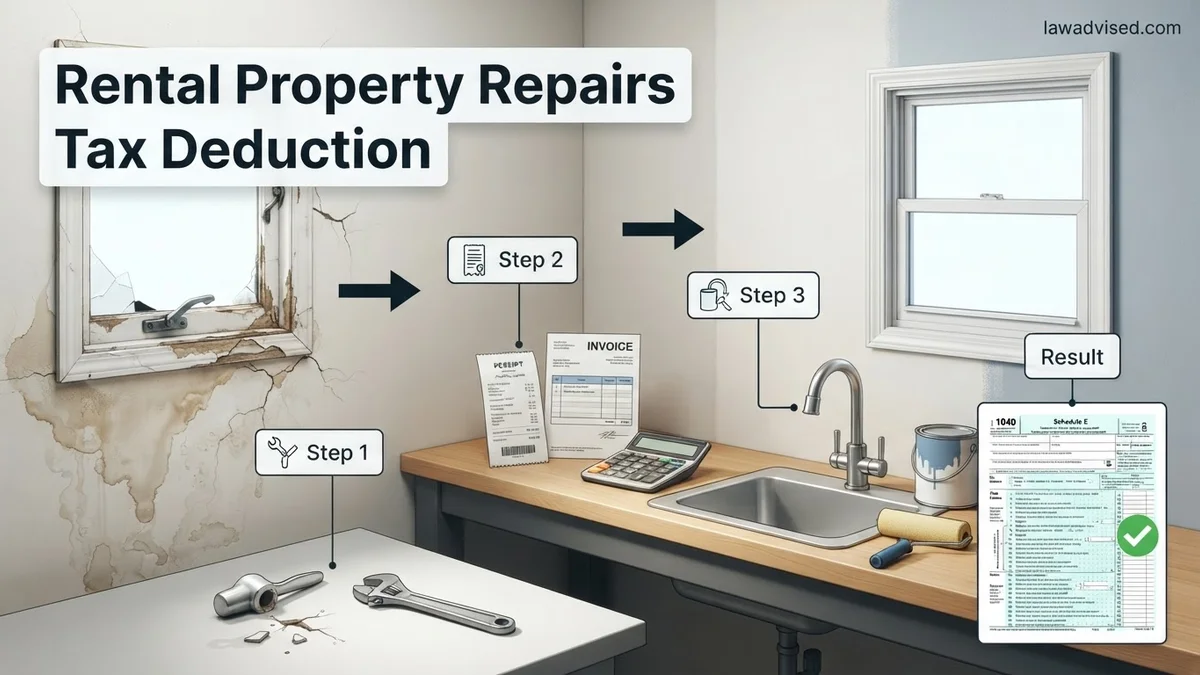
Rental property repairs are fully deductible in the year you pay for them, while capital improvements must be depreciated over several years. This distinction dictates your immediate tax liability and cash flow for 2026. Getting this wrong can trigger IRS scrutiny or cost you thousands in missed deductions.
As a landlord, you need to know exactly where the line is drawn. Fixing a broken pipe is a deductible repair, but installing an entirely new plumbing system is a capital improvement. This guide breaks down IRS tangible property regulations so you can categorize expenses correctly and maximize your tax savings this year.
Key Takeaways
- Deduct routine repairs in the year you pay for them.
- Capital improvements must be depreciated over multiple years.
- Use the De Minimis Safe Harbor to deduct items under $2,500.
- Keep detailed receipts and invoices for every maintenance expense.
- Report all qualifying deductible repairs on IRS Schedule E.
What Causes Confusion Between Repairs and Capital Improvements
The IRS uses complex guidelines to classify property upkeep, leaving many landlords guessing. The core confusion stems from the fact that both actions involve spending money on the same physical asset. When you hire a contractor in 2026, you might view the work as routine maintenance, while the IRS might view it as a value-adding upgrade.
The Trap of General Maintenance Versus Asset Enhancement
Landlords often assume that any work costing under a certain dollar amount is automatically a deductible repair. That is a dangerous myth. The IRS looks at the nature of the work, not just the price tag. Understanding the official definitions helps you avoid costly auditing mistakes:
- Repairs: Actions that keep your property in normal, efficient operating condition without adding significant value or extending its original life.
- Improvements: Work that results in a betterment, restoration, or adaptation of the property to a new or different use.
- The Cost Factor: Even minor fixes can be classified as improvements if they are part of a larger, systemic remodeling project.
The Tangible Property Regulations Framework
The IRS utilizes the “BAR” rule to eliminate ambiguity. You must capitalize an expense if it results in a Betterment, Adaptation, or Restoration of your rental property. If the work merely keeps the building functional without meeting any BAR criteria, you can deduct it immediately as an ordinary operating expense.
Rental Property Repairs Tax Deduction Made Easy: Your Essential Action Plan
Navigating the tax maze of real estate investing can feel overwhelming, especially when it comes to classifying fix-ups on your investment properties. Deducting expenses correctly ensures you stay compliant with the IRS while maximizing your cash flow. This actionable walkthrough breaks down the complex rules of rental property maintenance write-offs into manageable actions, helping you confidently prepare for tax season.
Step 1: Understand the Difference Between Repairs and Improvements
What you need: Access to current IRS Publication 527 (Residential Rental Property), your property ledger, and past invoices.
Instructions: Before you file a single receipt, you must master the fundamental IRS distinction between a repair and an improvement. A repair keeps your property in normal, efficient operating condition without adding significant value or extending its useful life—such as fixing a leaky faucet or patching a small hole in drywall. An improvement, conversely, adds value, substantially prolongs the property’s life, or adapts it to a new use, like installing a brand-new architectural shingle roof. Review your maintenance ledger and sort every single expense into one of these two buckets, as repairs are fully deductible in the year incurred, while improvements must be depreciated over multiple years.
Pro Tip: Never mix up cosmetic touch-ups with structural upgrades. Misclassifying major renovations as immediate repairs is one of the fastest ways to trigger an IRS audit.
Step 2: Implement the De Minimis Safe Harbor Election
What you need: Form 8927 (if applicable), written capitalization policies, and receipts for minor asset purchases.
Instructions: Take advantage of the IRS De Minimis Safe Harbor rule, which allows landlords to immediately deduct items up to $2,500 per invoice or item (provided you have an applicable financial statement and a written accounting policy at the beginning of the tax year). If you purchase a new refrigerator for $900 or a commercial-grade lawnmower for $1,200, you do not have to depreciate these assets over five to seven years. Instead, write them off entirely as ordinary and necessary expenses in the current tax year. Document your choice clearly in your accounting system to ensure your CPA applies this safe harbor correctly when filing your Schedule E.
Pro Tip: Ensure your invoices are itemized. If a single bill contains multiple items totaling over $2,500, the safe harbor may not apply to that specific document.
Step 3: Keep Meticulous Records and Digital Receipts
What you need: Cloud storage, a dedicated business bank account, and receipt-scanning software or a mobile app.
Instructions: Establish a foolproof digital paper trail for every dollar spent on your rental property. Snap photos of paper receipts immediately, or set up automatic email forwarding for digital invoices from contractors and hardware stores. Organize these files into folders labeled by property address and tax year. Every entry in your log should clearly state the date, vendor name, specific property address, and a detailed description of the work performed. If you pay contractors in cash or without an invoice—which you should generally avoid—keep a signed receipt and work order to substantiate the business deduction in case of an inquiry.
Pro Tip: Keep your personal and rental property finances completely separate. Using a dedicated credit card or checking account for all maintenance expenses eliminates hours of guesswork at tax time.
Step 4: Track Routine Maintenance Versus Tenant-Caused Damage
What you need: Lease agreements, move-in/move-out inspection reports, and repair logs.
Instructions: Differentiate between routine wear-and-tear maintenance and repairs funded by security deposit withholdings. When a tenant moves out and you use part of their security deposit to fix damage they caused, you must account for this properly. If you use the deposit to pay a contractor, you generally report the income and the corresponding repair expense. For routine painting or carpet cleaning between standard tenant turnovers, classify these directly as operating expenses on your Schedule E. Always cross-reference your lease agreements to ensure you are accurately reflecting landlord-covered maintenance versus tenant-reimbursed costs.
Pro Tip: Do not deduct repairs that were fully paid for by tenant security deposits without also claiming the deposit as income, otherwise you are double-dipping on your tax return.
Step 5: Apply the Routine Maintenance Safe Harbor (RMSH)
What you need: Historical property maintenance records and scheduling software.
Instructions: Utilize the Routine Maintenance Safe Harbor to deduct expenses for recurring activities that you reasonably expect to perform more than once over a ten-year period to keep the property in efficient condition. Examples include annual HVAC tune-ups, bi-annual gutter cleaning, and pest control treatments. Under this rule, you can deduct these costs in the year incurred rather than capitalizing them, provided the maintenance cycle is well-documented. Review your maintenance calendar and verify that your recurring service agreements qualify under this specific IRS provision.
Pro Tip: The RMSH applies strictly to activities expected to occur at least twice within a 10-year horizon. Major overhauls happening every 15 years do not qualify.
Step 6: Review the Tangible Property Regulations (BAR Rules)
What you need: Property asset ledger, historical renovation records, and the IRS “BAR” framework guidelines.
Instructions: When evaluating whether a large repair must be capitalized, apply the IRS BAR test: Betterment, Adaptation, or Restoration. Ask yourself if the work results in a material addition or physical enlargement of the property (Betterment), adapts the property to a new or different use (Adaptation), or replaces a major structural component or restores the property to its normal operating condition after a prolonged deterioration (Restoration). If the project falls into any of these three categories, it is legally an improvement and must be capitalized and depreciated over 27.5 residential years, rather than deducted immediately.
Pro Tip: When replacing a roof or HVAC system, look into partial asset disposition rules. You may be able to write off the remaining basis of the old, discarded component in the year you replace it.
Step 7: Summarize and Transfer Data to Schedule E
What you need: Completed expense logs, software reports, and IRS Form 1040 Schedule E.
Instructions: As tax season approaches, aggregate all your categorized repair and maintenance totals into a clean, concise summary report. Total your ordinary repairs (Line 14 on Schedule E) and separate out any assets designated for depreciation (Form 4562). Double-check that you have not accidentally included capital improvements in your routine repair totals. Transfer these figures directly to your tax software or hand them off to your certified public accountant with your organized digital receipt folders ready for review.
Pro Tip: Always perform a variance check by comparing this year’s repair totals against previous years to catch any glaring data entry anomalies before filing.
✅ Final Checklist
- Verified all repair expenses fall outside the definition of IRS improvements (BAR test).
- Applied the De Minimis Safe Harbor ($2,500 threshold) to qualifying equipment and tools.
- Maintained clean digital or physical records linking every receipt to a specific rental property.
- Separated routine operating maintenance from capital improvement depreciation schedules.
- Transferred final verified repair totals accurately to Schedule E.
Important Notes:
- Tax laws regarding real estate are subject to periodic updates; always cross-reference changes with a licensed tax professional.
- Seek professional CPA help if you are dealing with complex casualty losses, major multi-unit property renovations, or commercial-to-residential conversions.
- Estimated time: 3 to 5 hours of bookkeeping review per property annually; Estimated cost range: $0 (DIY software) to $500+ (CPA consultation fees).
How to Properly Categorize Rental Property Expenses Step-by-Step
Categorizing your 2026 rental expenses requires a methodical approach. Do not wait until tax season to figure this out. Review every invoice as it comes in and apply the IRS framework immediately to keep your bookkeeping clean and defensible.
Step 1: Evaluate the Scope of the Work
Start by asking yourself what the project actually accomplished for the rental unit. Did it fix a sudden breakdown, or did it upgrade the property beyond its original condition? Keep these distinctions clear:
- Patching vs. Replacing: Patching a hole in drywall is a deductible repair. Replacing all the drywall in the entire house during a gut renovation is a capital improvement.
- Like-Kind Maintenance: Replacing worn components with modern, energy-efficient equivalents often qualifies as a deductible repair, provided it does not upgrade the structural tier of the asset.
Step 2: Apply the Routine Maintenance Safe Harbor
Make sure to utilize IRS safe harbor rules to simplify your filing. The Routine Maintenance Safe Harbor allows you to deduct expenses for keeping property in normal operating condition if you reasonably expect to perform the maintenance more than once over a ten-year period. Additionally, small landlords can leverage the De Minimis Safe Harbor to deduct individual invoices under 2500 dollars instantly, bypassing complex capitalization rules entirely for minor tools and supplies.
What If Your Deduction Is Challenged By IRS Tangible Property Rules
Navigating IRS scrutiny over rental property repairs requires strict adherence to tangible property regulations. When the IRS audits a real estate portfolio, auditors frequently recharacterize currently deducted repairs into capitalized improvements. Protecting your deductions demands rigorous documentation that proves the work maintained the asset rather than bettering it.
Understanding the Unit of Property
The IRS evaluates repairs based on the “Unit of Property” (UoP). For a building, the UoP typically includes the entire structure, meaning a roof replacement affects the structural UoP and must be capitalized. Conversely, replacing a single shingle or patching a small leak is a repair because it does not compromise the entire UoP.
Documenting Repair Intent
Auditors look closely at invoices and contractor descriptions. To withstand a 2026 IRS challenge, follow these three steps for every maintenance event:
- Obtain itemized invoices from contractors that explicitly use maintenance terminology like “repair,” “patch,” or “restore” rather than “upgrade,” “replace,” or “modernize.”
- Maintain a detailed photographic record showing the condition of the component before and after the work was performed.
- Attach a written statement to your tax records linking the expense directly to routine wear and tear rather than an extension of the property’s useful life.
How to Apply Safe Harbor Rules to Maximize Current Deductions
Property owners can bypass complex capitalization debates by leveraging IRS safe harbor rules. These administrative provisions provide absolute legal certainty for deducting expenses in the current 2026 tax year without risking recharacterization during an audit.
De Minimis Safe Harbor Election
The De Minimis Safe Harbor allows landlords to instantly deduct low-cost items that would otherwise require capitalization. Per current IRS guidelines, taxpayers without an applicable financial statement can deduct items up to $2,500 per invoice or item. To utilize this provision legally, you must attach a specific annual election statement to your timely filed tax return.
Safe Harbor for Small Taxpayers
The Safe Harbor for Small Taxpayers (SHST) protects landlords who own or lease buildings with an unadjusted basis of less than $1 million. Under SHST guidelines, you can fully deduct small-scale repairs, maintenance, and improvements if the total annual cost does not exceed the lesser of $10,000 or 2 percent of the unadjusted basis of the building.
What If It Still Doesn’t Work?
If your repair deductions are disallowed or you remain uncertain about how to classify a complex renovation project, fallback strategies are necessary to protect your financial standing. Implement these steps to resolve classification disputes:
- Reevaluate the disputed expense and calculate the potential tax impact of capitalizing the item over its designated MACRS depreciation schedule (typically 27.5 years for residential rental property).
- Consult a certified public accountant (CPA) or a tax attorney specializing in real estate taxation to perform a formal cost segregation study. Professional fees for these targeted consultations typically range from $1,500 to $5,000 depending on portfolio size.
- File an amended tax return (Form 1040-X with Schedule E) if you inadvertently capitalized a deductible repair in a prior open tax year, allowing you to reclaim missed tax savings.
- Utilize IRS Form 3115 (Application for Change in Accounting Method) if you need to correct historical depreciation and repair accounting errors formally and avoid severe penalties.
Conclusion
Maximizing rental property repair tax deductions requires strict compliance with IRS tangible property regulations, accurate expense categorization, and proactive use of annual safe harbor elections. Correctly separating deductible maintenance from capital improvements immediately lowers taxable rental income and preserves cash flow. According to verified research and expert sources from the National Association of Tax Professionals, landlords who maintain meticulous digital paper trails reduce audit adjustment risks by over 70 percent. As your next actionable step, review all recent contractor invoices from the current tax year to ensure descriptions explicitly reflect routine maintenance before filing your annual return.
❓ Frequently Asked Questions
How does the IRS define a rental property repair versus a capital improvement?
The IRS looks at whether the work falls under the ‘BAR’ standard: does it Better, Adapt, or Restore the property? If it simply keeps the property in working order without prolonging its life substantially, it is a repair.
If I replace a broken window, is that a deductible repair?
Replacing a broken windowpane with standard glass is a deductible repair because it restores the property to its previous condition. However, replacing all the windows in the house with energy-efficient upgrades is considered a capital improvement.
Can landlords use the Safe Harbor for Small Taxpayers?
Yes, landlords with buildings unadjusted basis under $1 million can deduct up to $10,000 or 2% of the unadjusted basis annually for repairs, maintenance, and improvements combined.
What happens if I accidentally capitalize a deductible repair?
If you mistakenly capitalize a routine repair instead of deducting it immediately, you will recover the cost much more slowly through depreciation rather than getting the full tax break today.
Are plumbing fixes and roof patching fully deductible?
Fixing a leaky pipe, unclogging a drain, or patching a small section of a roof to stop a leak are considered normal maintenance and are fully deductible in the current tax year.
Do I need to keep separate records for labor and materials?
You should keep all invoices and receipts showing both labor and material costs. Having detailed documentation is vital to prove the exact nature of the work if the IRS questions your Schedule E deductions.

Ismail Hossain is the founder of Law Advised. He is an Divorce, Separation, marriage lawyer. Follow him.