Treasury Interest Tax Explained 2026 Guide to Rules
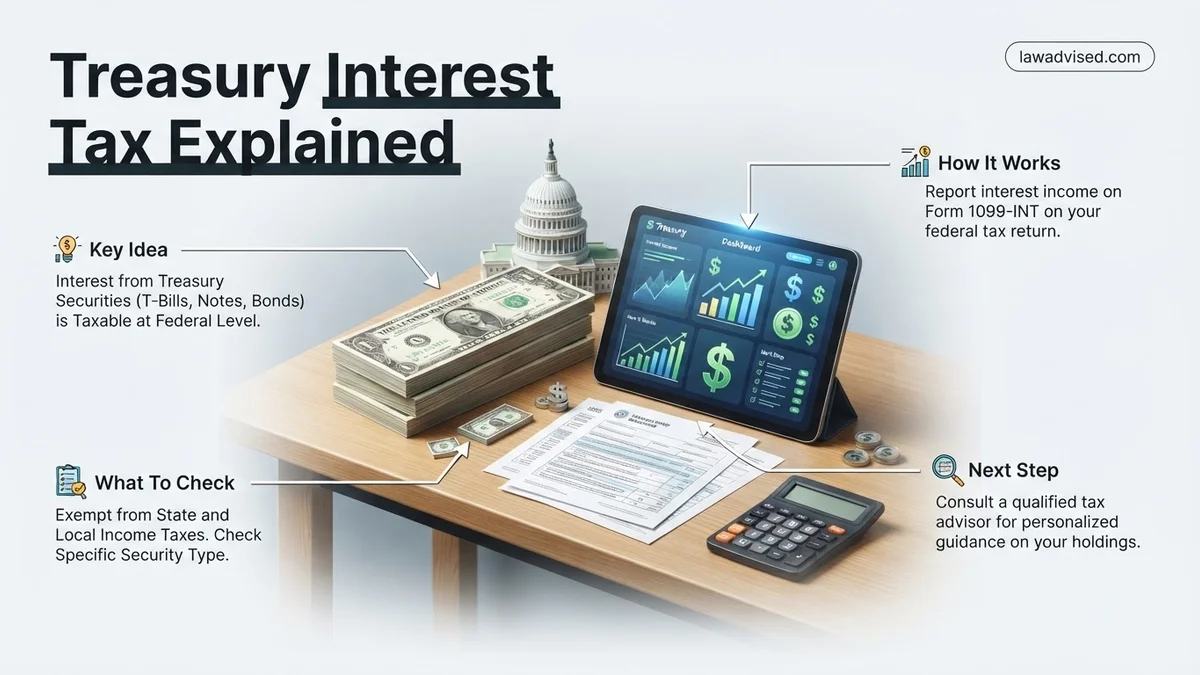
Interest earned from U.S. Treasury securities is subject to federal income tax but is completely exempt from state and local income taxes. Knowing how different securities like T-Bills, Notes, and TIPS handle tax reporting prevents costly errors on your return.
Interest earnings from U.S. Treasury securities are subject to federal income tax, but they are completely exempt from all state and local income taxes. This unique hybrid tax treatment makes Treasuries exceptionally attractive if you live in a high-tax state like California, New York, or New Jersey.
As you navigate your 2026 tax planning, knowing this specific distinction helps you compare the true after-tax yield of Treasuries against corporate bonds or high-yield savings accounts. State and local tax savings can significantly boost your net returns, shifting the math in favor of government-backed debt.
Key Takeaways
- Treasury interest is taxable at the federal level.
- All Treasury earnings are exempt from state and local taxes.
- T-Bills use original issue discount (OID) tax rules.
- TIPS inflation adjustments are taxed annually as income.
- Form 1099-INT Box 3 details your exact taxable interest.
What Causes Confusion With Treasury Interest Tax Rules
Investors often trip up over Treasury taxes because federal and state rules pull in opposite directions. While the IRS takes its cut, your local department of revenue gets nothing. That split creates widespread confusion about how to report the income accurately on different tax returns.
The Federal Versus State Tax Split
- Federal Income Tax: Every dollar of interest earned from Treasury bills, notes, bonds, and TIPS must be reported on your federal tax return.
- State and Local Exemption: Under federal law, state and local governments cannot tax the interest income generated by federal obligations.
- Municipal Bond Contrast: Municipal bonds are usually exempt from federal taxes, whereas Treasuries enjoy the exact opposite protection from state taxes.
When Tax Obligations Actually Trigger
Timing issues cause another major headache for taxpayers. Traditional coupon bonds pay semi-annual interest, making reporting straightforward. However, short-term securities like Treasury bills operate on a discount basis, meaning your interest is realized only when the security matures or is sold.
How to Calculate and Report Federal Taxes on T-Bills, Notes, and Bonds
Calculating your tax liability depends entirely on the specific type of Treasury security you hold. Each instrument distributes and reports interest differently, requiring careful attention to your Form 1099-INT at tax time.
Handling Treasury Bills and Original Issue Discount (OID)
Treasury bills do not pay periodic interest. Instead, you buy them at a discount to their par value and receive the full face value at maturity.
- The Discount is Interest: The difference between your purchase price and the payout at maturity is legally considered interest income.
- Form 1099-OID: Your broker or TreasuryDirect will issue a Form 1099-OID showing the exact taxable amount for the 2026 tax year.
- Cash Versus Accrual: Individual investors typically report OID income on a cash basis when the bill matures, unless they elect to accrue it annually.
Notes, Bonds, and TIPS Mechanics
Treasury notes and bonds pay traditional semi-annual coupon interest. TIPS (Treasury Inflation-Protected Securities) add another layer because their principal adjusts with inflation twice a year.
- Semi-Annual Coupons: Report these regular interest payments in the year you receive them, using Form 1099-INT.
- TIPS Principal Adjustments: Inflation adjustments to your TIPS principal are taxable as income in the year the adjustment occurs, even though you do not receive that cash until maturity.
How to Apply State and Local Tax Exemptions Correctly
Treasury interest holds a unique legal status under federal law. According to IRS tax code and verified Treasury guidance, interest earned on United States savings bonds, Treasury bills, notes, and bonds is completely exempt from state and local income taxes.
Taxpayers often misapply this rule by including total interest figures on state returns without making the necessary subtractions. Securing this exemption requires precise navigation of state-specific tax forms.
Step-by-Step State Exclusion Protocol
- Locate the total interest income figure reported on your federal Form 1040, Schedule B.
- Review your 1099-INT forms to separate interest from U.S. government obligations from corporate or municipal bond interest.
- Navigate to the subtraction or modification section of your state individual income tax return.
- Enter the exact amount of U.S. Treasury interest on the designated line for federally exempt interest.
- Attach supporting documentation if your state tax agency explicitly mandates verification for investment income adjustments.
State tax authorities enforce strict compliance on these subtractions. Overlooking this adjustment means you will overpay state income taxes on your federal securities.
What If Your Form 1099-INT Reporting Requires Adjustments
Financial institutions occasionally issue Form 1099-INT forms that group all interest earnings together without separating out U.S. Treasury obligations. When this happens, taxpayers must manually calculate and adjust the reported figures to avoid paying unnecessary state taxes.
Adjustment Procedures for Inaccurate Reporting
- Cross-reference your brokerage statements with the consolidated Form 1099-INT to isolate specific Treasury-backed yields.
- Calculate the precise portion of interest derived strictly from Treasury bills, notes, or bonds.
- Report the full interest amount on your federal return to match IRS automated matching systems.
- Subtract the Treasury-specific interest portion on your state tax return using the appropriate state-level adjustment schedule.
- Retain your brokerage statements and calculation worksheets for at least three years in case of an automated state audit.
Failing to reconcile these figures correctly can trigger state tax notices. Proper documentation protects your legal right to the intergovernmental tax immunity benefit.
What If It Still Doesn’t Work?
If automated tax software rejects your adjustments or state tax agencies issue discrepancy notices regarding your Treasury interest exemptions, you must take immediate remedial steps to resolve the issue.
- Contact the issuing brokerage or financial institution immediately to request a corrected Form 1099-INT if the original document failed to categorize the interest properly.
- Submit a formal written explanation along with your brokerage transaction history directly to the state department of revenue if an automated adjustment notice was issued in error.
- Consult a certified public accountant (CPA) or enrolled agent specializing in individual taxation if the disputed amount exceeds one thousand dollars. Professional assistance for complex tax resolution generally ranges from $250 to $600 depending on the complexity of the adjustments.
- File an amended state tax return using Form 1040-X equivalents if you discovered uncalculated Treasury interest exemptions from previous tax years within the three-year statute of limitations.
Conclusion
Navigating Treasury interest tax rules requires careful separation of federal obligations from standard investment income to maximize state and local tax exemptions for 2026. Applying these adjustments correctly ensures full compliance without overpaying state taxes. According to verified research and expert tax sources, maintaining meticulous records of your 1099-INT forms is the most effective way to defend your exemptions. Take action today by reviewing your brokerage statements to verify that all eligible Treasury yields are properly separated on your upcoming state tax filings.
❓ Frequently Asked Questions
How do state tax exemptions apply when filing local and state income tax returns?
When filing your state tax return, you must subtract any U.S. Treasury interest included in your federal adjusted gross income. Most tax software handles this automatically once you enter your 1099-INT details.
What is the difference in tax treatment between Treasury Bills, Notes, and Bonds?
T-Notes and T-Bonds pay semiannual interest that is taxed in the year received. T-Bills are sold at a discount and pay face value at maturity, meaning the interest is the difference between purchase price and payout.
How are Treasury Inflation-Protected Securities (TIPS) taxed?
TIPS require you to pay federal income tax annually on both the semiannual coupon interest and the inflation-adjusted increase in the principal value, even though you do not receive the principal adjustment until maturity.
What happens if I sell a Treasury security before maturity on the secondary market?
Selling a security before maturity may result in a capital gain or loss. This is separate from the accumulated interest and must be reported on Schedule D of your federal tax return.
Do I need to report Treasury interest if it is below a certain dollar threshold?
You may not receive a Form 1099-INT if your interest earnings are under $10, but you are still legally required to report all earned taxable interest income on your federal tax return.
How do mutual funds or ETFs holding Treasury bonds handle state tax exemptions?
Bond funds often pass through the state tax-exempt status of their underlying Treasury holdings. Look for the percentage of ordinary dividends derived from U.S. government obligations on your annual fund tax statement.

Ismail Hossain is the founder of Law Advised. He is an Divorce, Separation, marriage lawyer. Follow him.