Residential Energy Tax Credit Explained Step-by-Step 2026
Navigating home energy upgrades can be costly, but the residential energy tax credit offers substantial dollar-for-dollar savings on eligible green home improvements. This guide covers how to qualify, calculate your savings, and claim credits using IRS Form 5695.
The federal residential energy tax credits offer dollar-for-dollar reductions on your federal income taxes for making eco-friendly upgrades to your home. These incentives are split into two main buckets: the 25C Energy Efficient Home Improvement Credit for appliances and weatherization, and the 25D Residential Clean Energy Credit for systems like solar panels and geothermal. For the 2026 tax year, you can claim up to 30 percent of the total cost for many of these installations, significantly lowering the barrier to entry for home modernization.
Navigating these tax incentives directly slashes your upfront project costs while permanently reducing your monthly utility overhead. Whether you are replacing a failing furnace or transitioning your entire property to solar power, claiming these credits requires understanding precise equipment standards and proper IRS filing procedures. Let us break down how these financial incentives target your energy consumption and how you can maximize your savings.
Key Takeaways
- Section 25C covers energy efficiency upgrades like heat pumps, insulation, and windows up to $3,200 annually.
- Section 25D provides a 30% credit for residential clean energy systems like solar and battery storage.
- You must install equipment that meets specific ENERGY STAR certification standards to qualify.
- Credits reduce your tax liability dollar-for-dollar, though they are non-refundable and cannot create a cash refund.
- File IRS Form 5695 with your annual federal tax return to claim both 25C and 25D credits.
What Causes High Utility Bills and How Federal Tax Credits Target Them
The Hidden Drains on Your Monthly Energy Budget
Most households lose hundreds of dollars every year through invisible energy leaks. Outdated HVAC equipment, poorly insulated attics, and drafty windows force your heating and cooling systems to work twice as hard. When your equipment runs longer cycles to maintain a comfortable indoor temperature, your electricity and gas bills skyrocket. Federal tax credits specifically target these high-consumption areas by subsidizing the transition to high-efficiency alternatives.
Targeting Structural and Mechanical Inefficiencies
Instead of offering minor rebates, federal tax policy incentivizes comprehensive home overhauls. The government structures these credits to make high-tier, certified equipment more affordable than standard builder-grade replacements. By reducing the purchase price of premium technology, the tax code encourages homeowners to permanently upgrade their property infrastructure. Here is what these credits primarily address:
- Outdated fossil-fuel furnaces and central air conditioners
- Leaky exterior doors and single- or double-pane windows
- Insufficient attic, wall, and crawlspace insulation
- Energy-draining water heaters
How to Fix Inefficient Systems Using the 25C Energy Efficient Home Improvement Credit
Understanding the 25C Limits and Percentages
The 25C Energy Efficient Home Improvement Credit provides a 30 percent tax credit for qualified upgrades installed on your primary residence. For the 2026 tax year, the annual aggregate cap is generally $1,200, but certain categories have higher limits. For instance, heat pumps, biomass stoves, and biomass boilers have a separate annual limit of up to $2,000. You cannot exceed these yearly maximums, but you can spread different projects across multiple tax years to maximize your total return.
Qualifying Equipment Standards for 2026
You cannot simply buy any hardware off the shelf and claim the credit. The IRS and Department of Energy enforce strict efficiency ratings. For windows and doors, products must meet ENERGY STAR most efficient certification requirements. For HVAC units and water heaters, the equipment must meet or exceed the highest efficiency tier established by the Consortium for Energy Efficiency (CEE) in effect at the start of the installation. Always request the manufacturer certification statement and keep your itemized contractor receipts to substantiate your claim.
How to Claim the 30% Residential Clean Energy Credit for Solar and Storage Under Section 25D
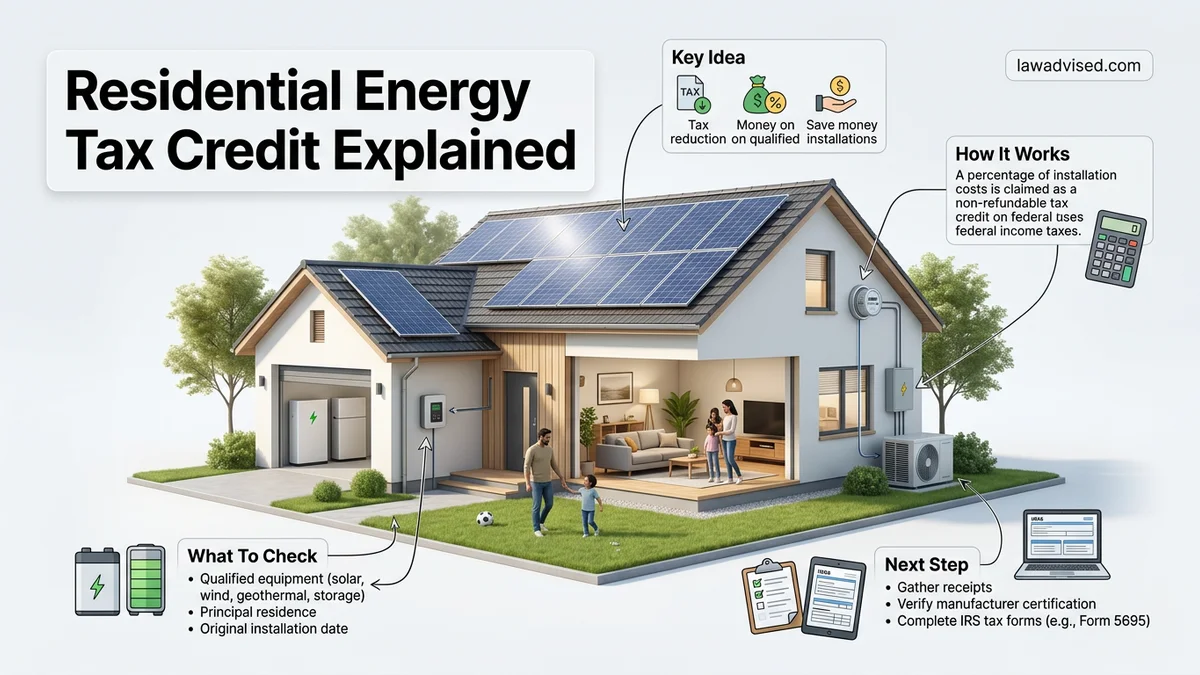
Claiming the 30% Residential Clean Energy Credit under Internal Revenue Code Section 25D requires meticulous record-keeping and precise IRS form completion. This federal incentive applies to solar electric panels, solar water heaters, wind turbines, geothermal heat pumps, and battery storage technology with a capacity of at least 3 kilowatt-hours. According to the U.S. Department of Energy, homeowners must file IRS Form 5695 alongside their standard federal income tax return to secure these savings for the 2026 tax year.
Step-by-Step Filing Procedure
- Gather Essential Documentation: Collect your itemized contractor invoices, equipment specification sheets, and proof of payment showing the installation was completed during the 2026 tax year.
- Complete IRS Form 5695: Enter your qualified renewable energy installation costs on Part I of Form 5695. Calculate the 30% credit amount using the specific lines designated for solar electric, battery storage, or geothermal systems.
- Transfer to Form 1040: Move the total allowable credit calculated on Form 5695 to Schedule 3 (Form 1040), and subsequently to your main Form 1040 tax return to reduce your overall tax liability dollar-for-dollar.
- Understand the Rollover Provision: Note that if your calculated credit exceeds your total tax liability for 2026, the remaining unused balance can be carried forward to offset tax liabilities in subsequent years.
What If Your Credit Is Rejected or You Need to Troubleshoot IRS Form 5695 Filing Errors
Even with careful preparation, IRS Form 5695 filings can occasionally trigger rejection notices or automated processing delays. Common errors include mismatched contractor identification numbers, calculating percentages on ineligible equipment expenses, or attempting to claim a standard property maintenance repair rather than a qualifying system upgrade. Verified tax data shows that proactive error correction prevents extended processing holds and accelerates potential federal tax refunds.
Troubleshooting Rejected Filings
- Verify Equipment Eligibility: Cross-reference your manufacturer specification sheets against IRS guidelines to ensure every installed component meets the statutory efficiency and capacity standards for 2026.
- Check Contractor Documentation: Contact your installation company immediately if your invoice lacks a clear taxpayer identification number or itemized labor versus equipment costs.
- Amend Previous Returns if Necessary: If you discovered a missed renewable energy credit from a prior year, file an amended return using Form 1040-X along with the corresponding Form 5695.
- Consult a Licensed Tax Professional: Engage a certified public accountant or enrolled agent specializing in green energy incentives if automated IRS rejections persist. Professional consultation fees typically range from $200 to $500 depending on return complexity.
What If It Still Doesn’t Work?
If standard troubleshooting steps fail to resolve your Form 5695 calculation errors or IRS clearance holds, additional intervention is necessary. Implement these structured fallback steps to protect your financial claim:
- Request a Detailed System Audit: Ask your solar or battery installation provider to issue a formalized compliance letter confirming that all installed hardware qualifies fully under Section 25D guidelines.
- Contact the IRS Taxpayer Assistance Center: Schedule an appointment at a local IRS office to review your specific Form 5695 rejection code directly with an agency representative.
- Retain Legal or Enrolled Agent Representation: Hire a credentialed tax professional to formally contest erroneous IRS automated adjustments. Expert representation services generally range from $300 to $800 based on the dispute hours required.
Conclusion
Navigating the Residential Clean Energy Credit requires careful adherence to IRS documentation standards and precise completion of Form 5695. By addressing filing discrepancies promptly and utilizing available credit rollover provisions, homeowners can successfully maximize their federal savings. According to verified research and expert energy sources, taking immediate action on document verification ensures full capture of these substantial 2026 tax incentives. Your next actionable step is to review your contractor invoices today and verify that all installed renewable hardware meets current federal standards.
❓ Frequently Asked Questions
What is the maximum credit amount available under Section 25C?
Under Section 25C, the maximum annual credit is generally $3,200. This includes a limit of $2,000 for heat pumps, biomass stoves, or biomass boilers, and up to $1,200 for other improvements like insulation, windows, and exterior doors.
Does the residential energy tax credit expire?
The current credits authorized under the Inflation Reduction Act run through December 31, 2032, providing long-term stability for homeowners planning phased energy efficiency upgrades.
Are installation and labor costs included in the tax credit?
Yes, for both solar (25D) and most energy-efficient equipment (25C), labor costs for on-site preparation, assembly, and original installation generally qualify for the credit calculation.
Can I claim the credit if I lease my solar panels?
No, leased solar systems or power purchase agreements (PPAs) do not qualify the homeowner for the 25D tax credit because you do not own the equipment. The third-party owner typically claims those incentives.
What documentation do I need to keep for my tax records?
You should keep the manufacturer’s certification statement, itemized receipts or invoices from the contractor showing equipment details, and your completed IRS Form 5695.
Can I claim these federal credits alongside state or utility rebates?
Generally, standard utility rebates reduce the total cost basis of the equipment before you calculate your federal tax credit, while many state tax credits can be stacked on top of federal incentives.

Ismail Hossain is the founder of Law Advised. He is an Divorce, Separation, marriage lawyer. Follow him.