Clean Energy Tax Credits Explained A Step-by-Step Guide 2026
Navigating the complexities of federal incentives can be overwhelming, but clean energy tax credits offer substantial savings for going green. This guide breaks down the 30% solar credit, home efficiency upgrades, and EV purchasing rules so you can maximize your tax return.
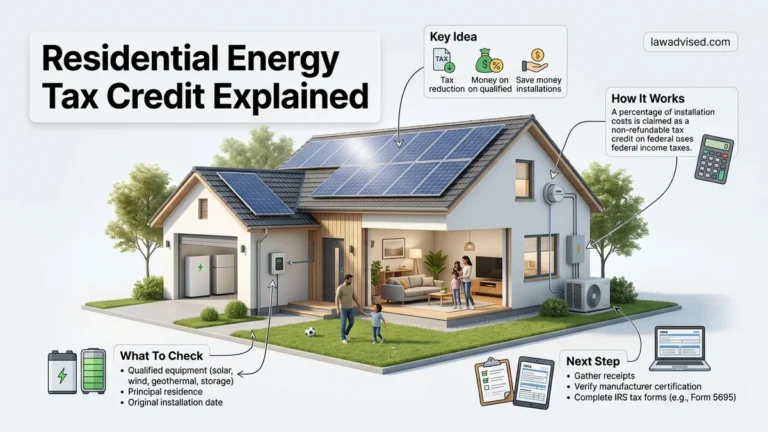
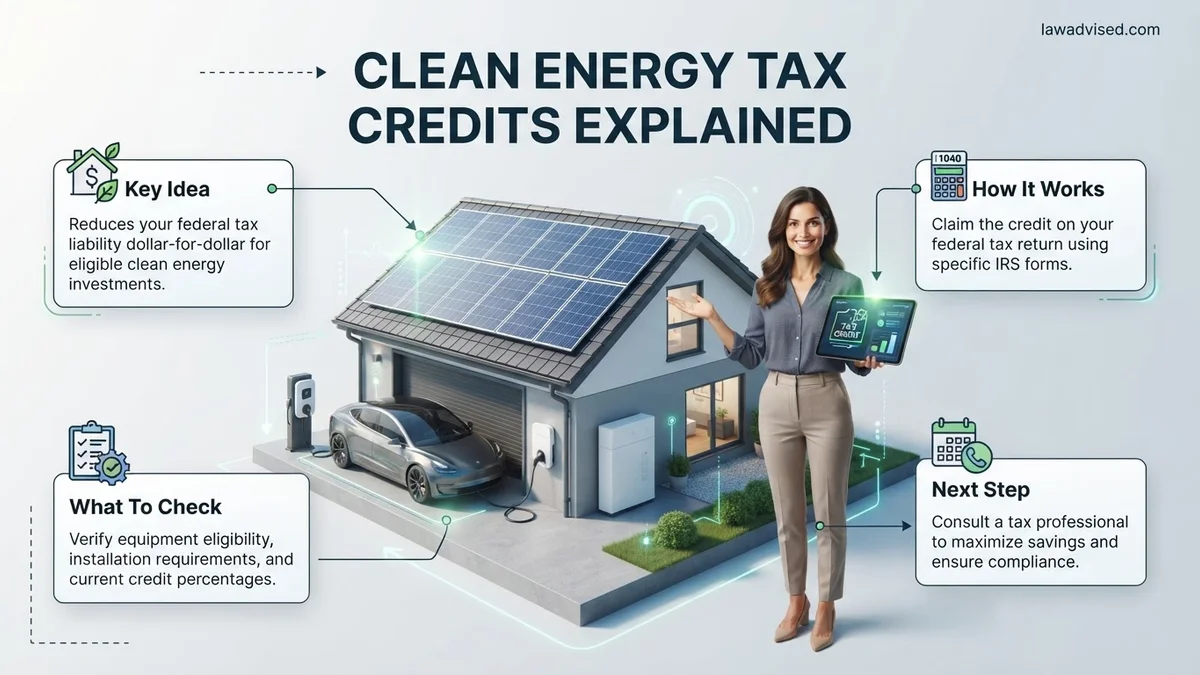
Clean energy tax credits reduce your federal income tax liability dollar-for-dollar based on the cost of eligible home upgrades, solar installations, and electric vehicle purchases. Under current 2026 guidelines, the federal framework offers robust financial incentives—most notably a flat 30% tax credit for residential solar installations and energy efficiency improvements.
Navigating these incentives requires understanding exact credit percentages, strict equipment qualification rules, and IRS filing procedures. Whether you are upgrading your home’s HVAC system or purchasing a new electric vehicle, knowing the precise monetary limits ensures you maximize your savings this tax season.
Key Takeaways
- Claim a 30% tax credit for residential solar and battery storage installations through 2032.
- The Energy Efficient Home Improvement Credit offers up to $3,200 annually for eligible upgrades.
- New electric vehicle purchases qualify for a federal tax credit of up to $7,500.
- Use IRS Form 5695 to properly claim residential clean energy credits on your tax return.
- Most residential credits are non-refundable, meaning they reduce your tax liability to zero.
What Causes Confusion With Clean Energy Tax Credits
Misunderstanding the Difference Between Tax Credits and Deductions
Many homeowners confuse tax credits with tax deductions, leading to major budgeting surprises. A tax deduction simply lowers your taxable income, while a clean energy tax credit directly subtracts from the actual taxes you owe. If you owe 5,000 dollars in federal taxes and qualify for a 4,000 dollar solar tax credit, your tax liability drops to 1,000 dollars. Furthermore, understanding the nuances of non-refundable credits versus refundable credits dictates your financial planning.
- Non-refundable credits: The Residential Clean Energy Credit (Section 25D) reduces your tax liability to zero, but any excess credit rolls over to the next tax year.
- Refundable credits: Certain commercial or specific low-income community credits may trigger a direct IRS payout, though standard residential credits rely on your tax liability.
- Dollar-for-dollar impact: Every dollar of credit directly preserves cash in your bank account compared to a percentage-based deduction.
Overlooking Complex IRS Equipment and Vendor Guidelines
Another major trap involves purchasing equipment that fails to meet strict IRS efficiency thresholds or hiring uncertified contractors. For example, the Energy Efficiency Home Improvement Credit (Section 25C) demands that heat pumps, biomass stoves, and central air conditioners meet specific Consortium for Energy Efficiency (CEE) tier requirements. If your installed model falls just short of the mandated seasonal energy efficiency ratio (SEER2), the IRS will reject your claim.
- Manufacturer Certification Statements: You must obtain a manufacturer identification number and certification statement to successfully file.
- Installation Timelines: The upgrade must be fully installed and operational within the calendar year you intend to claim the credit.
- Labor Cost Exclusions: While solar panel labor costs qualify for the 30% credit, certain standard home improvements have specific caps on labor inclusion.
Clean Energy Tax Credits Made Easy: Your Essential Action Plan
Navigating the landscape of green incentives can feel overwhelming, but mastering clean energy tax credits can save you thousands of dollars while reducing your carbon footprint. This guide walks you through the exact process of identifying, claiming, and maximizing federal, state, and local incentives for residential solar, battery storage, energy-efficient HVAC upgrades, and electric vehicles.
Step 1: Identify Eligible Home Energy Upgrades
What you need: Current utility bills, a copy of your home inspection or blueprints, and a list of planned home improvements.
Instructions: Begin by cataloging all potential energy upgrades under the Energy Efficient Home Improvement Credit (Section 25C) and the Residential Clean Energy Credit (Section 25D). Focus on high-impact projects such as installing rooftop solar panels, geothermal heat pumps, battery storage systems with a capacity of 3 kilowatt-hours or greater, and high-efficiency heat pump water heaters. Review the current IRS guidelines to ensure each prospective product meets or exceeds the necessary Consortium for Energy Efficiency (CEE) tiers and efficiency ratings. Create a spreadsheet to track the upfront costs, estimated annual energy savings, and potential tax credit percentages for each specific upgrade you are considering.
Pro Tip: Do not rely solely on contractor promises; always verify that the specific manufacturer’s certification statement for the equipment matches IRS eligibility requirements before making a purchase.
Step 2: Calculate Your Potential Federal Tax Savings
What you need: Contractor quotes or equipment pricing, calculator, and a basic understanding of your household income tax liability.
Instructions: Calculate the exact financial benefit using current federal guidelines. Under Section 25D, the Residential Clean Energy Credit offers a 30% tax credit for solar, wind, geothermal, and battery storage projects with no lifetime cap. Under Section 25C, non-solar upgrades like heat pumps, insulation, and efficient windows are capped at $1,200 annually (though heat pumps have an expanded $2,000 annual limit). Multiply your total project costs by the applicable percentage to determine your estimated tax credit. Keep in mind that these are credits, not deductions, meaning they directly reduce your tax liability dollar-for-dollar.
Pro Tip: Remember that these credits are non-refundable, meaning you cannot get cash back if the credit exceeds your total tax liability, but unused portions can typically be rolled over to the following tax year.
Step 3: Research State and Local Rebates
What you need: Your zip code, local utility provider account information, and the Database of State Incentives for Renewables & Efficiency (DSIRE) website.
Instructions: Federal credits are just the starting point. Navigate to the DSIRE website or your state energy office portal to uncover localized incentives. Enter your zip code to generate a comprehensive list of state tax credits, utility cash-back rebates, solar Renewable Energy Certificates (SRECs), and low-interest financing programs. Many utility providers offer instant point-of-sale rebates for smart thermostats, insulation, and heat pumps. Stack these local incentives with your federal tax credits, but always check if a state rebate reduces the cost basis used to calculate your federal credit.
Pro Tip: Apply for utility rebates prior to project installation whenever possible, as many programs require pre-approval to qualify for their highest payout tiers.
Step 4: Hire Certified Contractors and Verify Specs
What you need: List of local licensed contractors, consumer review platforms, and manufacturer spec sheets.
Instructions: Select licensed, insured, and certified contractors who specialize in clean energy installations. For solar and battery systems, ensure the installer is NABCEP (North American Board of Certified Energy Practitioners) certified. Request itemized bids that clearly separate equipment costs from labor and permit fees, as this breakdown is crucial for tax reporting. Before signing any contracts, review the equipment specification sheets to double-check that SEER ratings, thermal efficiency percentages, and ENERGY STAR certifications strictly align with IRS guidelines for the tax year in which the installation will be completed.
Pro Tip: Ensure your contract specifies that the contractor will provide you with all necessary manufacturer certification statements and proof of project completion upon final payment.
Step 5: Schedule and Complete the Installation
What you need: Finalized project contract, building permits, and unobstructed access to the installation site.
Instructions: Allow your contractor to perform the installation while ensuring all required municipal and utility building permits are properly pulled and closed out. For grid-tied systems like solar, your utility company must perform an interconnection inspection and grant permission to operate (PTO). The official date of the installation—specifically when the system is fully operational and inspected—determines the tax year in which you can claim the credit. Do not rush this phase; make sure the final walkthrough is completed and you understand how to monitor your new energy system’s performance.
Pro Tip: Keep a digital and physical folder containing all permits, inspection sign-offs, final invoices, and proof of payment, as the IRS may request these documents later.
Step 6: Gather Documentation and File Your Taxes
What you need: IRS Form 5695 (Residential Energy Credits), Form 1040, itemized invoices, and manufacturer certification numbers.
Instructions: When tax season arrives, prepare to file IRS Form 5695 (“Residential Energy Credits”) alongside your standard Form 1040. Input the costs for Section 25D clean energy equipment in Part I and Section 25C energy-efficient home improvements in Part II. Transfer the calculated credit totals from Form 5695 directly onto your main tax return to reduce your overall tax liability. If you use tax preparation software, search specifically for “Energy Credits” or “Form 5695” during the deductions and credits interview phase. If working with a CPA, hand them your complete folder of equipment invoices, manufacturer certificates, and payment receipts.
Pro Tip: Double-check all product identification numbers and contractor taxpayer identification numbers (TIN) on your forms to prevent processing delays or automated IRS audits.
✅ Final Checklist
- Verified that all installed equipment meets or exceeds current IRS and ENERGY STAR efficiency standards
- Obtained itemized invoices showing a clear separation of equipment and labor costs
- Secured all municipal building permits and official utility interconnection approval (PTO)
- Successfully completed and attached IRS Form 5695 to your annual tax return
- Archived all receipts, manufacturer certificates, and proof of payment in a secure location for at least 7 years
Important Notes:
- Tax laws and credit percentages can change; always verify current thresholds with a qualified tax professional or the official IRS website before executing projects.
- Seek professional help from a Certified Public Accountant (CPA) or Enrolled Agent if you have complex income structures, rental properties, or questions about carrying over unused credit amounts.
- Allow 2 to 4 weeks for project planning and paperwork gathering, with total project costs varying widely from $1,200 for basic insulation upgrades up to $30,000+ for comprehensive solar and storage arrays.
How to Fix Your Eligibility Strategy and Claim the Best 2026 Credits
Targeting the Most Lucrative 2026 Residential Credits
To secure the highest possible financial return, you must align your home improvement projects with the most valuable federal incentives active in 2026. The Residential Clean Energy Credit provides a 30% credit with no lifetime dollar limit for qualifying solar electric, solar water heating, wind, and battery storage systems. Meanwhile, the Energy Efficiency Home Improvement Credit caps annual savings at 1,200 dollars, though heat pumps and biomass stoves enjoy a separate 2,000 dollar annual limit.
- Solar ITC (Section 25D): Covers 30% of total system and installation costs for photovoltaic panels and battery storage units of 3 kilowatt-hours or greater.
- HVAC and Insulation (Section 25C): Offers up to 600 dollars for efficient windows, doors, and electrical panel upgrades, plus 2,000 dollars specifically for heat pump installations.
- Clean Vehicle Credits (Section 30D): Delivers up to 7,500 dollars for new electric vehicles, provided the vehicle meets strict North American final assembly and critical mineral sourcing rules.
Executing the Correct IRS Filing Process
Claiming your clean energy tax credits accurately prevents costly processing delays and potential IRS audits. You cannot simply write the credit amount onto your standard 1040 form without the supporting calculations. You must attach specific IRS forms to your annual federal tax return, cross-referencing your receipts, contractor invoices, and manufacturer certification documents.
- Gather Documentation: Collect itemized contractor invoices, proof of payment, and the official manufacturer certification statement for every installed product.
- Complete Form 5695: Use IRS Form 5695 (Residential Energy Credits) to calculate your exact credit amounts for solar, battery storage, and home energy efficiency upgrades.
- Transfer to Form 1040: Input your calculated total from Form 5695 directly onto your main federal income tax return (Schedule 3) to reduce your final tax liability.
Step-by-Step Guide to Filing IRS Form 5695 Correctly
Claiming your residential clean energy incentives requires accurate paperwork filed directly with your annual federal tax return. IRS Form 5695 is the specific document designated for calculating and claiming these credits for the 2026 tax year. Precision prevents processing delays and ensures you receive the maximum financial benefit allowed under current regulations.
Gathering Documentation Before You Begin
Success starts with organizing your records well before you open tax software or sit down with a professional. You will need manufacturer certification statements, itemized contractor invoices, and proof of payment showing the installation date falls within the 2026 calendar year.
- Locate your original itemized purchase contract and final paid invoice from the licensed installer.
- Download or print the manufacturer’s official certification statement confirming the equipment meets 2026 efficiency standards.
- Calculate your total net out-of-pocket costs, excluding any state-level rebates or utility cash incentives that reduce your baseline price.
- Open IRS Form 5695 and ensure you are using the updated version specifically designated for the 2026 tax filing season.
What If Your Tax Liability is Too Low to Use the Full Credit
A common hurdle for homeowners installing expensive solar arrays or geothermal systems in 2026 is having insufficient tax liability to absorb the entire credit in a single year. Unlike deductions, tax credits directly reduce what you owe dollar-for-dollar, but most residential clean energy credits are non-refundable.
Understanding the Carryforward Provision
Fortunately, IRS rules permit taxpayers to roll over any unused portion of the Section 25D residential clean energy credit into future tax years. According to financial guidance from the U.S. Department of Energy, excess credit amounts do not simply expire; they automatically apply to your tax liability for subsequent years until the balance is fully exhausted.
- Complete Part I of IRS Form 5695 to calculate your total allowable residential clean energy credit for 2026.
- Compare your calculated credit amount against your total federal income tax liability listed on your Form 1040.
- If your credit exceeds your liability, use the specific calculation lines at the bottom of Form 5695 to determine your exact carryforward amount.
- Transfer this residual figure to your personal tax records so you can apply it when filing your federal return next year.
What If It Still Doesn’t Work?
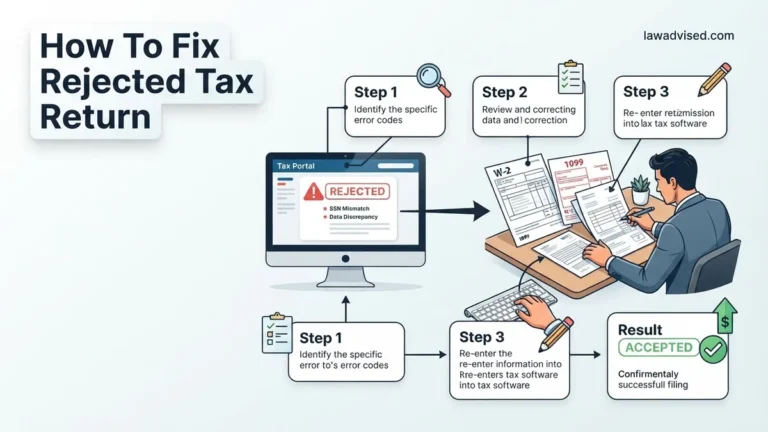
If you encounter filing rejections, complex calculations involving battery storage systems, or disputes regarding equipment eligibility for 2026, standard software may fall short. Consider these fallback steps to resolve the issue:
- Double-check that your equipment’s product identification number matches the manufacturer certification statement exactly.
- Review your state energy office portal to ensure local rebates were subtracted correctly from your federal baseline calculation.
- Consult a certified public accountant (CPA) or Enrolled Agent who specializes in residential renewable energy taxation. Professional consultation fees typically range from $200 to $500 depending on return complexity.
- Contact the IRS dedicated tax assistance line or submit a formal inquiry through a verified tax professional to clarify ambiguous component costs.
Conclusion
Navigating clean energy tax credits in 2026 requires careful adherence to IRS documentation rules and accurate filing using Form 5695. By understanding how non-refundable credits and carryforward provisions work, homeowners can successfully capture thousands of dollars in federal savings. According to verified research and expert sources from the National Renewable Energy Laboratory, taking full advantage of these incentives dramatically accelerates the return on investment for green home upgrades. Your next actionable step is to gather your installation invoices and manufacturer certificates today to prepare for an error-free tax filing.
❓ Frequently Asked Questions
How does the 30% residential clean energy credit work for solar panels?
The credit lets you deduct 30% of the total installation cost—including equipment, labor, and permitting—directly from your federal income taxes. It applies to both primary residences and second homes, provided you own the system rather than lease it.
What specific home improvements qualify for the Energy Efficient Home Improvement Credit?
Upgrades such as exterior doors, windows, insulation, heat pumps, biomass stoves, and upgraded electrical panel boards qualify. The credit covers up to 30% of the total cost, capped at $1,200 per year for general improvements or up to $2,000 annually specifically for heat pumps and biomass heaters.
Can businesses also take advantage of clean energy tax credits?
Yes, commercial entities can utilize the Commercial Clean Energy Credit and the Investment Tax Credit (ITC) or Production Tax Credit (PTC). Businesses may also qualify for direct pay options, allowing tax-exempt organizations to receive cash refunds equivalent to the credit value.
What are the income limitations for claiming the used electric vehicle tax credit?
For used EVs, your modified adjusted gross income cannot exceed $150,000 for joint filers, $112,500 for heads of household, and $75,000 for single filers. The used vehicle must also be purchased from a licensed dealer for a sale price of $25,000 or less.
What happens if my tax liability is less than the total clean energy credit amount?
Since residential credits like the solar ITC are non-refundable, you will not receive a cash refund for the unused portion. However, the IRS allows you to carry forward any remaining unused credit amount to offset your tax liability in subsequent tax years.
Are state and local rebates subtracted before calculating the federal tax credit?
Generally, utility rebates or manufacturer incentives that reduce the final cost of the equipment must be subtracted before calculating your 30% federal credit. However, state tax credits or cash rebates that are considered taxable income usually do not reduce the federal basis.

Ismail Hossain is the founder of Law Advised. He is an Divorce, Separation, marriage lawyer. Follow him.