Selling Rental Property Tax Explained Step-by-Step 2026
When selling rental property, you face significant tax liabilities including capital gains, state taxes, and the often-surprising depreciation recapture. Calculating your adjusted basis accurately is crucial to determining the exact tax owed and protecting your investment returns.
When you sell a rental property in 2026, you will likely face three main tax liabilities: capital gains tax, net investment income tax, and depreciation recapture. Unlike selling your primary residence, investment properties do not qualify for the Section 121 exclusion unless you previously lived in the home as your primary residence for two out of the five years before the sale.
Calculating your tax burden requires breaking down your profits into distinct buckets, with depreciation recapture often catching unprepared investors off guard. Understanding these calculations before listing your property allows you to accurately estimate your net proceeds and evaluate potential tax-saving strategies like a 1031 exchange.
Key Takeaways
- Depreciation recapture is taxed as ordinary income up to a maximum rate of 25%.
- Your adjusted basis equals original purchase price plus capital improvements minus total depreciation taken.
- Capital gains tax rates range from 0% to 20% depending on your taxable income.
- A Section 1031 exchange allows you to defer all capital gains and depreciation recapture taxes.
- Net Investment Income Tax adds an extra 3.8% surtax for high-income real estate investors.
What Causes High Tax Bills When Selling a Rental Property
Depreciation Recapture Taxes
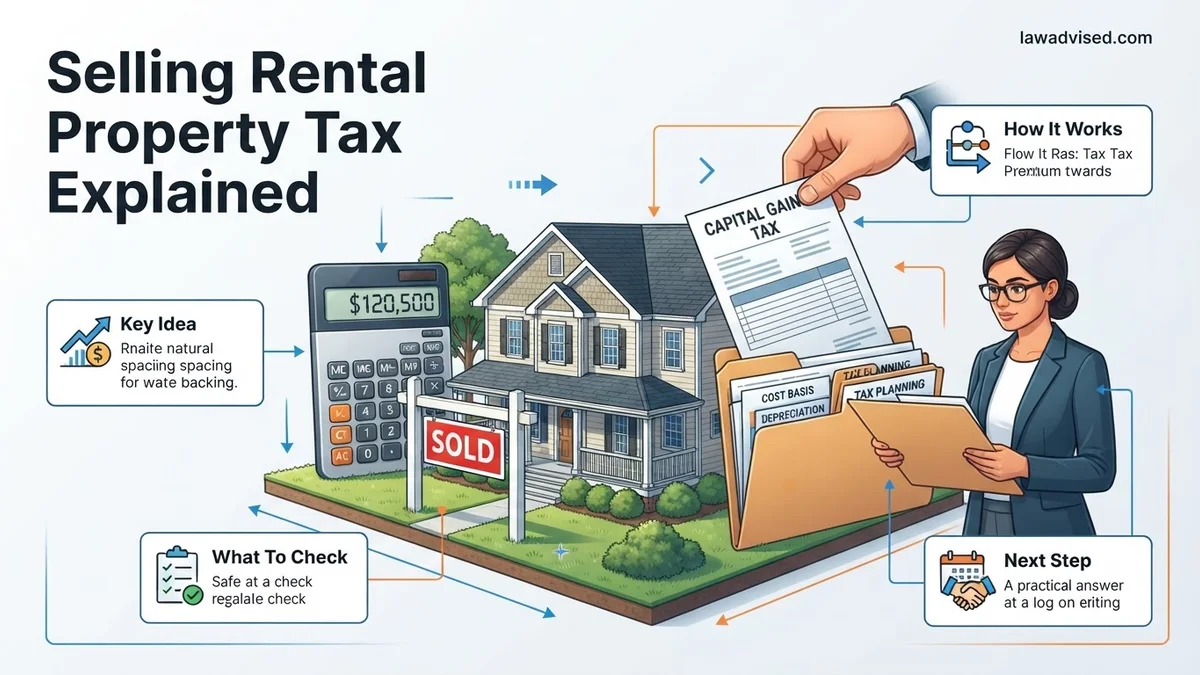
The IRS requires you to depreciate residential rental properties over 27.5 years, allowing you to deduct a portion of the building’s cost each year against your rental income. When you sell the property, the IRS forces you to pay tax on all the depreciation you either claimed or should have claimed during your ownership period. This is called unrecaptured Section 1250 gain, and it is taxed at a maximum federal rate of 25%, regardless of your ordinary income tax bracket.
Capital Gains and Additional Surtaxes
Beyond depreciation recapture, your actual profit is subject to capital gains tax. Long-term capital gains rates for 2026 are 0%, 15%, or 20%, depending on your taxable income and filing status. High-income earners may also owe an additional 3.8% Net Investment Income Tax (NIIT) on the gain. Combined, your total tax rate on a rental property sale can easily approach 30% to 40% when factoring in state taxes.
- Federal depreciation recapture tax capped at 25%
- Capital gains tax rates of 0%, 15%, or 20% for 2026
- Additional 3.8% NIIT for high earners with modified adjusted gross income over statutory thresholds
How to Calculate Your Adjusted Basis and Depreciation Recapture Step-by-Step
Step 1: Determine Your Adjusted Basis
Your tax bill is not based on your gross sale price, but rather your gain, which starts with your adjusted basis. Take your original purchase price, add capital improvement costs (like a new roof or HVAC system), and subtract all the depreciation you claimed over the years. This adjusted basis represents your baseline investment in the property for tax purposes.
Step 2: Calculate Your Total Gain and Recaptured Amount
Subtract your adjusted basis from your net selling price (gross sale price minus closing costs) to find your total realized gain. Next, isolate the total amount of depreciation you took during your holding period. That exact dollar amount is your depreciation recapture, taxed at the 25% rate. Any profit remaining above that recaptured amount is taxed as standard capital gains.
- Start with original purchase price plus buying costs and capital improvements.
- Subtract total accumulated depreciation to find your adjusted basis.
- Subtract adjusted basis from net selling price to determine total gain.
- Separate accumulated depreciation to tax at the 25% recapture rate.
How to Fix Your Tax Burden Using a Section 1031 Exchange
When selling rental property, accumulating massive capital gains and depreciation recapture taxes can severely drain your investment capital. According to real estate tax data from the National Association of Realtors, utilizing a Section 1031 exchange remains the most effective legal mechanism to defer 100% of these taxes. By reinvesting the proceeds into a “like-kind” property, you keep your equity working entirely for you in 2026.
Strict Timelines You Must Follow
The IRS enforces rigid deadlines that brook no exception. Missing either of these statutory windows immediately triggers full tax liability for the transaction year.
- Identify replacement property: You must formally identify up to three potential replacement properties in writing to your qualified intermediary within exactly 45 calendar days of closing the sale of your original rental property.
- Acquire the replacement property: You must officially close on the purchase of the identified replacement property within 180 calendar days of closing your original sale, or by the due date of your tax return, whichever comes first.
Working with a Qualified Intermediary
Tax code regulations explicitly prohibit you from taking physical or constructive receipt of the sales proceeds during the exchange process. You must hire a bonded Qualified Intermediary (QI) before closing the sale. The QI holds the cash in a secure escrow account until it is time to purchase the replacement property. Average QI setup fees range from $1,000 to $2,000 depending on the complexity of the transaction structure.
What If Your 1031 Exchange Fails or You Need Alternative Tax Strategies
Real estate transactions frequently encounter unforeseen obstacles. If a buyer falls through, an identified replacement property fails structural inspection, or you simply cannot meet the strict 1031 deadlines, your exchange will fail. When this happens, taxes become immediately due unless you implement backup strategies.
Fallback Steps for Failed Exchanges
- Utilize the Installment Sale Method (IRS Section 453): Spread your capital gains tax liability over multiple tax years by acting as the lender for the buyer, receiving payments over an agreed timeline rather than a lump sum.
- Offset Gains with Real Estate Losses: Designate your tax status as a Real Estate Professional to offset ordinary and capital gains losses against your active rental income.
- Hire a Certified Public Accountant (CPA) or Tax Attorney: Consult a licensed tax professional immediately upon exchange failure to recalculate your modified adjusted gross income and factor in state-level tax implications. Professional consultation fees typically range from $300 to $600 per hour.
- Execute a Partial Exchange: If you successfully acquired one replacement property but have leftover cash (known as “boot”), pay taxes only on that specific cash portion while deferring the remaining gains.
Conclusion
Navigating rental property taxes in 2026 requires meticulous planning to mitigate capital gains and depreciation recapture liabilities. While tools like Section 1031 exchanges offer powerful tax deferral, strict timelines demand flawless execution and professional oversight. According to verified research and expert sources from major financial institutions, proactively structuring your real estate sales preserves thousands of dollars in investment capital. Your definitive next step is to consult a certified tax professional before listing your rental property to map out a customized exit strategy.
❓ Frequently Asked Questions
How does depreciation recapture work when selling a rental property?
The IRS requires you to pay tax on the depreciation deductions you took (or should have taken) over the years. This unrecaptured Section 1250 gain is taxed at ordinary income rates up to a maximum of 25%, regardless of your regular capital gains bracket.
What happens if I lived in the rental property before selling it?
If you owned and lived in the property as your primary residence for at least two out of the five years before the sale, you may qualify for the Section 121 exclusion. However, any depreciation claimed after 1997 cannot be excluded and remains subject to recapture.
How do I calculate the net profit on my rental property sale?
Start with your gross sales price and subtract selling expenses like agent commissions and closing costs to find the amount realized. Then, subtract your adjusted basis from that amount to determine your total taxable gain.
What qualifies as a capital improvement versus a repair?
Capital improvements add long-term value, prolong the property’s life, or adapt it to new uses, and they get added to your cost basis. Routine repairs simply maintain the property in normal operating condition and are deducted in the year incurred.
Are state taxes applied to rental property sales?
Yes, most states with a state income tax will tax the capital gain from the sale of real estate located within their borders. Some states also tax depreciation recapture at ordinary state income tax rates.
What are the strict timelines for a Section 1031 exchange?
You must identify replacement properties within 45 days of closing on your sold property and complete the purchase of the replacement property within 180 days. A qualified intermediary must handle the funds throughout the entire process.

Ismail Hossain is the founder of Law Advised. He is an Divorce, Separation, marriage lawyer. Follow him.