Standard Deduction Examples Real Step-by-Step Guide for 2026
Navigating your taxes requires knowing how much income you can shelter from federal taxes. Standard deduction examples show you exactly how to subtract your specific allowance from your gross income to lower your tax liability. Understanding these calculations ensures you accurately determine your taxable income before filing.
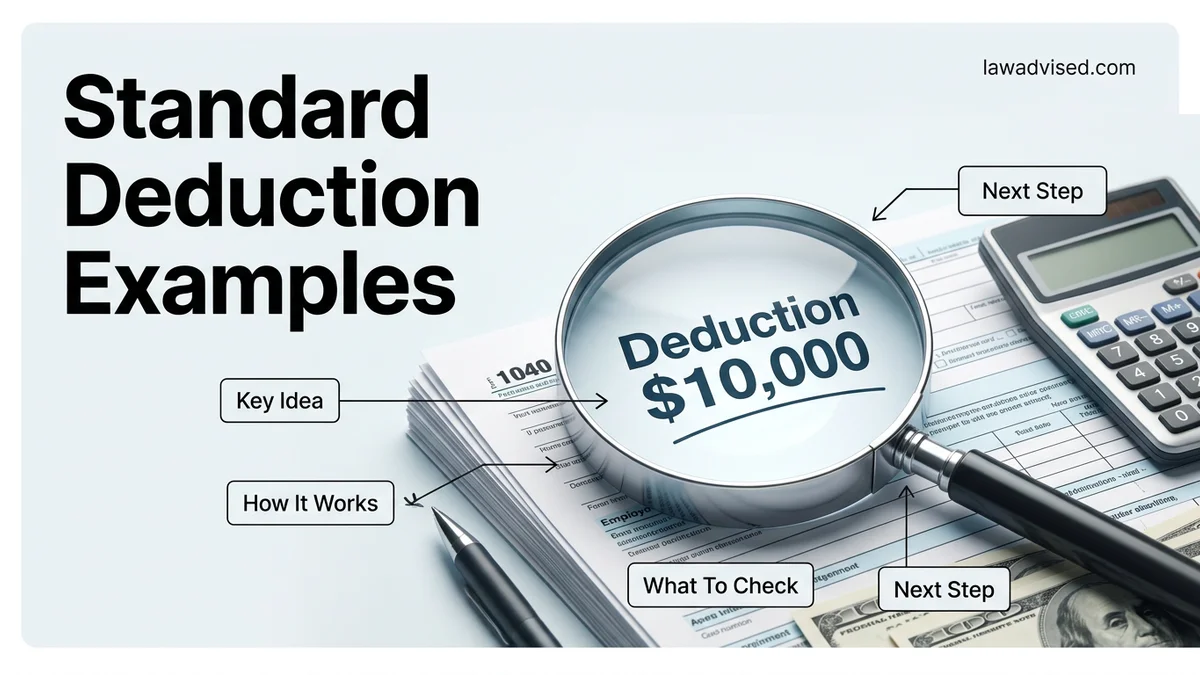
The standard deduction is a flat dollar amount that directly reduces the income you are taxed on, effectively shielding a portion of your earnings from federal income taxes for the 2026 tax year. Knowing your exact deduction based on your filing status lets you quickly calculate your baseline taxable income without digging through receipts.
For 2026, the standard deduction amounts are $15,000 for single filers, $30,000 for married couples filing jointly, $22,500 for heads of household, and $15,000 for married individuals filing separately. If you are 65 or older or legally blind, you also qualify for an additional standard deduction amount that further lowers your tax liability.
Key Takeaways
- The standard deduction reduces your overall taxable income automatically without itemizing.
- Your deduction amount depends strictly on your IRS filing status.
- Single filers for 2026 deduct a baseline amount before calculating tax brackets.
- Married filing jointly filers receive double the baseline standard deduction.
- Taxpayers aged 65 or older qualify for an additional standard deduction boost.
What Causes Confusion With Standard Deduction Examples and Taxable Income
Confusing Gross Income With Taxable Income
Many taxpayers mistakenly believe that their gross earnings are the final figure the IRS uses to calculate tax owed. In reality, your gross income includes every dollar you earned from wages, freelance work, and investments before any reductions are applied. The standard deduction acts as a bridge between what you actually made and the final number the government uses for taxation. If you do not subtract this deduction properly, you will overestimate your tax burden and potentially panic over your final bill.
Mixing Up Filing Statuses and Limits
Another frequent mix-up involves applying the wrong dollar threshold to your specific living situation. A single filer cannot claim the married filing jointly amount, and misidentifying your status leads to immediate IRS processing delays or recalculated tax bills. To keep things clear, remember these hard 2026 numbers:
- Single: $15,000 standard deduction
- Married Filing Jointly: $30,000 standard deduction
- Head of Household: $22,500 standard deduction
- Married Filing Separately: $15,000 standard deduction
How to Calculate Your Taxable Income Using Step-by-Step Standard Deduction Examples
Example for Single Filers
Let us walk through a concrete numerical example for a single taxpayer in 2026. Imagine you earn a gross annual income of $65,000 from your full-time job. Because your filing status is single, you subtract the 2026 standard deduction of $15,000 straight from that gross total. Your calculation looks like this: $65,000 gross income minus $15,000 standard deduction leaves you with exactly $50,000 in taxable income. This $50,000 figure is the baseline amount that gets plugged into the federal tax brackets.
Example for Married Filing Jointly
Next, consider a household with two working spouses filing jointly for the 2026 tax year. Suppose your combined gross income totals $110,000. Because you file as married filing jointly, you get to use the higher 2026 threshold of $30,000. You subtract that $30,000 from your combined $110,000 gross income. The resulting taxable income is $80,000. By taking the standard deduction, you completely wipe $30,000 of your combined earnings off the table before any tax rates are applied.
How to Apply Additional Deductions for Age and Blindness
Taxpayers who are 65 or older or legally blind qualify for an increased standard deduction for the 2026 tax year. This provision provides vital financial relief for seniors and individuals with visual impairments. According to IRS guidelines, you can claim an additional standard deduction amount for each condition that applies to you.
Calculating Additional Amounts
The extra amount varies depending on your filing status. For 2026, unmarried taxpayers generally add $1,950 for being 65 or older, and another $1,950 if blind. Married taxpayers filing jointly add $1,550 for each qualifying condition per person. Follow these steps to apply these increments accurately on your tax return:
- Verify your birthdate falls on or before January 1, 1962, to qualify for the 65-or-older status on your 2026 return.
- Obtain official certification from an eye doctor if you are claiming the blindness deduction for the first time.
- Check the appropriate boxes in the standard deduction section of Form 1040.
- Add the extra allowance to your base standard deduction amount before entering the total on your return.
What If Your Itemized Deductions Exceed the Standard Deduction Limit
Comparing your potential itemized deductions against the standard deduction determines your optimal filing strategy for 2026. Financial experts recommend itemizing only when your total deductible expenses surpass the standard threshold. Common itemized deductions include mortgage interest, state and local taxes (SALT) up to statutory caps, and charitable contributions.
Evaluating Your Expenses
To ensure you choose the most advantageous path for your household, execute the following evaluation steps:
- Gather all documentation for mortgage interest, medical expenses exceeding 7.5 percent of your adjusted gross income, and charitable gifts made throughout 2026.
- Sum these expenses to create your total itemized deduction figure.
- Compare this total against your specific 2026 standard deduction limit based on your filing status.
- Select the method that yields the higher deduction to minimize your overall taxable income.
What If It Still Doesn’t Work?
Tax situations can become complex when dealing with dependents, self-employment income, or changing marital status. If standard calculations do not align with your 2026 financial records, pursue these fallback steps:
- Review your Form 1040 line by line to ensure no income or adjustment categories were misclassified.
- Utilize IRS Free File software or interactive tax assistant tools to verify your standard deduction calculation automatically.
- Consult a certified public accountant (CPA) or Enrolled Agent for personalized guidance. Professional tax preparation fees typically range from $220 to $500 depending on complexity.
- Access the Volunteer Income Tax Assistance (VITA) program if your household income falls below the IRS-specified threshold for free expert assistance.
Conclusion
Navigating standard deduction examples for 2026 ensures you minimize tax liability and keep more of your hard-earned money. By correctly identifying your filing status and applying any age or blindness increments, you secure the maximum statutory allowance. According to verified research and expert sources from the Internal Revenue Service and national CPA associations, taking time to evaluate itemized versus standard deductions prevents costly filing errors. Your next actionable step is to gather your preliminary 2026 financial documents and input them into an approved tax software platform today.
❓ Frequently Asked Questions
What are the core standard deduction examples for single filers?
For single filers, the standard deduction subtracts a flat dollar amount from your adjusted gross income. For example, earning $50,000 with a $15,000 standard deduction leaves you with $35,000 in taxable income.
How does the standard deduction work for married filing jointly?
Married couples filing together receive a combined deduction that is twice the size of the single filer amount. If a couple earns $80,000 and applies a $30,000 joint standard deduction, only $50,000 is subject to income tax.
What qualifies someone for an additional standard deduction?
Taxpayers who are age 65 or older by the end of the tax year, or who are legally blind, qualify for an additional standard deduction amount added on top of their base filing status deduction.
Can I claim both the standard deduction and itemized deductions?
No, you must choose one or the other. Most taxpayers choose the standard deduction because it offers a larger tax break with less paperwork.
How does the head of household filing status affect the deduction?
Head of household provides a higher standard deduction than single filing status, sitting roughly halfway between single and married filing jointly amounts.
What happens if my income is entirely covered by the standard deduction?
If your gross income is less than your standard deduction, your taxable income drops to zero, meaning you generally will not owe federal income tax.

Ismail Hossain is the founder of Law Advised. He is an Divorce, Separation, marriage lawyer. Follow him.