Itemized Deductions Explained A Step-by-Step Guide for 2026
Itemized deductions allow taxpayers to lower their taxable income by listing out specific qualified personal expenses, such as mortgage interest and medical bills. Choosing whether to itemize depends entirely on whether your total eligible expenses exceed the IRS standard deduction threshold for 2026. This guide breaks down exactly how to evaluate your expenses and claim them correctly.
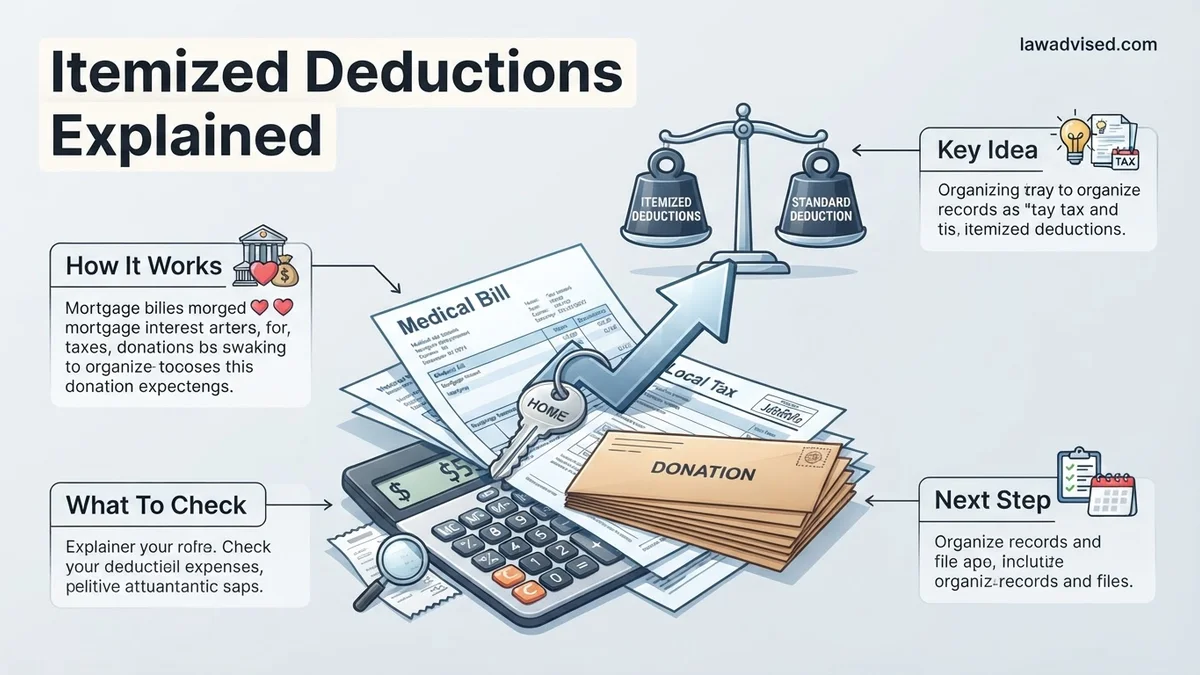
Itemized deductions are specific, eligible expenses that you can subtract from your adjusted gross income to lower your overall taxable amount. Instead of accepting the government’s flat-rate standard deduction, you tally up your actual spending on things like medical care, state taxes, mortgage interest, and charitable gifts.
You should choose to itemize when your total eligible expenses exceed the standard deduction threshold for the 2026 tax year. Mastering this choice ensures you never leave your hard-earned money on the table when tax season arrives.
Key Takeaways
- Itemize only if your total eligible expenses exceed the 2026 standard deduction.
- Medical expenses must exceed 7.5% of your Adjusted Gross Income to be deductible.
- The SALT (State and Local Tax) deduction is capped at $10,000 annually.
- Charitable cash donations are generally deductible up to 60% of your AGI.
- Use IRS Schedule A to report and claim all itemized deductions.
What Causes the Decision to Itemize Versus Take the Standard Deduction
The Math Behind the Threshold
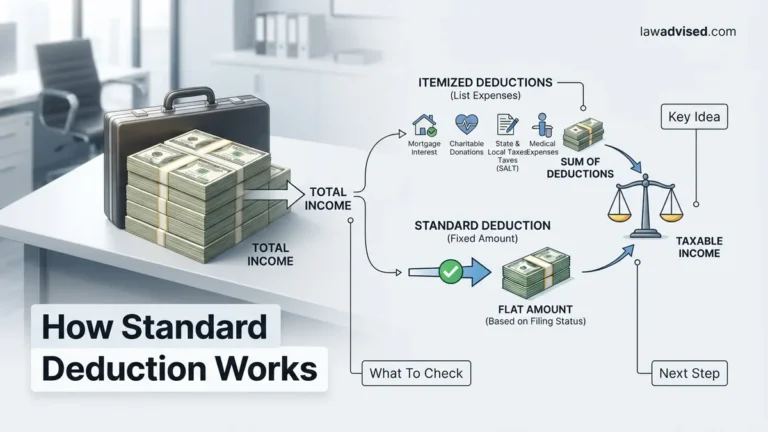
The decision to itemize versus taking the standard deduction comes down to a simple mathematical comparison. You must calculate whether your cumulative deductible expenses surpass the flat standard deduction amount established for 2026. If your receipts total more than that baseline, itemizing saves you money.
Key Life Events That Trigger Itemization
Certain major financial milestones naturally push your deductible expenses past the standard threshold. For instance, buying a home loads up your deductions with heavy mortgage interest and property taxes. Significant medical events or high charitable giving also frequently trigger the need to itemize.
- Purchasing a primary residence with a large mortgage
- Incurring high, out-of-pocket medical or dental bills
- Living in a state with high income or property taxes
- Making substantial donations to qualified charitable organizations
How to Calculate and Track Your Eligible Itemized Expenses
Sorting and Documenting Deductible Categories
Accurate tracking forms the foundation of a successful itemized tax return. You need to organize your spending into distinct, IRS-approved buckets throughout the 2026 calendar year. Keeping digital copies of receipts and bank statements prevents a scramble when filing time arrives.
Navigating Percentage Floors and Limits
Not every dollar you spend in an eligible category reduces your taxable income. The IRS enforces strict percentage floors and caps that you must factor into your calculations before filing.
- Medical and Dental Expenses: You can only deduct the portion of your unreimbursed medical expenses that exceeds 7.5 percent of your adjusted gross income (AGI).
- State and Local Taxes (SALT): Your deduction for state and local income, sales, and property taxes remains capped under federal rules.
- Charitable Contributions: Cash and property donations are limited based on specific percentages of your AGI, depending on the type of organization you support.
Step-by-Step Guide on How to File Using IRS Schedule A
Filing with itemized deductions requires moving beyond the standard 1040 form and attaching a specific supplementary document. According to IRS instructions, this process demands careful organization throughout the 2026 tax year to ensure complete accuracy.
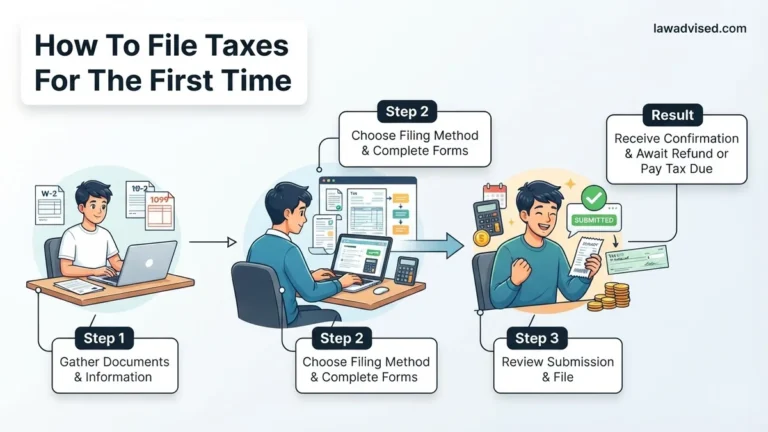
Step 1: Gather and Organize Your Supporting Documents
- Collect all Form 1098 statements showing mortgage interest paid to financial institutions.
- Compile official receipts and acknowledgment letters for all charitable donations made during 2026.
- Sort medical and dental expense bills, keeping only those that exceed the required percentage threshold of your adjusted gross income.
- Print out state and local tax payment records, including property tax assessments and vehicle registration receipts.
Step 2: Complete and Attach IRS Form Schedule A
- Download or open the 2026 IRS Schedule A (Form 1040) document in your tax software.
- Transfer your medical expenses to lines 1 through 4, and calculate the allowable deduction amount.
- Enter your state and local tax totals on lines 5a through 5d, keeping in mind statutory caps.
- Input your home mortgage interest on lines 8a through 8e using your lender statements.
- Sum all categories at the bottom of the page and transfer the final total to your main Form 1040.
What If Your Deductions Still Fall Short of the Standard Threshold
Many taxpayers discover that their total itemized expenses fail to clear the 2026 standard deduction threshold. When itemizing does not lower your tax liability more than the standard amount, proactive adjustments are necessary.
Fallback Strategies When Itemizing Fails
- Take the standard deduction: Accept the higher standard threshold to maximize your tax savings with zero paperwork complexity.
- Practice bunching strategies: Group multiple years of charitable donations or elective medical procedures into a single tax year to surge past the threshold.
- Consult a tax professional: Hire a certified public accountant (CPA) or Enrolled Agent to review complex portfolios for overlooked deductions. Professional tax preparation typically costs between $300 and $600 depending on complexity.
- Utilize above-the-line deductions: Focus on deductions that do not require itemizing, such as student loan interest or retirement contributions.
Conclusion
Navigating itemized deductions for the 2026 tax year requires careful comparison between your cumulative eligible expenses and the updated standard deduction limits. If your itemized total falls short, pivoting to the standard deduction or applying bunching strategies will protect your bottom line. According to verified research and expert tax sources, proactive planning throughout the year remains the single most effective way to optimize your tax outcome. Your immediate actionable next step is to tally your potential 2026 deductible expenses today to determine whether itemizing or taking the standard deduction makes financial sense for your household.
❓ Frequently Asked Questions
What are the most common types of itemized deductions?
The primary categories include mortgage interest, state and local taxes (SALT) up to $10,000, charitable donations, and medical expenses that exceed specific percentage thresholds of your AGI.
How do the 2026 standard deduction amounts affect my choice?
Your total itemized expenses must surpass the inflation-adjusted standard deduction for your filing status (single, married filing jointly, etc.) for itemizing to make mathematical sense.
Are all medical expenses deductible if I itemize?
No, only un-reimbursed medical and dental expenses that exceed 7.5% of your Adjusted Gross Income (AGI) can be included in your itemized deductions.
What documentation do I need to keep to itemize safely?
You should retain all receipts, canceled checks, Form 1098 for mortgage interest, donation acknowledgments from charities, and medical bills in case the IRS audits your return.
Can I change my mind after filing and switch from itemized to standard?
Generally, you can amend your tax return using Form 1040-X to switch between the standard deduction and itemized deductions as long as the statute of limitations remains open.
Are state taxes always deductible up to the limit?
You can choose to deduct either state and local income taxes or state and local sales taxes, but the combined total for all SALT deductions cannot exceed $10,000 per year.

Ismail Hossain is the founder of Law Advised. He is an Divorce, Separation, marriage lawyer. Follow him.