Taxes on Investment Withdrawals A Step-by-Step Guide 2026
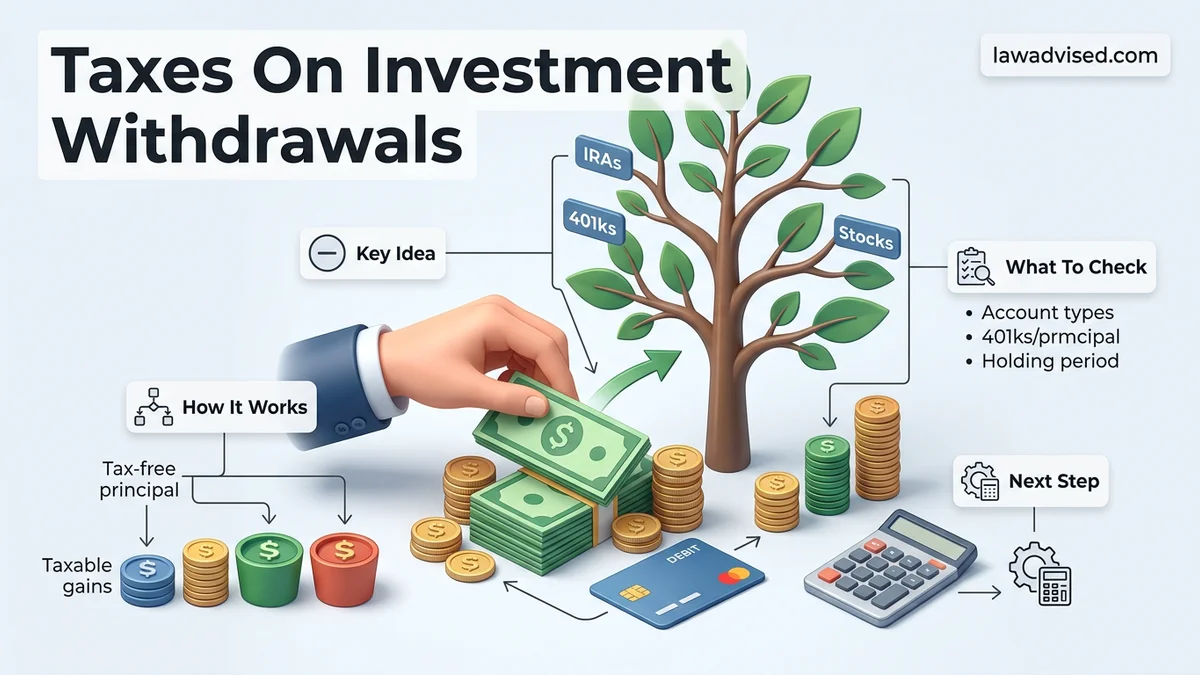
Taxes on investment withdrawals depend heavily on the type of account you pull money from and how long you held the asset. Pre-tax retirement accounts are taxed as ordinary income, while standard brokerage accounts trigger capital gains taxes based on your holding period.
How you are taxed when withdrawing money from investments depends entirely on the specific account type you hold and how long you owned the asset. Pre-tax accounts like traditional IRAs subject your entire withdrawal to ordinary income tax rates, while taxable brokerage accounts only tax your realized capital gains, often at preferential rates.
Navigating these rules in 2026 requires a clear strategy because uncoordinated withdrawals can push you into a higher tax bracket and trigger surcharges on your Medicare premiums. Managing your cash flow efficiently means knowing precisely which account to tap first.
Key Takeaways
- Traditional IRAs and 401(k)s are taxed as ordinary income upon withdrawal.
- Roth accounts allow completely tax-free withdrawals if qualification rules are met.
- Taxable brokerage accounts only tax realized capital gains and dividends.
- Withdrawals before age 59½ often trigger an additional 10% early penalty.
- Required Minimum Distributions (RMDs) force taxable withdrawals starting at age 73.
What Causes High Taxes on Investment Withdrawals
Large Pre-Tax Account Withdrawals
Pulling large sums from traditional 401(k)s or IRAs in 2026 often triggers a steep tax bill. Every dollar you take out of a pre-tax account counts as ordinary income. If you withdraw too much in a single year, that income stacks on top of other earnings and pushes you into a higher federal tax bracket.
- Ordinary income tax brackets for 2026 range from 10% up to 37% federally.
- Large distributions can accidentally trigger the 85% taxable threshold for your Social Security benefits.
- Spikes in your adjusted gross income can also increase your Medicare Part B and Part D premiums two years later.
Realizing Massive Capital Gains at Once
Selling assets in a taxable brokerage account without a plan creates a concentrated tax liability. If you sell appreciated stock, mutual funds, or crypto after holding them for more than a year, you trigger long-term capital gains taxes. Selling assets held for one year or less triggers short-term capital gains, which are taxed at ordinary income rates.
- Long-term capital gains rates for 2026 remain tiered at 0%, 15%, and 20% depending on your taxable income.
- High-income earners may also owe the 3.8% Net Investment Income Tax on these gains.
- Concentrated selling can eliminate valuable tax deductions and credits tied to your adjusted gross income.
How to Calculate Capital Gains and Ordinary Income Taxes
Determining Cost Basis and Capital Gains
To calculate what you owe on a taxable brokerage account withdrawal, you must find your cost basis. Cost basis is typically what you paid for the asset, plus any reinvested dividends and trading fees. Your capital gain is the difference between your net sale price and your cost basis.
- If you bought shares of an index fund for 10,000 dollars and sell them for 25,000 dollars, your capital gain is 15,000 dollars.
- You can use specific identification methods to choose which specific tax lots you sell, allowing you to minimize your gain.
- Capital losses can offset your capital gains dollar-for-dollar, reducing your overall tax burden for the year.
Applying Ordinary Income Tax Brackets
Ordinary income tax rules apply to traditional retirement account withdrawals, short-term capital gains, and wages. The United States uses a progressive tax system, meaning your income is taxed in slices or brackets rather than at a single flat rate across your entire withdrawal.
- Only the dollars falling within a specific bracket are taxed at that bracket’s rate.
- State taxes may also apply to your ordinary income withdrawals, varying significantly depending on where you reside in 2026.
- Withholding taxes upfront can prevent underpayment penalties, though you should calculate the precise amount to avoid overpaying the IRS.
Step-by-Step Guide to Minimizing Withdrawal Penalties
Minimizing taxes and avoiding early withdrawal penalties requires a deliberate sequence of actions. Follow these steps to optimize your asset drawdown strategy for the 2026 tax year.
- Audit your account types: Group your portfolio into taxable brokerage accounts, tax-deferred accounts like traditional IRAs, and tax-free vehicles like Roth IRAs to identify withdrawal sources.
- Review age-based milestones: Verify whether you have reached age 59½ to bypass the IRS 10% early withdrawal penalty, or if you have reached the mandatory age for Required Minimum Distributions.
- Utilize strategic Roth conversions: Convert portions of your traditional IRA to a Roth account during low-income years to lock in lower tax rates before RMDs begin.
- Time capital gains harvesting: Sell appreciated assets in taxable accounts strategically to stay within the 0%, 15%, or 20% long-term capital gains tax brackets for 2026.
- Execute tax-efficient placement: Withdraw funds from taxable accounts first, followed by tax-deferred accounts, and allow tax-free accounts to compound growth for as long as possible.
What If Your RMDs and Account Withdrawals Push You Into a Higher Tax Bracket
Large Required Minimum Distributions combined with discretionary withdrawals can easily inflate your adjusted gross income and trigger higher marginal tax brackets or Medicare surcharges.
Proactive Income Smoothing
According to retirement tax research by the Center for Retirement Research at Boston College, proactive planning is essential. Financial planners recommend executing partial Roth conversions in your early retirement years—specifically between retirement and the start of Social Security or RMDs—to drain tax-deferred balances and smooth out your lifetime tax liability.
Qualified Charitable Distributions
If you are age 70½ or older, you can utilize Qualified Charitable Distributions (QCDs) to satisfy your RMD requirements. You can transfer up to $105,000 (indexed for inflation in 2026) directly from your traditional IRA to a qualified charity. This amount is excluded from your taxable income entirely.
What If It Still Doesn’t Work?
If your DIY tax minimization strategy fails to lower your bracket or you face complex multi-state tax implications, apply these fallback steps:
- Run automated tax projection software: Utilize comprehensive retirement modeling platforms to test different withdrawal sequences against current 2026 tax tables.
- Consult a fiduciary financial planner: Engage a fee-only Certified Financial Planner (CFP) to review your comprehensive distribution schedule.
- Retain a Certified Public Accountant (CPA): Partner with a tax professional specializing in retirement income to file complex returns and manage estimated tax payments.
- Anticipate professional fees: Expect to pay between $1,500 and $3,500 for a comprehensive retirement income and tax-planning engagement from a qualified fiduciary firm.
Conclusion
Managing taxes on investment withdrawals is critical to preserving your retirement nest egg against unnecessary erosion from federal and state levies. By sequencing your withdrawals and utilizing vehicles like Roth conversions, you retain control over your effective tax rate. According to verified research and expert sources from the National Bureau of Economic Research, strategic withdrawal sequencing can extend portfolio longevity by up to five years. Take your next step today by auditing your 2026 projected income and scheduling a consultation with a certified tax professional to review your distribution plan.
❓ Frequently Asked Questions
How do tax rates differ between short-term and long-term capital gains?
Short-term capital gains apply to assets held for one year or less and are taxed at ordinary income tax rates. Long-term capital gains apply to assets held for more than a year and benefit from reduced preferential tax rates.
What are the specific exceptions to the 10% early withdrawal penalty?
Exceptions include qualified higher education expenses, first-time home purchases (up to $10,000), certain medical expenses, and setting up substantially equal periodic payments under Rule 72(t).
How do Required Minimum Distributions (RMDs) affect my tax bracket?
RMDs are added directly to your annual taxable income, which can push you into a higher federal income tax bracket and potentially trigger higher Medicare premiums.
Can I strategically choose which account to withdraw from to lower taxes?
Yes, strategic withdrawal sequencing—such as drawing from taxable accounts first, pre-tax accounts second, and Roth accounts last—can help manage your overall annual tax burden.
Are dividends taxed if they are automatically reinvested?
Yes, qualified and ordinary dividends generated within a taxable brokerage account are considered taxable income in the year they are received, even if you choose to automatically reinvest them into more shares.
What constitutes a ‘qualified’ distribution from a Roth IRA?
A distribution is qualified if you have held the Roth IRA for at least five tax years and you are at least 59½ years old, disabled, or utilizing the first-time homebuyer exemption.

Ismail Hossain is the founder of Law Advised. He is an Divorce, Separation, marriage lawyer. Follow him.