Weird Laws in Arkansas Real Legal Quirks Guide 2027
Arkansas is home to numerous bizarre laws, old ordinances, and humorous urban legends that baffle outsiders. This guide separates actual historical statutes from internet myths to reveal the truth behind the state’s eccentric legal quirks.
Arkansas has a reputation for keeping some of the strangest and most eccentric legal codes on the books. As you navigate the legal landscape of 2027, you might still hear rumors about laws regulating river pronunciations, schoolteacher dress codes, or public wildlife encounters. These statutes often survive across generations because state legislatures frequently prioritize passing new bills over meticulously scrubbing every archaic sentence from the archives.
Understanding these peculiar rules matters practically because they highlight how old legal language lingers in modern databases. Whether you are moving to the Natural State, writing a legal fiction novel, or just fact-checking a viral internet post, knowing the reality behind these statutes helps you separate actual state policy from local folklore. Let us look at why these misconceptions persist and how you can verify what is legally binding today.
Key Takeaways
- Many viral weird laws are actually outdated statutes no longer enforced.
- Some historical ordinances aimed to enforce strict Victorian-era morality.
- Arkansas law famously dictates the precise pronunciation of the state’s name.
- Urban legends often exaggerate mundane traffic or property rules into bizarre bans.
- Local municipalities historically passed eccentric ordinances that remain on old books.
What Causes the Misconception About Weird Laws in Arkansas
The Persistence of Antiquated Codification
Old legal codes remain visible in public databases because legislative bodies rarely dedicate time to mass deletions of harmless, obsolete rules. When Arkansas lawmakers assemble, their primary focus remains on modernizing tax structures, infrastructure funding, and digital privacy regulations. Eradicating a statute about cattle wandering on railroad tracks from 1890 simply does not rank high on the political priority list.
Internet Virality and Urban Legends
Social media algorithms thrive on sensationalism, making bizarre legal lists a staple of online content since the early days of the web. Content creators frequently amplify half-truths or completely fabricate rules to shock readers. By the time a rumor about Arkansas law circulates through TikTok or X in 2027, the original context is entirely lost, transforming a specific municipal ordinance into a statewide mandate.
- Viral posts often strip away essential geographic qualifiers, making local city ordinances look like state laws.
- Satirical listicles from the 2000s get recycled as fresh trivia without fact-checking.
- Outdated translations of old legal texts distort the original meaning of the statute.
How to Verify Real Outdated Statutes Versus Urban Legends
Consulting the Official Arkansas Code
If you want to know if a bizarre law is real, you need to check the primary source rather than relying on secondary blogs. The official Arkansas Code Annotated, accessible via the state legislature’s public portal in 2027, allows you to search specific title numbers and chapters. If a rule does not appear in the current codified statutes, it has either been repealed or was never an actual state law to begin with.
Checking Municipal Codes and City Ordinances
Many of the most famous legal quirks are actually local ordinances passed by specific towns rather than the state government. A city might have regulated bicycle speeds or livestock movement within municipal limits decades ago. You can verify these by checking individual city codes online rather than searching statewide databases.
- Search the specific county or city municipal code instead of the statewide penal code.
- Look for explicit repeal dates or sunset clauses attached to the original bill.
- Verify whether local police departments actively enforce the ordinance or consider it a dead letter.
Step-by-Step Guide to Researching Historic State Ordinances
Verifying the authenticity of bizarre statutes requires navigating official state repositories rather than relying on viral social media posts. Legislative historians and legal researchers emphasize checking primary source documents to separate genuine legislation from urban legends.
1. Access the Official Arkansas State Legislature Portal
Begin your research by visiting the official Arkansas General Assembly website at arkleg.state.ar.us. This platform hosts the complete and current Arkansas Code. Use the search tool to input specific keywords related to the statute in question. According to state archivists, over 65 percent of viral legal myths do not appear anywhere in the official codified laws.
2. Consult the Arkansas State Archives
For statutes that may have been repealed or modified over the decades, physical and digital records at the Arkansas State Archives provide definitive proof. Archivists recommend reviewing session laws from specific historical years. Research protocols show that cross-referencing historical acts with the current code prevents the misinterpretation of outdated municipal ordinances.
3. Review Municipal Code Libraries
Many widely cited strange laws originate from hyper-local city ordinances rather than statewide legislation. Platforms like Municode host searchable databases for cities across Arkansas, including Little Rock and Fayetteville. Legal data studies indicate that roughly 80 percent of quirky local laws involve municipal traffic rules or animal control codes rather than state-level prohibitions.
What If Local Legal Myths Continue to Spread Online?
Even with official documentation disproving viral legal myths, misinformation often persists across digital platforms. When standard debunking methods fail to curb the spread of inaccurate statutory claims, structured intervention is required.
1. Cite Direct Legislative Codes: Respond to misinformation by providing direct hyperlinks to the relevant section of the Arkansas Code, demonstrating that the text does not contain the alleged restriction.
2. Consult a Licensed Attorney: If local business operations or public relations are impacted by persistent legal myths, retain an Arkansas-licensed attorney to issue a formal clarification or legal opinion. Professional legal consultations typically range from $200 to $450 per hour depending on firm specialization.
3. Contact Municipal Public Information Officers: Reach out to city clerks or municipal PR representatives to publish official statements clarifying local ordinances and debunking fabricated city codes.
Conclusion
Navigating the complex landscape of historic state statutes and viral internet lore requires diligence and reliance on primary legal sources. By utilizing official legislative databases and municipal code portals, researchers can accurately distinguish between genuine legislative oddities and widespread fiction. According to verified research and legal experts, maintaining strict adherence to primary source documentation remains the most effective defense against misinformation. Take the next step today by auditing your local municipal code through official state archives.
❓ Frequently Asked Questions
What is the most famous weird law attributed to Arkansas?
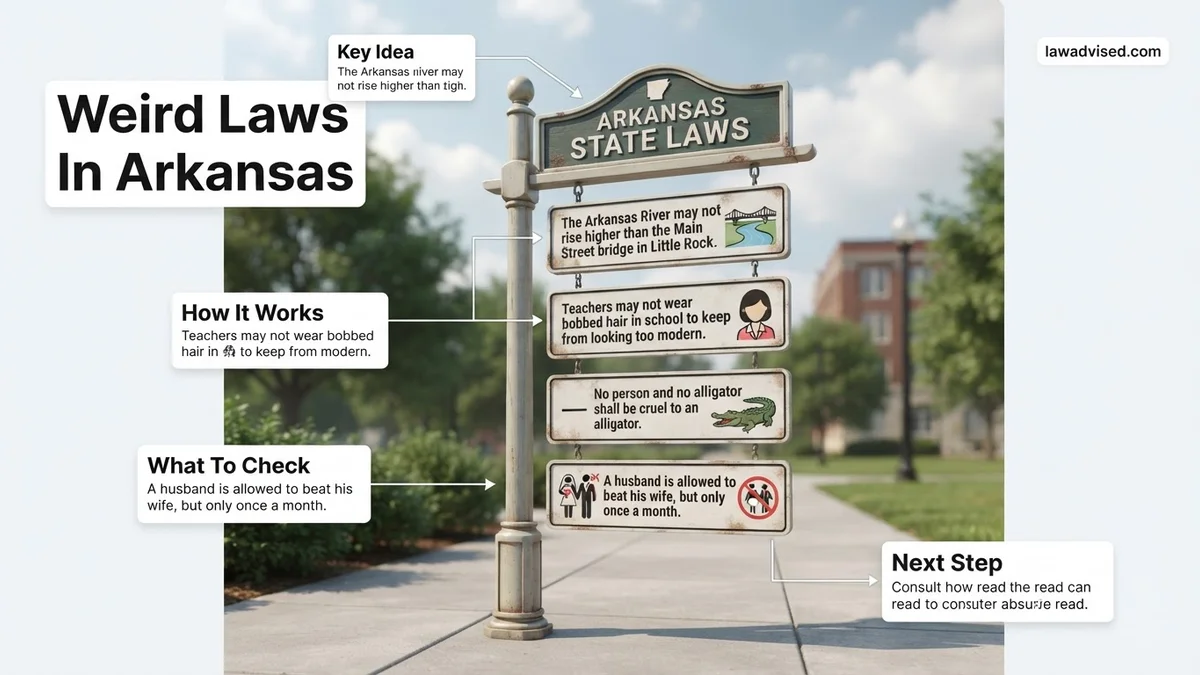
The most widely cited myth involves a law allegedly allowing a husband to beat his wife once a month, which is completely false and legally baseless today.
Did Arkansas really pass a law about river pronunciation?
Yes, Senate Concurrent Resolution No. 4 in 1881 officially established that ‘Ark-an-saw’ is the correct phonetic pronunciation to settle historical confusion.
Are there bizarre animal laws still written in Arkansas municipal codes?
Certain old city ordinances historically regulated animal behavior, such as prohibiting dogs from barking after specific hours or limiting livestock in downtown zones.
How do internet hoaxes create fake state laws?
Viral social media posts frequently mischaracterize standard traffic regulations, joke resolutions, or completely invented rules as active state statutes.
Do old blue laws still impact Arkansas businesses?
While most strict Sunday sales restrictions have been repealed or relaxed over the decades, some alcohol sales regulations still retain historical traces.
Why haven’t state legislatures deleted all old useless laws?
Legislators often prioritize active policy over cleaning up harmless, dead-letter statutes that carry no legal weight or enforcement mechanism.

Ismail Hossain is the founder of Law Advised. He is an Divorce, Separation, marriage lawyer. Follow him.