What Happens If You Owe the IRS 2026 Step-by-Step Guide
If you owe the IRS and fail to pay, penalties, interest, and aggressive collection actions will begin accumulating immediately. However, the agency offers multiple relief programs to help taxpayers resolve their balance over time.
If you owe money to the IRS for the 2026 tax season and cannot pay, the worst thing you can do is ignore the bill. The agency does not simply forget about unpaid taxes; instead, it triggers a strict, automated enforcement timeline that moves from standard billing notices to severe collection actions like wage garnishments and property liens.
Facing the IRS without a plan leads to rapidly accumulating penalties and interest that can easily double your original tax debt. Understanding this step-by-step enforcement process helps you take control of your financial situation, stop collection actions before they escalate, and utilize official IRS relief programs to resolve your debt.
Key Takeaways
- File your tax return on time even if you cannot pay to avoid steep penalties.
- The IRS sends a series of formal notices outlining your exact unpaid balance.
- Failure-to-file penalties are significantly higher than failure-to-pay penalties.
- Payment plans and installment agreements can stop aggressive IRS collection actions.
- Contacting the IRS early opens up more flexible debt resolution options.
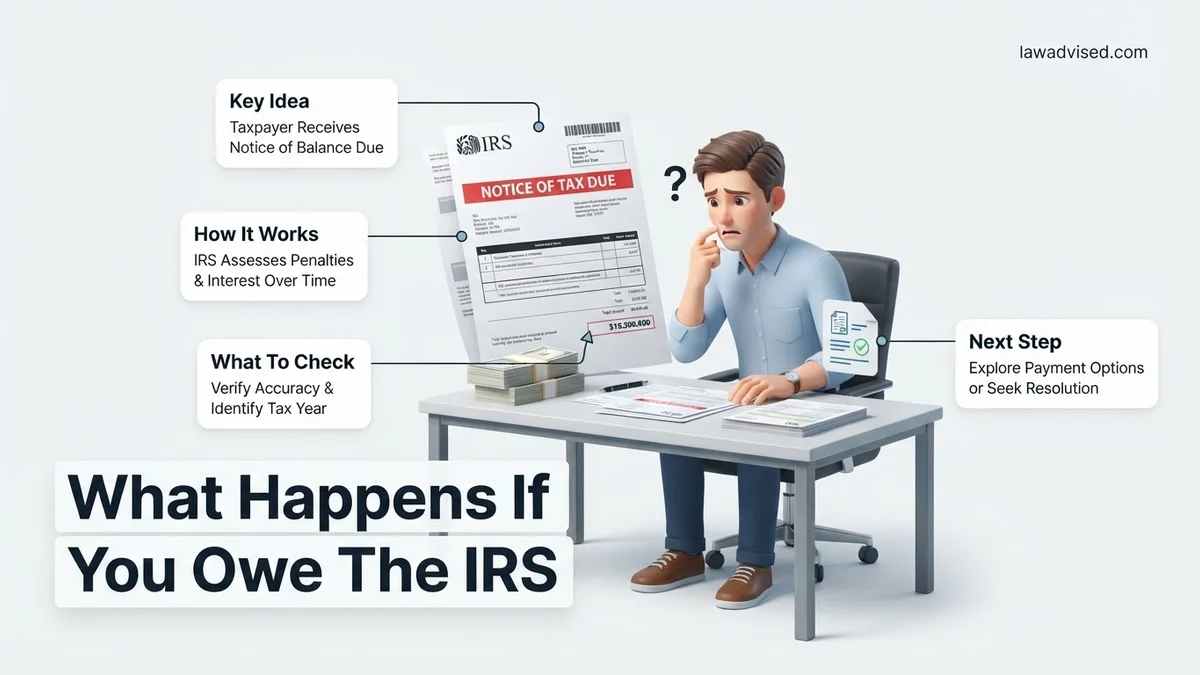
What Happens When You Owe the IRS and Ignore It
Ignoring your tax debt starts a predictable chain reaction. The IRS relies on automated systems to flag unpaid balances and issue statutory notices. If you fail to respond or make arrangements to pay, the agency escalates enforcement through a series of legal mechanisms designed to recover the funds.
The Escalation of IRS Notices
When you file your return showing a balance due—or if the IRS calculates that you owe money after an audit—the process begins with a formal demand letter.
- Notice CP14: This is your initial bill, notifying you of the unpaid tax, assessed penalties, and interest.
- Follow-up Reminders: If the balance remains unpaid, you will receive subsequent notices (such as CP501, CP503, and CP504) warning of impending enforcement.
- Final Notice of Intent to Levy: Notice CP504 or Letter 1058 is the final warning before the IRS takes legal action to seize your property or income.
Immediate Risks to Your Assets and Credit
Once past the initial warning stage, the IRS exercises powerful federal collection tools that standard creditors cannot match.
- Federal Tax Liens: The IRS files a Notice of Federal Tax Lien, which is a public claim against your current and future property, severely damaging your credit score.
- Levies and Seizures: The IRS can issue levies directly to your employer to garnish your wages, freeze and empty your bank accounts, or seize physical assets like vehicles.
- Passport Restrictions: Under federal law, if you owe a seriously delinquent tax debt (exceeding inflation-adjusted thresholds in 2026), the IRS can notify the State Department to deny, revoke, or limit your passport.
How the IRS Penalties, Interest, and Collection Notices Work
Waiting to address your tax liability is expensive. The IRS tacks on multiple penalties and compounds interest daily until the entire balance is paid in full. Knowing how these costs accumulate highlights why you must act quickly.
The Cost of Penalties: Failure-to-File vs. Failure-to-Pay
The IRS distinguishes heavily between people who do not file their tax returns and those who file on time but cannot afford to pay.
- Failure-to-File Penalty: Charged if you do not submit your return on time. It is typically 5 percent of the unpaid taxes for each month the return is late, up to a maximum of 25 percent.
- Failure-to-Pay Penalty: Charged if you file your return without paying. This is much lower, generally 0.5 percent of your unpaid taxes per month, also capped at 25 percent.
- Combined Cap: If both penalties apply in the same month, the failure-to-file penalty is reduced by the failure-to-pay penalty, making timely filing critical even if you have zero cash.
Interest Accumulation
In addition to penalties, federal law requires the IRS to charge interest on unpaid taxes and penalties. Interest compounds daily until the balance is completely cleared. The IRS interest rate fluctuates quarterly based on the federal short-term rate plus 3 percent. Because interest compounds on top of already penalized amounts, your total balance grows aggressively month over month, making early intervention essential.
Step-by-Step Guide on How to Fix Your IRS Tax Debt
Resolving unpaid taxes requires immediate and structured action to minimize escalating statutory penalties. According to financial compliance experts, ignoring a tax balance only invites aggressive collection actions like wage garnishments. Follow this sequential roadmap to address your 2026 tax liability effectively.
- Review the IRS Notice: Examine your official IRS bill or CP notice to confirm the exact tax year, principal owed, and accrued interest calculations.
- File All Missing Returns: The IRS will not negotiate a payment arrangement until all delinquent tax returns from previous years are officially filed.
- Choose Your Resolution Pathway: Select an appropriate relief program based on your current liquidity, such as a short-term payment extension, an installment agreement, or an Offer in Compromise.
- Submit Your Application: Apply online using the IRS Online Payment Agreement tool or mail Form 9465 for an installment plan to secure approval quickly.
- Maintain Strict Compliance: Ensure you make every monthly payment on time and file future returns accurately to keep your relief agreement active.
What If Your Payment Plan or Offer in Compromise Gets Denied
Tax relief applications face rejection if financial disclosures are incomplete or if the taxpayer fails to meet strict eligibility criteria. When the IRS rejects your proposed installment plan or denies your Offer in Compromise, immediate counter-measures are necessary to prevent asset seizures.
Filing an Appeal
You have the legal right to challenge an IRS rejection. Submit Form 12153 within 30 days of the denial notice to request a Collection Due Process hearing with the IRS Independent Office of Appeals.
Submitting a Revised Proposal
Re-evaluate your financial statements to correct errors or include overlooked necessary living expenses. Submitting an amended application with updated documentation often reverses an initial rejection.
What If It Still Doesn’t Work?
If standard administrative appeals fail and the IRS intensifies collection efforts, alternative intervention strategies are required. When self-service options break down, utilize these fallback steps to protect your financial standing:
- Request Currently Not Collectible (CNC) Status: Contact the IRS to demonstrate that paying your tax debt would prevent you from meeting basic living expenses, temporarily pausing collections.
- Engage a Licensed Tax Professional: Hire a Certified Public Accountant, Enrolled Agent, or tax attorney to negotiate directly with IRS revenue officers on your behalf. Professional representation typically costs between $1,500 and $5,000 depending on case complexity.
- Contact the Taxpayer Advocate Service: Reach out to this independent organization within the IRS if you are experiencing systemic hardship or unresponsive agency delays.
- Explore Penalty Abatement: Formally request a first-time penalty abatement if you have a clean compliance history for the preceding three tax years.
Conclusion
Owing money to the IRS in 2026 can feel overwhelming, but ignoring the debt only triggers severe financial penalties and forced collections. Resolving the issue quickly requires verifying your balance, filing missing paperwork, and securing an active payment arrangement. According to verified research and tax compliance experts, proactive communication remains the single most effective strategy to prevent aggressive IRS enforcement actions. Take your immediate next step today by logging into your secure online IRS account to evaluate your personalized relief options.
❓ Frequently Asked Questions
What happens if I cannot pay my taxes at all?
If you cannot pay, you should still file your return and apply for an IRS relief program such as a short-term payment extension, an installment agreement, or an Offer in Compromise.
How much are the failure-to-file and failure-to-pay penalties?
The failure-to-file penalty is usually 5% of the unpaid taxes for each month the return is late, while the failure-to-pay penalty is generally 0.5% per month.
What is an Offer in Compromise and do I qualify?
An Offer in Compromise allows certain taxpayers to resolve their tax liability with the IRS for a lower amount than what they originally owed, based on financial hardship.
Can I go to jail for owing the IRS money?
You generally will not go to jail simply for being unable to pay your taxes, but criminal tax evasion and intentionally hiding assets can lead to prosecution.
What does ‘Currently Not Collectible’ status mean?
If the IRS determines you have zero ability to pay due to severe financial hardship, they may temporarily pause collection efforts until your financial situation improves.
How do I set up an IRS payment plan online?
You can apply for a short-term payment plan or a long-term installment agreement directly through the IRS website using the Online Payment Agreement tool.

Ismail Hossain is the founder of Law Advised. He is an Divorce, Separation, marriage lawyer. Follow him.