Short Term vs Long Term Capital Gains The Best 2026 Guide
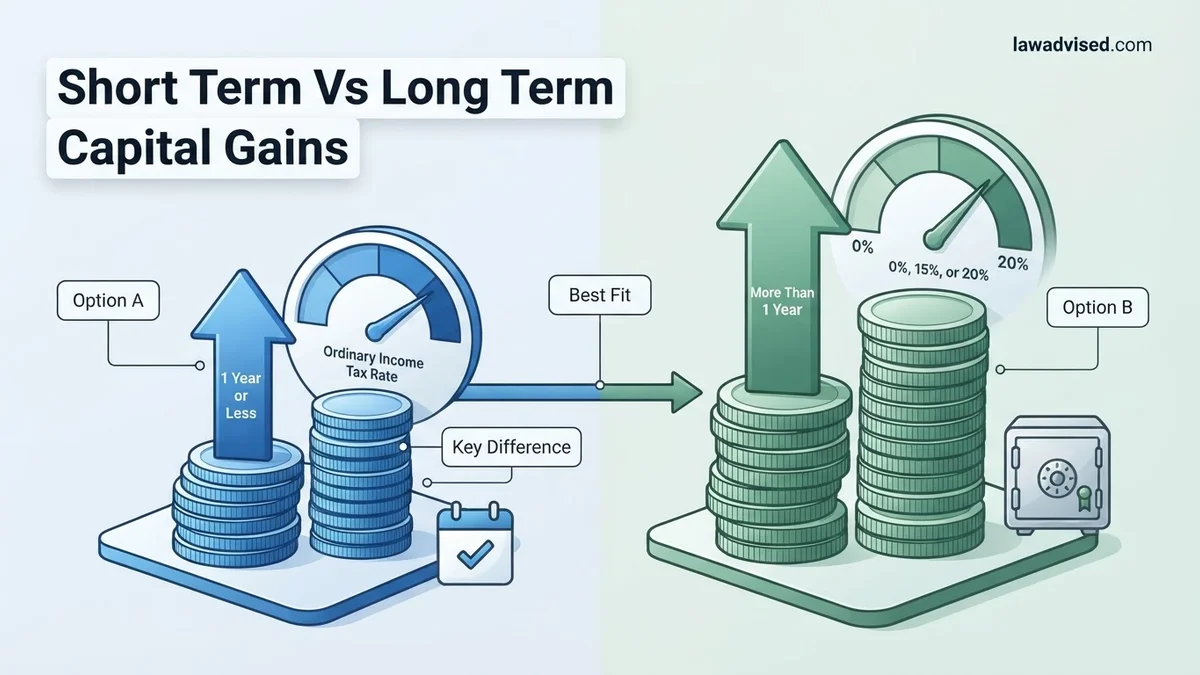
The main difference between capital gains is the holding period threshold, which dictates whether profits are taxed at higher ordinary income rates or lower preferential rates. Understanding this one-year rule allows investors to strategically time asset sales and significantly reduce their tax liability.
The core difference between short-term and long-term capital gains comes down to how long you hold an asset before selling it. If you sell an asset you owned for one year or less, your profit faces short-term capital gains tax rates, which match your ordinary income tax bracket. If you hold that same asset for more than one year, it qualifies for long-term capital gains tax rates, which are significantly lower at 0 percent, 15 percent, or 20 percent depending on your taxable income for 2026.
Managing this timeline is the single most effective legal way to keep more of your investment profits. A tax mistake here can cost you thousands of dollars unnecessarily. By understanding the holding period threshold and the exact tax bracket differences, you can schedule your asset sales to maximize your net returns in 2026.
Key Takeaways
- Assets held for one year or less are taxed as short-term capital gains at ordinary income rates.
- Assets held for longer than one year qualify for preferential long-term capital gains tax rates.
- Long-term tax brackets are generally 0%, 15%, or 20% depending on your total taxable income.
- Waiting just a few extra days to cross the one-year mark can yield massive tax savings.
- Tax-loss harvesting helps offset capital gains and lowers your overall yearly tax obligation.
What Causes High Capital Gains Tax Bills
The Danger of the One-Year Holding Threshold
Selling an asset too quickly triggers the highest possible tax rates on your investment profits. The Internal Revenue Service draws a strict line at the 365-day mark. If you liquidate a stock, cryptocurrency, or piece of real estate on day 364, your gains are lumped directly into your regular earned income. For high earners in 2026, this means paying up to 37 percent in federal taxes, plus any applicable state taxes. That is a massive penalty for impatience.
Bracket Creep and Ordinary Income Rates
When short-term gains are added on top of your salary or business revenue, they can easily push you into a higher tax bracket. Your investment profit does not sit in a vacuum. It amplifies your total taxable income for the year. This unfortunate compounding effect often shocks investors who fail to calculate their exact holding periods before hitting the sell button.
- Short-term gains are taxed at ordinary income rates up to 37 percent in 2026.
- Selling on day 365 or later shifts your profits to preferential long-term schedules.
- State taxes apply to short-term gains just like standard wage income in most states.
How to Fix Your Asset Timeline and Qualify for Lower Rates
Targeting the 0 Percent, 15 Percent, and 20 Percent Brackets
Holding your investments for just one year and a day completely changes your tax equation. For the 2026 tax year, long-term capital gains benefit from preferential federal brackets that spare you from ordinary income rates. If your taxable income falls below specific thresholds, your long-term profits are entirely tax-free at the federal level. Even for higher earners, the maximum federal long-term rate caps out at 20 percent, protecting you from the steepest tax tiers.
Numerical Example of the Real Savings
Imagine you make a $50,000 profit on a stock portfolio and fall into the 24 percent ordinary income tax bracket. If you sell at 11 months, your short-term tax bill is $12,000. If you wait until 13 months and qualify for the 15 percent long-term capital gains bracket, your tax bill drops to $7,500. You instantly save $4,500 in hard cash simply by waiting a few extra weeks.
- Calculate your exact purchase date before placing a sell order.
- Verify that settlement dates do not prematurely trigger a short-term classification.
- Review your projected 2026 adjusted gross income to determine your exact long-term rate tier.
Step-by-Step Guide to Calculating Short-Term vs Long-Term Taxes
Calculating your capital gains tax liability requires a methodical approach to ensure accuracy when filing your 2026 tax return. According to the Internal Revenue Service guidelines, proper tracking prevents costly overpayments.
1. Determine Your Holding Period
First, identify the exact purchase date and sale date of the asset. The holding period begins on the day after you acquire the property and ends on the day you dispose of it. If you sell an asset exactly one year and one day after purchase, it qualifies for long-term treatment.
2. Calculate Your Net Capital Gains
Subtract your cost basis—what you paid for the asset plus any commissions or fees—from the final sale price. Offset your capital gains with any capital losses realized within the same tax year. According to financial planning experts, tax-loss harvesting remains a primary strategy to minimize your overall taxable base.
3. Apply the Correct Tax Bracket
Match your net short-term gains against your ordinary income tax bracket. For long-term gains, consult the specific 2026 thresholds for the 0%, 15%, or 20% tiers based on your filing status and total taxable income. Always account for the 3.8% Net Investment Income Tax if your modified adjusted gross income exceeds statutory limits.
What If Your Investments Still Trigger Heavy Taxes?
If your projected capital gains tax liability for 2026 remains excessively high despite holding assets longer, specialized mitigation strategies are required. When standard buy-and-hold investing fails to reduce your tax burden sufficiently, consider these advanced fallback steps:
- Execute Tax-Loss Harvesting: Offset high-gain assets by intentionally selling underperforming positions at a loss. You can offset all capital gains plus up to $3,000 of ordinary income annually.
- Utilize Tax-Advantaged Accounts: Rebalance your portfolio inside a traditional or Roth IRA, or a 401(k) plan, where trades do not trigger immediate capital gains tax events.
- Explore Charitable Remainder Trusts: For highly appreciated assets like real estate or single-stock portfolios, transfer them into a charitable trust to defer taxes while generating income.
- Consult a Certified Public Accountant (CPA): Engage a licensed tax professional to model multi-year tax projections. Professional CPA fees typically range from $300 to $1,000+ depending on the complexity of your investment portfolio.
Conclusion
Navigating short-term versus long-term capital gains is essential for preserving investment returns and minimizing unnecessary tax liabilities. By understanding holding periods and leveraging strategic tax planning, you can significantly optimize your net portfolio growth. According to verified research and expert financial sources, proactive asset location and timing remain the most reliable methods to control tax exposure. Your actionable next step for 2026 is to review your current portfolio breakdown and identify any assets approaching the one-year long-term threshold before executing a sale.
❓ Frequently Asked Questions
What exact date does the holding period clock start and stop?
The holding period starts on the day after you purchase the security or property. It stops on the exact day you execute the sale, meaning the asset must be owned for longer than 365 days to qualify as long-term.
How do short-term capital gains impact my regular income tax bracket?
Short-term gains are stacked directly on top of your ordinary earned income, such as a W-2 salary. This additional income can easily push you into a higher federal income tax bracket for that year.
Are there additional surtaxes I should know about for high earners?
Yes, high-income earners may also be subject to the 3.8% Net Investment Income Tax (NIIT) if their modified adjusted gross income exceeds specific statutory thresholds.
How does tax-loss harvesting work to lower my overall tax burden?
Tax-loss harvesting involves selling underperforming assets at a loss to offset realized capital gains. If your losses exceed your gains, you can deduct up to $3,000 of ordinary income per year.
Do state taxes apply differently to short-term versus long-term gains?
Most U.S. states tax capital gains as ordinary income regardless of how long you held the asset. Only a handful of states offer preferential treatment or exemptions for capital gains.
What strategies can I use if I am forced to sell an asset before the one-year mark?
If you must sell early, you can pair the transaction with capital losses from other investments in your portfolio. Maximizing tax-advantaged accounts like IRAs or 401(k)s can also help shield your overall wealth from immediate taxes.

Ismail Hossain is the founder of Law Advised. He is an Divorce, Separation, marriage lawyer. Follow him.