Tax on Stock Profits Explained 2026 A Proven Guide
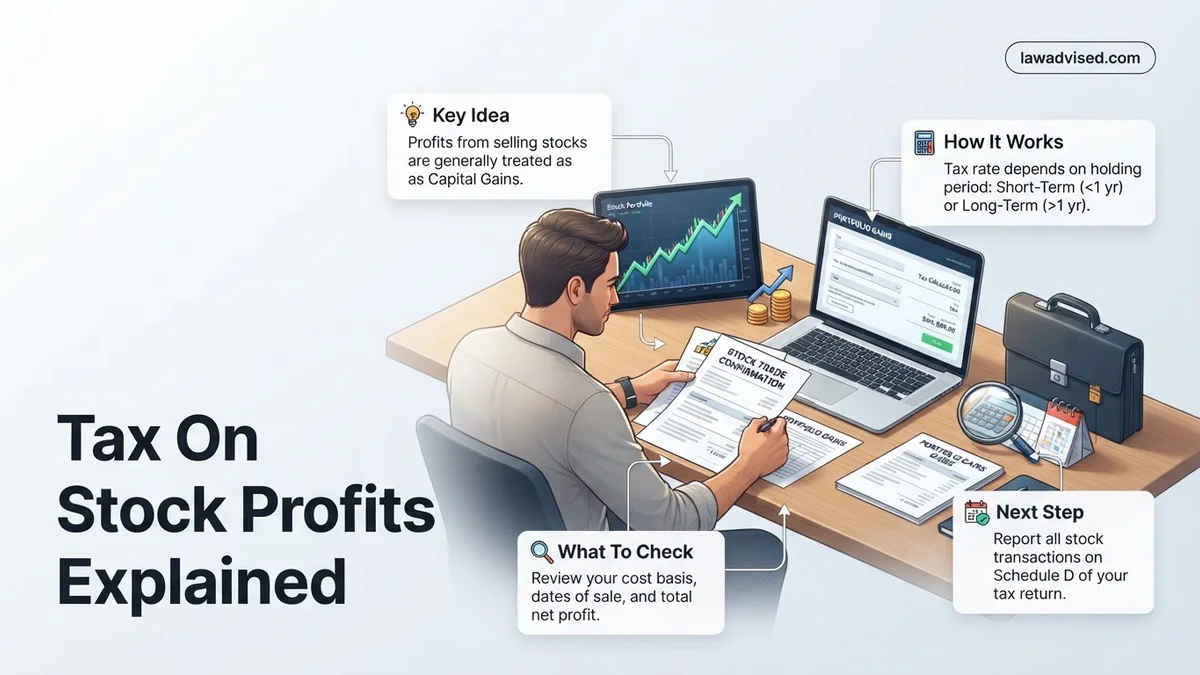
When you sell stocks for a profit in a taxable account, the IRS taxes your gains based on how long you held the asset. Understanding short-term versus long-term capital gains is essential to legally minimizing your tax liability and keeping more of your investment earnings.
When you sell a stock for more than you bought it for, the resulting profit is called a capital gain. How much of that profit you get to keep depends almost entirely on one factor: how long you held the asset before selling.
As you navigate the 2026 tax landscape, the IRS splits your stock profits into two distinct buckets. Short-term capital gains apply to stocks you held for one year or less, and they are taxed at your ordinary income tax rate. Long-term capital gains apply to stocks held for more than a year, and they benefit from significantly lower tax rates of 0%, 15%, or 20%. Knowing the difference prevents you from handing over a massive chunk of your returns to the government.
Key Takeaways
- Stocks held for one year or less face higher short-term capital gains tax rates.
- Assets held for more than a year qualify for lower long-term capital gains rates.
- Net capital gains are calculated by subtracting capital losses from your total profits.
- Tax-advantaged accounts like IRAs and 401(k)s protect your profits from immediate taxation.
- Tax-loss harvesting allows you to offset investment gains with realized losses.
What Causes High Taxes on Stock Profits
Short-Term Holding Periods Trigger Ordinary Income Rates
Day trading and quick momentum plays feel exciting until tax season arrives. If you sell a winning stock 364 days or less after buying it, the IRS treats those gains as ordinary income. In 2026, your short-term capital gains tax rate matches your exact income tax bracket, which can range from 10% all the way up to 37% for high earners. That means a successful short-term trade could lose over a third of its value immediately to federal taxes alone.
The Hidden Impact of State Taxes and Investment Income Surcharges
Federal brackets do not tell the whole story. High earners face additional hurdles that amplify their tax burden:
- State Taxes: Most states tax capital gains as ordinary income, adding up to 13.3% on top of federal rates.
- Net Investment Income Tax (NIIT): High earners face an extra 3.8% surtax if their modified adjusted gross income crosses specific thresholds.
- Bracket Creep: A massive stock profit can accidentally push your total taxable income into a higher federal bracket for that year.
How to Calculate and Lower Your Stock Profit Taxes Step-by-Step
Calculating Your Net Capital Gains
Before you can lower your tax bill, you need to know your exact taxable profit. The calculation is straightforward:
- Find your cost basis, which is the original purchase price plus any broker commissions or fees.
- Subtract the cost basis from your sale price to find the gross capital gain or loss for that specific transaction.
- Group all your transactions into short-term and long-term buckets.
- Net your gains and losses within each bucket. If you have remaining losses in one bucket, you can use them to offset gains in the other.
Using Tax-Loss Harvesting to Offset Your Gains
You do not have to pay taxes on every single dollar of profit if you also took some losses during the year. Tax-loss harvesting lets you sell underperforming stocks at a loss to cancel out your capital gains.
- Offsetting Gains: Dollar-for-dollar, your capital losses eliminate your capital gains. Unlimited losses can offset unlimited gains.
- Deducting Ordinary Income: If your total losses exceed your total gains, you can use up to $3,000 of those leftover losses to lower your ordinary taxable income.
- The Wash-Sale Rule: Beware of buying back the exact same stock within 30 days before or after selling it at a loss, or the IRS will disallow the tax break.
What If Your Capital Losses Exceed Your Gains
Market downturns happen, but a portfolio loss does not mean a total write-off. When your capital losses exceed your capital gains in 2026, the tax code provides a mechanism called capital loss offset to cushion the blow.
Netting Losses Against Gains
First, you must offset all your capital losses against your capital gains of the same type. Short-term losses offset short-term gains, and long-term losses offset long-term gains. If one category has excess losses, you can apply them to the other category.
Claiming the Annual Deduction
If your total losses exceed your total gains, you can deduct up to $3,000 of the net loss against your ordinary income per year. For married individuals filing separately, this limit is capped at $1,500. According to IRS guidelines, any remaining excess loss rolls over indefinitely into future tax years until completely exhausted.
Best Strategies to Protect Investment Profits Using Tax-Advantaged Accounts
The most effective way to manage taxes on stock profits is to avoid triggering them in traditional taxable accounts altogether. Utilizing tax-advantaged accounts in 2026 legally shields your returns from annual capital gains taxation.
Maximizing Retirement Accounts
Traditional 401(k)s and IRAs defer taxes until you withdraw money in retirement, often at a lower tax bracket. Roth accounts—including Roth IRAs and Roth 401(k)s—use after-tax dollars, allowing your investments to compound and withdraw completely tax-free. Financial analysts emphasize that maxing out these accounts should be the first line of defense for long-term investors.
Leveraging Health Savings Accounts
Health Savings Accounts offer a unique triple-tax advantage for eligible high-deductible health plan participants. Contributions are tax-deductible, funds grow tax-free, and withdrawals for qualified medical expenses are entirely tax-free. Many modern brokerages allow you to invest HSA funds directly into the stock market.
What If It Still Doesn’t Work?
Navigating complex investment portfolios, multi-state tax rules, and carryover losses can sometimes overwhelm standard tax software. If your capital gains calculations remain unclear or conflicting, consider these fallback steps:
- Re-export your official Form 1099-B data directly from your brokerage firm into your tax preparation software to ensure no cost-basis data was dropped.
- Check for disallowed wash sales that may have been incorrectly omitted from your brokerage’s adjusted cost basis calculations.
- Consult a Certified Public Accountant (CPA) or Enrolled Agent (EA) specializing in trader taxation. According to industry data, professional tax preparation for complex investment portfolios generally ranges from $400 to $1,500 depending on the volume of transactions.
- File for an automatic tax extension if you need more time to reconcile missing historical cost basis records from older stock transfers.
Conclusion
Managing taxes on stock profits requires strategic planning, accurate cost-basis tracking, and smart utilization of tax-advantaged accounts. By understanding how capital gains, losses, and holding periods interact, investors can legally minimize their liabilities in 2026. According to verified research and expert financial sources, proactive tax-loss harvesting and account structuring can significantly boost net portfolio returns over time. Your actionable next step is to review your current brokerage statements and calculate your year-to-date realized gains before the tax deadline approaches.
❓ Frequently Asked Questions
What triggers a tax liability when trading stocks in a standard brokerage account?
A taxable event is triggered strictly when you sell a stock for a higher price than you purchased it for, resulting in a realized capital gain. Simply holding a stock that increases in value does not incur any immediate tax obligation.
How do short-term capital gains tax rates compare to ordinary income tax brackets?
Short-term capital gains are taxed at your exact marginal ordinary income tax bracket, which can range from 10% up to 37% federally depending on your total annual taxable income.
What income thresholds apply to the 0%, 15%, and 20% long-term capital gains rates?
The specific tax tier depends on your filing status and taxable income thresholds, which adjust annually for inflation. For example, lower-income earners often qualify for the 0% rate, while high earners face the 20% rate.
How does tax-loss harvesting work to lower overall tax liability?
Tax-loss harvesting involves selling underperforming stocks at a loss to offset the capital gains realized from your winning investments. If your losses exceed your gains, you can deduct up to $3,000 against ordinary income per year.
Are dividends treated the same as stock sale profits for tax purposes?
Dividends are taxed in the year they are received rather than when shares are sold. Qualified dividends are taxed at the lower long-term capital gains rates, while ordinary dividends are taxed as regular income.
Do trades inside a traditional IRA or Roth IRA incur capital gains taxes?
No, trades executed inside tax-advantaged accounts like traditional or Roth IRAs and 401(k)s are exempt from immediate capital gains taxes, allowing your investments to compound tax-free or tax-deferred.

Ismail Hossain is the founder of Law Advised. He is an Divorce, Separation, marriage lawyer. Follow him.