Taxes on Stock Trading in 2026 Expert Guide to Capital Gains
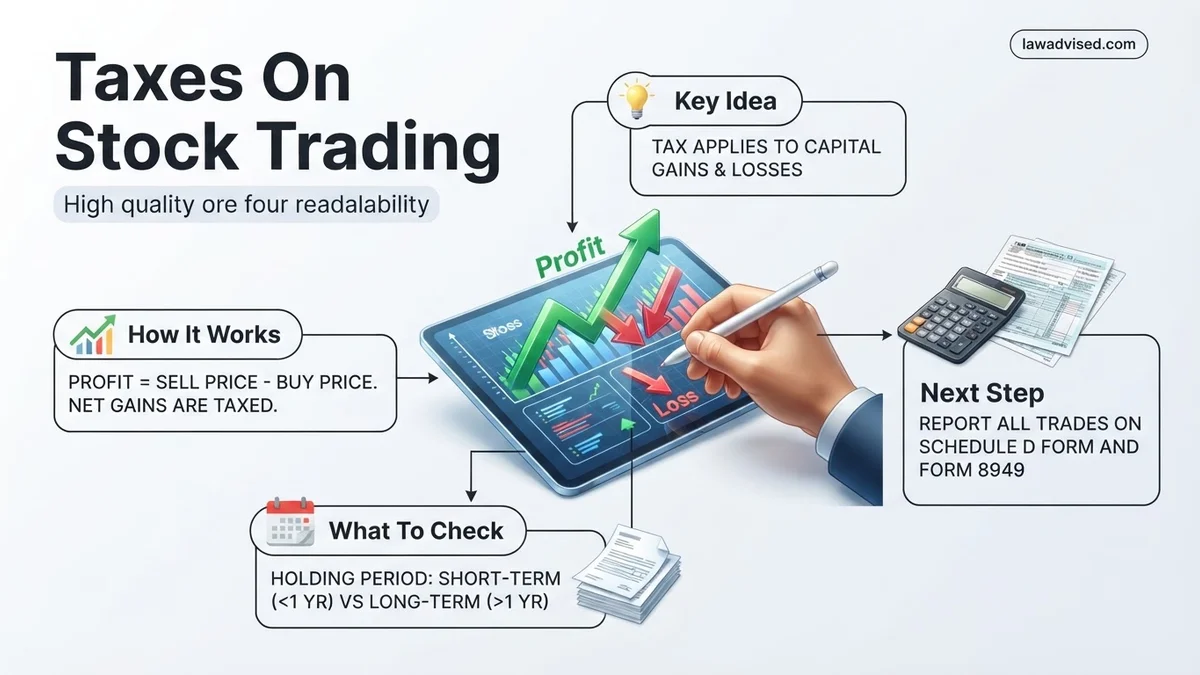
Taxes on stock trading depend primarily on how long you hold an asset before selling it. Short-term capital gains are taxed at ordinary income tax rates, while long-term capital gains benefit from preferential tax rates of 0%, 15%, or 20%. Understanding these rules helps you minimize your tax liability through smart loss-offsetting strategies.
When you sell a stock for more than you bought it, the profit is called a capital gain, and the IRS wants a cut of that money. How much you actually owe depends almost entirely on how long you held the asset before selling it, as well as your total taxable income for the year 2026. If you trade stocks frequently without understanding these rules, your tax bill can easily consume a massive chunk of your hard-earned profits.
Navigating these rules correctly determines whether you keep your returns or hand them over to the government. This guide breaks down exactly how stock trades are taxed in 2026, how the holding period changes your tax bracket, and how you can use losses to offset what you owe.
Key Takeaways
- Hold stocks for over one year to qualify for lower long-term capital gains tax rates.
- Short-term capital gains apply to assets held for one year or less and use ordinary income brackets.
- Offset your capital gains by claiming up to $3,000 in net capital losses against ordinary income.
- Report all stock sales and calculate gains using IRS Form 8949 and Schedule D.
- Avoid the wash-sale rule by waiting 30 days before repurchasing a substantially identical stock at a loss.
What Causes High Taxes on Stock Trading and Capital Gains
Short-Term Capital Gains Tax Rates
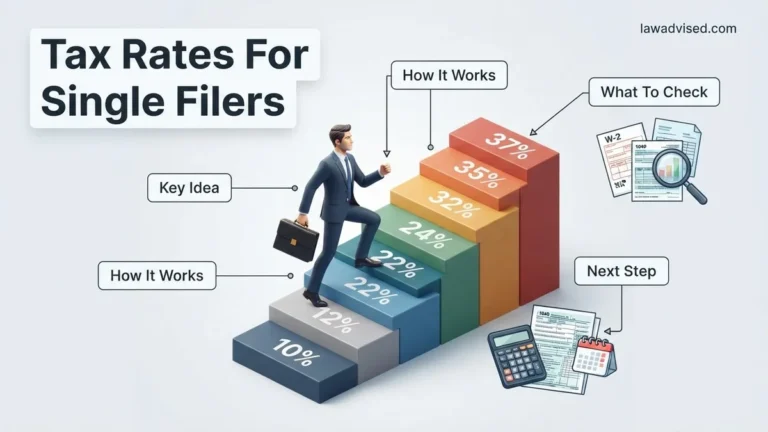
Trading stocks rapidly is the primary trigger for the highest possible tax rates on your investments. When you buy a stock and sell it less than 365 days later, any profit is classified as a short-term capital gains tax. The IRS taxes these short-term gains at your ordinary income tax rate. Depending on your 2026 tax bracket, that means you could pay anywhere from 10 percent up to 37 percent on your trading profits.
- Profits are added directly to your W-2 or business income.
- High earners face the maximum 37 percent federal rate on quick trades.
- State taxes may apply on top of these federal rates.
The Impact of Frequenty Day Trading
Day traders and swing traders suffer the most from this structure because every profitable trade resets the clock. If you make hundreds of short-term trades throughout 2026, you cannot benefit from preferential tax rates. Even if your net profit at the end of the year feels modest, a high volume of short-term transactions pushes your effective tax rate much higher than that of a patient long-term investor.
How to Calculate and Lower Your Stock Trading Tax Bill Step-by-Step
Step 1: Determine Your Holding Period
Your first calculation separates your trades into short-term and long-term buckets. The holding period begins the day after you buy the stock and ends on the day you sell it. If you sell on day 366 or later, your profits qualify for long-term capital gains tax rates. These rates are significantly lower than ordinary income rates:
- 0 Percent Rate: Applies to single filers with total taxable income up to roughly $48,350 in 2026.
- 15 Percent Rate: Applies to the vast majority of middle-income earners.
- 20 Percent Rate: Applies to high-income earners above the top threshold.
Step 2: Net Your Gains and Losses
You do not pay taxes on every single winning trade in isolation. At the end of 2026, you must net all your capital gains and capital losses together. Subtract your total losses from your total gains to find your net capital gain. If your losses exceed your gains, you can use up to $3,000 of those net losses to offset your ordinary income, such as your salary, reducing your overall tax burden for the year.
What If Your Capital Losses Exceed Your Gains During Tax Season
Market downturns happen, but a portfolio loss does not mean a wasted tax year. According to IRS guidelines, if your capital losses exceed your capital gains, you can use those excess losses to offset your ordinary income. Financial planning experts emphasize that this strategy turns market volatility into a tangible tax-saving mechanism for retail traders navigating the 2026 fiscal landscape.
Offsetting Ordinary Income and Carryovers
Taxpayers can deduct up to $3,000 of net capital losses per year against their ordinary earned income. Married couples filing separately face a reduced limit of $1,500. Certified Public Accountants note that any remaining losses above this threshold do not vanish. Instead, they roll over indefinitely into future tax years until fully exhausted.
The Wash-Sale Trap to Avoid
Traders must remain vigilant regarding the strict IRS wash-sale rule. This regulation disallows loss deductions if you buy a substantially identical stock within 30 days before or after the sale. Brokerage platforms flag these transactions on your 1099-B, permanently adding the disallowed loss to the cost basis of your replacement shares.
Advanced Best Practices for Reporting Trades and Avoiding IRS Penalties
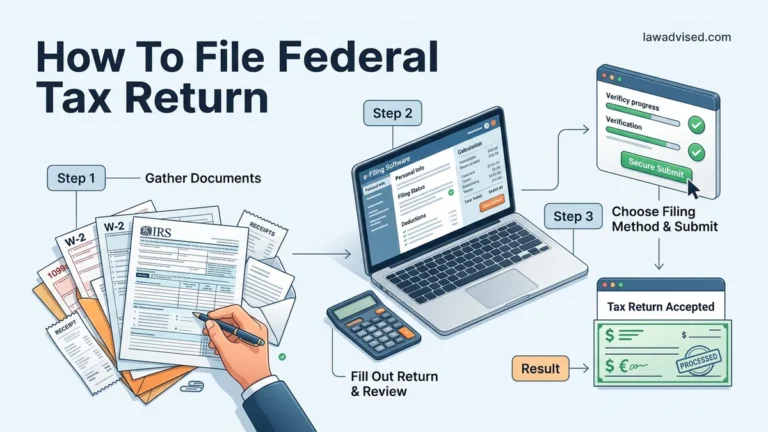
Accurate reporting prevents costly IRS audits and penalty assessments. Automated brokerage integrations simplify data transfer, but high-volume day traders must reconcile complex discrepancies before filing Form 8949 and Schedule D.
- Reconcile all 1099-B forms: Cross-reference every brokerage statement against your personal trade logs to catch missing cost basis data or misreported wash sales.
- Utilize FIFO or specific identification: Designate your cost-basis accounting method with your broker before executing sales to legally minimize your realized gains.
- Make quarterly estimated tax payments: Avoid underpayment penalties by paying estimated taxes to the IRS four times a year if your trading generated significant net gains.
- Maintain meticulous digital audit trails: Keep confirmation slips, execution timestamps, and ledger records for at least three years following your filing date.
What If It Still Doesn’t Work?
Brokerage data mismatches or complex multi-account portfolios can disrupt standard tax filing software. If your capital gains calculations fail to balance or automated imports generate errors, execute these fallback steps:
- Request a corrected Form 1099-B directly from your brokerage compliance department if historical cost basis data is missing.
- Export raw CSV transaction logs from your trading platforms to manually calculate adjustments using specialized tax software designed for active traders.
- Consult a Certified Public Accountant (CPA) or Enrolled Agent (EA) specializing in securities taxation for personalized guidance. Professional advisory fees for complex trading returns typically range from $500 to $2,500 depending on trade volume.
Conclusion
Navigating taxes on stock trading in 2026 requires strict attention to holding periods, accurate cost basis tracking, and strategic loss harvesting. Failing to properly report short-term and long-term gains invites costly IRS penalties and unnecessary tax liabilities. According to verified research and tax experts, proactive record-keeping and early software reconciliation remain the most effective defenses against compliance errors. Take the next actionable step today by exporting your current brokerage transaction logs and verifying your year-to-date realized gains before the quarterly filing deadline.
❓ Frequently Asked Questions
What are the specific tax brackets for long-term capital gains?
For the 2026 tax year, long-term capital gains rates are 0%, 15%, or 20%, depending on your taxable income and filing status. High earners may also be subject to the 3.8% Net Investment Income Tax.
How does tax-loss harvesting work in a taxable brokerage account?
Tax-loss harvesting involves selling losing investments to offset the capital gains realized from winning investments. This strategy lowers your overall adjusted gross income and reduces your tax liability.
Are dividends taxed the same way as stock trading capital gains?
Qualified dividends are taxed at the same lower rates as long-term capital gains, while ordinary (unqualified) dividends are taxed at your standard ordinary income tax rate.
Does trading stocks inside an IRA trigger immediate taxes?
No, traditional and Roth IRAs are tax-advantaged accounts. You do not pay capital gains tax on individual stock trades executed within these accounts.
What happens if I forget to report a stock trade on my taxes?
The IRS receives copies of Form 1099-B from your brokerage firm. Failing to report trades can trigger automated IRS notices, potential back taxes, penalties, and interest charges.
Can I offset crypto or real estate gains with stock losses?
Yes, all capital losses and capital gains from various asset classes, including stocks, cryptocurrencies, and real estate, are combined together on your tax return to determine your net gain or loss.

Ismail Hossain is the founder of Law Advised. He is an Divorce, Separation, marriage lawyer. Follow him.