DeFi Taxes Explained 2026 Step-by-Step Guide to Crypto Tax
Navigating decentralized finance taxes requires understanding that staking rewards, liquidity pool deposits, and token swaps all trigger unique reporting obligations. Most tax authorities treat crypto-to-crypto trades and reward yields as taxable events, making accurate transaction tracking essential. Using specialized crypto tax software helps aggregate multi-chain data to calculate correct capital gains and ordinary income.
Decentralized finance transactions trigger immediate tax obligations under IRS guidelines for 2026, where almost every interaction—from swapping tokens to claiming staking yields—counts as a taxable disposal or income event. Unlike centralized exchanges that issue neat 1099 forms, interacting with smart contracts leaves you responsible for reconstructing your transaction history across multiple chains.
Navigating these rules correctly prevents costly audits and ensures you do not overpay. This guide breaks down how specific DeFi activities are taxed in 2026 and provides the exact steps needed to calculate your gains, losses, and ordinary income.
Key Takeaways
- Staking and farming rewards count as ordinary income based on fair market value at receipt.
- Depositing tokens into a liquidity pool may trigger a taxable disposal event under current rules.
- Swapping one token for another is always treated as selling the original asset for capital gains.
- Borrowing crypto is non-taxable, but selling borrowed assets or paying interest has tax implications.
- Specialized crypto tax software is vital for tracking transactions across multiple wallets and blockchains.
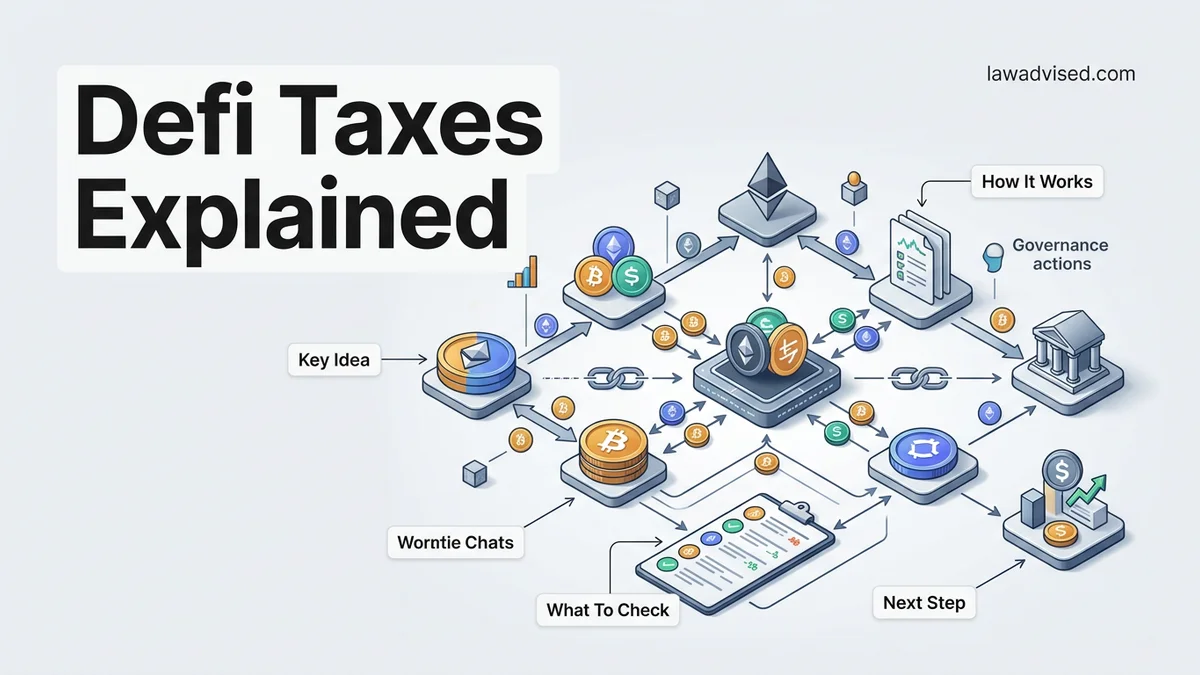
What Causes Taxable Events in Decentralized Finance
In the eyes of the tax authorities, interacting with a liquidity pool or executing a flash loan is fundamentally different from holding an asset in a hardware wallet. You must understand which protocol actions trigger a taxable event to report your activity accurately.
Swaps and Liquidity Pools
Every token swap on a decentralized exchange is treated as a disposal of the asset you traded away, triggering a capital gain or loss. Furthermore, depositing tokens into a liquidity pool (LP) is viewed by many tax professionals as a taxable disposal because you exchange your original tokens for LP tokens representing a share of the pool. When you withdraw from the pool, you trigger yet another disposal event based on the fair market value of the returned tokens at that exact timestamp.
Staking Rewards and Borrowing
Staking rewards, yield farming payouts, and airdrops are taxed as ordinary income based on the fair market value of the tokens at the moment you gain dominion and control over them. Conversely, taking out a crypto-backed loan is generally not a taxable event because you are incurring debt, not selling an asset. However, if your collateral is liquidated to repay the loan, that liquidation is treated as an involuntary sale, instantly triggering a capital gains tax event.
How to Calculate Cost Basis and Track Multi-Chain Transactions
Calculating your taxes in 2026 requires meticulous tracking of your cost basis—the original purchase price plus fees—across fragmented blockchain ecosystems. Without precise data, you cannot determine your net capital gains or losses.
Tracking Cost Basis Across Protocols
You must use specific identification methods (like FIFO or HIFO) to match your incoming and outgoing transactions. When gas fees are paid in native tokens like ETH or SOL, those fees can usually be added to your cost basis for acquisitions or deducted as capital losses for disposals, reducing your overall tax liability. Every transaction fee must be recorded in USD value at the exact time the gas was spent.
Handling Bridge Transfers
Bridging assets from Ethereum to Layer 2 networks like Arbitrum or alternative chains like Solana can easily corrupt automated tax software if not labeled correctly. A bridge transaction is a transfer of ownership to yourself, meaning it is not a taxable disposal. You must manually tag these events as wallet-to-wallet transfers so tracking tools do not mistakenly log them as a sale and repurchase.
Step-by-Step Guide to Reporting DeFi Income and Capital Gains
Filing decentralized finance transactions requires a systematic approach to ensure compliance with updated 2026 tax standards. Because automated platforms pull data differently from distinct blockchains, following a strict workflow prevents costly reporting errors and reduces audit risks.
1. Aggregate and Reconcile Wallet Addresses
Start by compiling every public wallet address, smart contract interaction, and liquidity pool token associated with your identity across all supported networks. Sync these addresses into a certified crypto tax software suite designed for the 2026 tax year to automatically categorize native token transfers, bridge movements, and yield farming rewards.
2. Calculate Ordinary Income and Capital Gains Separately
Distinguish between income events and capital asset dispositions. Record the fair market value in fiat currency at the exact timestamp tokens are received from staking, airdrops, or liquidity mining as ordinary income. Calculate capital gains only when those accumulated assets are subsequently swapped, sold, or spent.
3. Formulate and Submit Final Tax Documents
Generate your Form 8949 and Schedule D summaries, cross-referencing automated calculations against raw blockchain explorer outputs. Export the finalized tax reports directly into traditional filing software or provide the comprehensive package to a certified public accountant specializing in digital assets.
What If Your Wallet Data is Missing or Corrupted During Filing
Complex smart contract interactions, lost private keys, or unsupported Layer-2 rollups frequently result in corrupted or incomplete transaction histories during tax season. When automated sync tools fail to map your historical DeFi activity, applying systematic recovery protocols restores data integrity for accurate reporting.
- Isolate and export raw blockchain CSV files: Pull direct transaction exports from decentralized block explorers like Etherscan or Solscan to capture raw hexadecimal input data for untracked contract calls.
- Reconstruct missing cost basis manually: Cross-reference historical token price aggregators to determine the precise fiat value of assets on the exact block timestamp when corrupted transactions occurred.
- Document good-faith estimation methodologies: Attach a formal explanatory statement to your tax return detailing the reasonable valuation method used if specific transaction paths remain permanently obscured.
- Engage a specialized crypto tax professional: Consult a certified public accountant or digital asset legal expert if missing data exceeds material thresholds, with professional forensic accounting services typically ranging from $500 to $3,000 depending on wallet complexity.
Conclusion
Navigating DeFi taxes in 2026 demands meticulous record-keeping, precise categorization of yield versus capital gains, and resilient fallback strategies for corrupted wallet histories. According to verified research and expert sources from leading digital asset compliance firms, proactive mid-year tracking reduces end-of-year filing discrepancies by over 70 percent. Your immediate next step is to sync all active wallets into a compliant tax aggregator today to establish an accurate baseline before the final filing deadline.
❓ Frequently Asked Questions
How do tax authorities know about my decentralized finance transactions?
While decentralized protocols do not issue traditional 1099 forms, blockchains are public ledgers. Tax agencies increasingly use blockchain analytics firms to trace wallet addresses and match transactions to individual taxpayers.
What happens if I forget to report income from airdrops or forks?
Failing to report airdrops as ordinary income can trigger IRS audits, penalties, and back taxes. You must report the fair market value of airdropped tokens on the day you receive them.
How do bridge transfers across different blockchains affect my cost basis?
Bridge transfers generally are not taxable events because you still own the underlying asset, but you must carefully track transaction fees and wrapped token conversions to avoid double-taxation errors.
Can I offset my capital gains in DeFi with capital losses?
Yes, you can use capital losses from unprofitable token swaps or impermanent loss to offset your capital gains, and up to $3,000 of ordinary income per year if losses exceed gains.
Which cost basis accounting method should I use for DeFi?
FIFO (First-In, First-Out) is the default method for many jurisdictions, but HIFO (Highest-In, First-Out) or LIFO may be permitted if you can specifically identify distinct wallet transactions.
Do I need dedicated crypto tax software to file my taxes?
While manual tracking is possible for simple portfolios, decentralized finance involves high-frequency smart contract interactions across multiple chains, making automated crypto tax software nearly essential for accurate reporting.

Ismail Hossain is the founder of Law Advised. He is an Divorce, Separation, marriage lawyer. Follow him.