Savings Account Interest Taxes 2026 A Step-by-Step Guide
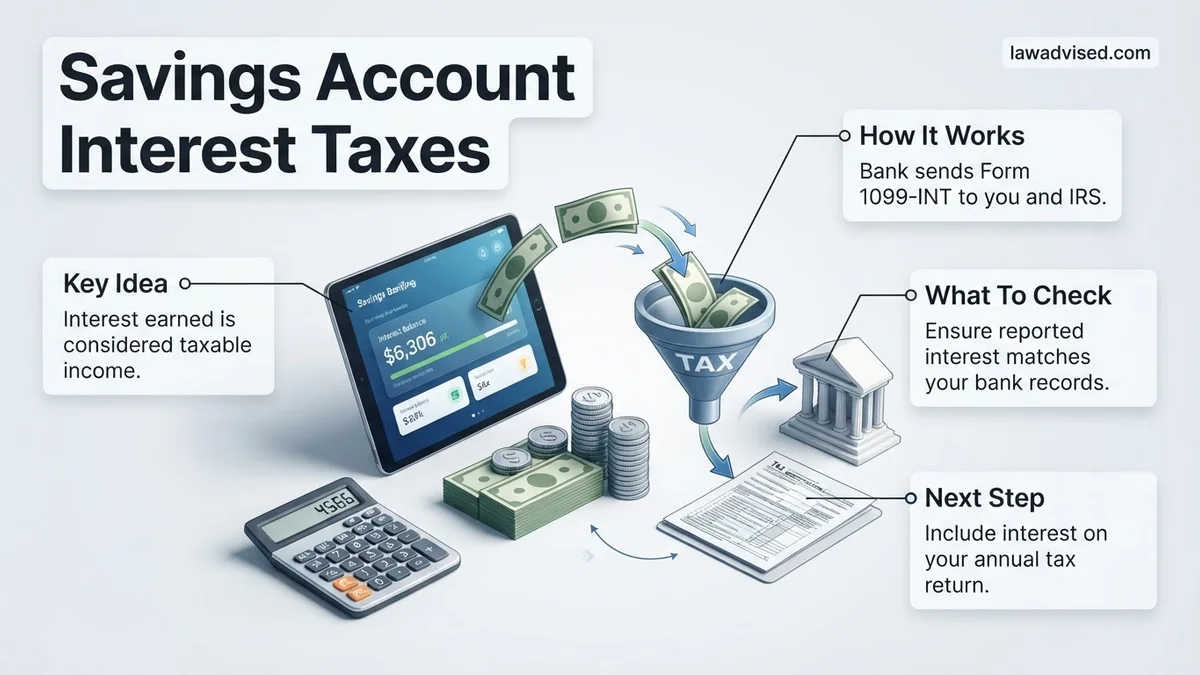
Yes, interest earned in a savings account is considered taxable income by the IRS and must be reported on your federal tax returns. Banks will issue a Form 1099-INT if you earn $10 or more, but you are legally required to report every dollar of interest earned even if you do not receive a form.
Yes, you must pay federal and state income taxes on the interest earned in your savings account. The IRS views every dollar of interest your bank pays you as taxable unearned income, meaning it is subject to the same income tax rates as your regular job earnings.
Knowing your tax obligations for the 2026 tax year helps you avoid unexpected penalties and underpayment fees. Whether you earned ten dollars or ten thousand dollars in your high-yield savings account, the IRS requires full disclosure, and financial institutions report these earnings directly to federal authorities.
Key Takeaways
- Savings account interest is fully taxable as ordinary income.
- You must report all interest, even if it falls below the $10 Form 1099-INT threshold.
- Banks mail Form 1099-INT by January 31 detailing your annual earnings.
- Report your total taxable interest on IRS Form 1040, Schedule B.
- State and local taxes may also apply to your interest earnings.
What Causes Savings Account Interest Taxes and How They Work
The Form 1099-INT Trigger
Banks and credit unions issue a Form 1099-INT at the beginning of the year to report your earnings. If you earned at least $10 in interest during 2026, your bank is legally required to send you and the IRS this form. Even if you do not receive a 1099-INT because you earned less than the $10 threshold, the law still requires you to report every cent of interest on your tax return.
Ordinary Income Tax Brackets
Savings interest does not qualify for preferential capital gains tax rates. Instead, your bank interest stacks on top of your wage income and is taxed according to your ordinary income tax bracket for 2026. If you fall into the 22 percent federal tax bracket, you will surrender 22 percent of your savings interest to the federal government, plus any applicable state and local taxes.
-
Key facts about savings interest taxation:
- Taxed at your marginal ordinary income tax rate
- No minimum threshold exempts you from reporting earnings
- State income taxes may also apply depending on where you live
How to Fix and Report Your Savings Interest on Tax Returns
Locating and Transferring Data to Form 1040
When filing your 2026 federal tax return, you must report all taxable interest on your primary Form 1040. Look at Box 1 of your Form 1099-INT to find your total taxable interest amount. You will transfer this exact figure to line 2b of your Form 1040.
When You Need Schedule B
If your total taxable interest across all financial institutions exceeds $1,500 for the 2026 tax year, you cannot simply drop the total onto Form 1040. You must complete and attach Schedule B (Interest and Ordinary Dividends). Schedule B requires you to list the name of every bank that paid you interest and the exact dollar amount.
-
Step-by-step reporting checklist:
- Gather all Form 1099-INT documents from every bank or credit union you used in 2026.
- Add up your interest earnings to check if you cross the $1,500 threshold.
- Enter individual payer names and amounts on Schedule B if your interest exceeds $1,500.
- Transfer the final sum to Line 2b of your Form 1040 and file.
Step-by-Step Guide to Calculating Tax Liability on Earned Interest
Calculating your 2026 tax liability on savings account interest requires matching your earnings against your current federal income tax bracket. According to Internal Revenue Service (IRS) guidelines, interest income is taxed as ordinary income rather than capital gains. Follow this procedural framework to determine your exact obligation.
1. Aggregate Your Total Interest Income
- Gather all Form 1099-INT documents issued by your banks, credit unions, and digital wallet providers for the 2026 tax year.
- Sum the amounts listed in Box 1 (taxable interest) across every financial institution you utilized.
- Include any interest earned from high-yield savings accounts, traditional savings, and certificates of deposit maturing in 2026.
2. Identify Your Tax Bracket
- Determine your filing status, such as single, married filing jointly, or head of household for 2026.
- Calculate your adjusted gross income (AGI) by subtracting above-the-line deductions from your total gross income.
- Locate your applicable marginal tax rate on the IRS tax bracket schedule for 2026, which ranges from 10 percent up to 37 percent.
3. Compute the Final Tax Owed
- Multiply your total aggregate interest income from Step 1 by your marginal tax rate percentage from Step 2.
- Add this resulting figure to your primary tax calculation before accounting for standard or itemized deductions.
- Verify that the interest is properly reported on Schedule B (Form 1040) if your total taxable interest exceeds $1,500.
What If You Didn’t Receive a Form 1099-INT?
Financial institutions are only legally required to issue a Form 1099-INT if your total earned interest for the year reaches or exceeds $10. Failing to receive this document does not exempt you from your legal obligation to report the income. Every single dollar of earned savings interest must be declared to tax authorities.
Uncovering Missing Interest Statements
- Log into your online banking portal and navigate to the statements or tax documents section to download electronic copies.
- Review your December 2026 year-end account statement, which typically summarizes the cumulative interest earned for the entire 12-month period.
- Contact customer service directly via phone or secure message to request a duplicate 1099-INT if the online portal lacks the document.
What If It Still Doesn’t Work?
If you encounter complex scenarios like mismatched interest amounts, joint accounts with deceased relatives, or missing records that prevent accurate filing, targeted interventions are necessary. According to certified public accountant (CPA) associations, failing to resolve discrepancies before filing can trigger automated IRS notices.
- Calculate the interest manually using monthly bank statements to establish a reliable baseline figure for your tax return.
- File for an automatic six-month tax extension using Form 4868 to secure additional time to resolve documentation errors with your bank.
- Consult a licensed tax professional or CPA if your unreported interest involves complex multi-state accounts or foreign financial assets. Professional tax advisory services typically cost between $200 and $500 depending on the complexity of the return.
- Submit an amended return via Form 1040-X if you discover missing interest income after your initial tax submission has already been processed.
Conclusion
Navigating savings account interest taxes for 2026 requires meticulous aggregation of your 1099-INT forms and accurate ordinary income calculations. Failing to report minor earnings can trigger costly IRS automated underreporter notices and statutory penalties. According to verified research and expert financial sources, proactive record-keeping remains the most effective defense against compliance errors. One actionable next step is to log into your primary high-yield savings account portal today to download and secure your annual tax documentation before filing season reaches its peak.
❓ Frequently Asked Questions
How is savings account interest taxed?
Savings account interest is added to your other ordinary income, such as wages or salary, and taxed at your marginal federal income tax bracket. This means your tax rate depends on your total taxable income and filing status for the year.
What is the threshold for receiving a Form 1099-INT?
Financial institutions are legally required to send you and the IRS a Form 1099-INT if your account earns $10 or more in interest. However, taxpayers must report every dollar of interest earned, even if the total is under $10.
Where do I report savings account interest on my tax return?
You report your total taxable interest on IRS Form 1040 (Line 2b). If your total taxable interest exceeds $1,500 from all sources, you must also complete and attach Schedule B to your return.
Do I have to pay state and local taxes on savings interest?
In most U.S. states, savings account interest is subject to state and local income taxes. Only interest earned from specific government bonds is typically exempt from state taxation.
What happens if I forget to report my savings account interest?
Failing to report interest income can trigger an IRS matching notice if the bank submitted a Form 1099-INT. This can result in recalculation of your taxes, additional interest charges, and potential penalties.
Are high-yield savings accounts taxed differently than traditional ones?
No, the tax treatment is identical. Whether your account pays 0.01% or a much higher high-yield rate, all earned interest is considered ordinary taxable income and must be reported to the IRS.

Ismail Hossain is the founder of Law Advised. He is an Divorce, Separation, marriage lawyer. Follow him.