Bond Interest Tax Explained 2026 Guide to Rules
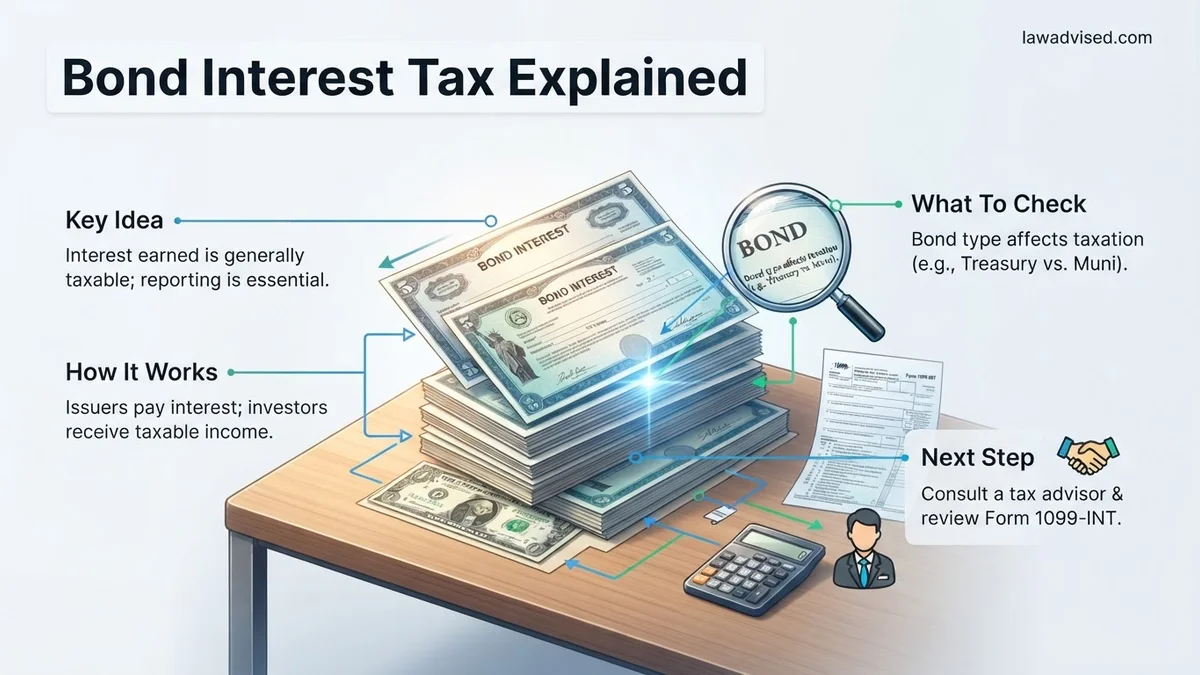
Navigating bond taxation depends entirely on the issuer, with Treasury, municipal, and corporate bonds all facing different tax rules. Understanding these differences helps investors accurately calculate federal, state, and local tax liabilities. Bond interest is generally taxable in the year it is received and reported on Form 1099-INT.
How bond interest is taxed depends entirely on the issuer of the bond. In 2026, federal, state, and local tax authorities treat municipal, Treasury, and corporate bond interest very differently. Treasury bond interest escapes state and local taxes, municipal bond interest is generally free from federal income tax, and corporate bond interest is fully taxable across the board.
Getting your bond tax strategy right protects your portfolio returns. If you hold corporate bonds in taxable accounts, a chunk of your yield goes straight to the government. Choosing the right bond type based on your tax bracket and location can significantly boost your net income.
Key Takeaways
- Corporate bond interest is fully taxable at both the federal and state levels.
- Treasury bond interest is subject to federal income tax but exempt from state and local taxes.
- Municipal bond interest is typically exempt from federal and often state taxes if you reside in the issuing state.
- Taxable municipal bonds exist and require special attention because their interest is subject to federal taxes.
- Original Issue Discount (OID) rules may require you to report phantom interest before you actually receive the cash.
What Causes Tax Liabilities on Bond Interest
Tax liabilities on bond interest are triggered when an issuer makes a scheduled interest payment to you. The tax code evaluates these payments based on where the bond originated. Your personal tax bracket and geographic location also dictate your final tax burden.
Federal Tax Rules by Bond Type
- Treasury Bonds: Interest is subject to federal income tax, but completely exempt from state and local income taxes.
- Municipal Bonds: Interest is generally exempt from federal income taxes. If you buy municipal bonds issued by your home state, the interest is usually exempt from state and local taxes too.
- Corporate Bonds: Interest is fully taxable at the federal, state, and local levels.
The Impact of Tax-Equivalent Yields
Because municipal bond interest is federally tax-free, it often pays a lower nominal rate than a corporate bond. To compare them fairly in 2026, you must calculate the tax-equivalent yield. For example, if you are in the 32 percent federal tax bracket, a tax-free municipal bond paying 4 percent provides the same after-tax return as a corporate bond paying nearly 5.88 percent. Always run these calculations before making investment moves in your taxable brokerage accounts.
How to Calculate and Report Bond Interest Taxes
Tracking your bond interest ensures accurate reporting on your tax return and prevents IRS penalties. Bond interest is generally considered taxable in the specific calendar year you receive it, regardless of whether you withdraw the cash or automatically reinvest it into more bonds.
Understanding Form 1099-INT
- Issuance: Financial institutions send you a Form 1099-INT by early February detailing the interest paid to you during the previous tax year.
- Box 1: This box reports your taxable interest income, which applies to corporate bonds and U.S. Treasuries.
- Box 8: This box reports tax-exempt interest, which typically covers your municipal bond earnings. Even though this income is tax-free, you must still report it on your federal tax return.
Reporting Obligations for 2026 Returns
When filing your 2026 taxes, report your total taxable bond interest on Schedule B of Form 1040 if it exceeds 1,500 dollars. Keep meticulous records of any original issue discount (OID) or bond premiums, as these factors adjust your cost basis and the amount of interest you must report each year.
What If You Hold Taxable Municipal Bonds or OID Instruments
Not all municipal bonds are completely tax-free at the federal level. If a municipality issues bonds for purposes that the federal government does not deem strictly governmental—such as building a stadium or funding private-activity projects—the interest becomes subject to federal income tax. These are known as private activity bonds, and investors often face alternative minimum tax considerations depending on their specific bracket.
Understanding Original Issue Discount (OID) Bonds
Original Issue Discount bonds introduce additional complexity to your 2026 tax filings. When a bond is issued at a price lower than its stated redemption price at maturity, the difference is considered OID. According to Internal Revenue Service regulations, investors must report a portion of this discount as taxable interest income each year, even though no cash payment is received until maturity.
Navigating Market Discount Rules
If you purchase a bond on the secondary market for less than its par value, the discount is treated as market discount. Unlike OID, you generally do not have to report market discount income annually unless you make a formal election to do so. However, when you sell the bond or it matures, that accumulated discount is recharacterized as ordinary income rather than capital gains.
Key Steps for Managing Your Bond Portfolio Tax Burden
Strategic portfolio management can significantly reduce the impact of taxes on your fixed-income returns. Implementing a structured approach ensures compliance while maximizing your after-tax yield for the 2026 tax year.
Actionable Portfolio Strategies
- Evaluate your marginal tax bracket to determine the precise threshold where municipal bonds outperform taxable corporate bonds on an after-tax basis.
- Locate high-yield corporate bonds and taxable debt instruments inside tax-advantaged accounts like traditional or Roth IRAs.
- Track your cost basis meticulously, incorporating amortization adjustments for premium bonds and accretion for OID instruments.
- Review your year-end capital gains and losses to offset any realized bond market discounts or taxable distributions.
What If It Still Doesn’t Work?
If your automated tax software fails to reconcile complex bond interest schedules or OID calculations, manual intervention is required to avoid IRS penalties. Resolving reporting discrepancies for multi-state municipal holdings or complex secondary market trades often exceeds standard DIY capabilities.
- Re-examine your broker-issued Form 1099-OID and 1099-INT against your monthly brokerage statements to isolate transcription errors.
- Consult a certified public accountant or tax attorney specializing in fixed-income securities and municipal debt instruments.
- Prepare for professional consultation fees, which typically range from $300 to $600 per hour for advanced investment tax planning.
- File for a formal extension using Form 4868 if you are waiting on corrected brokerage statements past the initial 2026 filing deadlines.
Conclusion
Navigating bond interest taxation requires careful attention to security types, issuance discounts, and account placement. According to verified research from major financial institutions and tax experts, proactive asset location remains the most effective method for preserving investment returns. As your immediate next step, review your current brokerage statements to identify any taxable municipal holdings or OID bonds that require special reporting on your upcoming tax return.
❓ Frequently Asked Questions
How is corporate bond interest taxed?
Corporate bond interest is fully taxable at the federal, state, and local levels. You must report this income on your federal tax return as ordinary income, regardless of your state of residence.
What is Original Issue Discount (OID) and how is it taxed?
OID occurs when a bond is issued for less than its face value. Even though you may not receive cash interest payments annually, the IRS requires you to report a portion of this discount as taxable interest income each year.
Are zero-coupon bonds tax-exempt if they are municipal bonds?
Municipal zero-coupon bonds are generally exempt from federal income tax on the imputed interest, but you may still face state tax liabilities depending on where you live and the bond’s origin.
What is a taxable municipal bond?
Taxable municipal bonds are issued by local or state governments to fund projects that do not qualify for federal tax exemption, such as sports stadiums or pension deficits, meaning their interest is federally taxable.
Does the Alternative Minimum Tax (AMT) affect municipal bond interest?
Yes, certain private activity municipal bonds generate interest that is treated as a preference item under the Alternative Minimum Tax, potentially triggering federal tax liability for high-income earners.
When do I receive Form 1099-INT for my bond holdings?
Financial institutions and brokerages are generally required to issue Form 1099-INT by January 31st of the year following the tax year in which the interest was earned.

Ismail Hossain is the founder of Law Advised. He is an Divorce, Separation, marriage lawyer. Follow him.