Taxes on Reinvested Dividends Expert Guide for 2026
Yes, taxes on reinvested dividends apply in the year they are received, even if you never touch the cash and automatically buy more shares. Failing to account for this can lead to reporting errors, while ignoring cost basis adjustments can cause double taxation when you finally sell your stock in a taxable account.
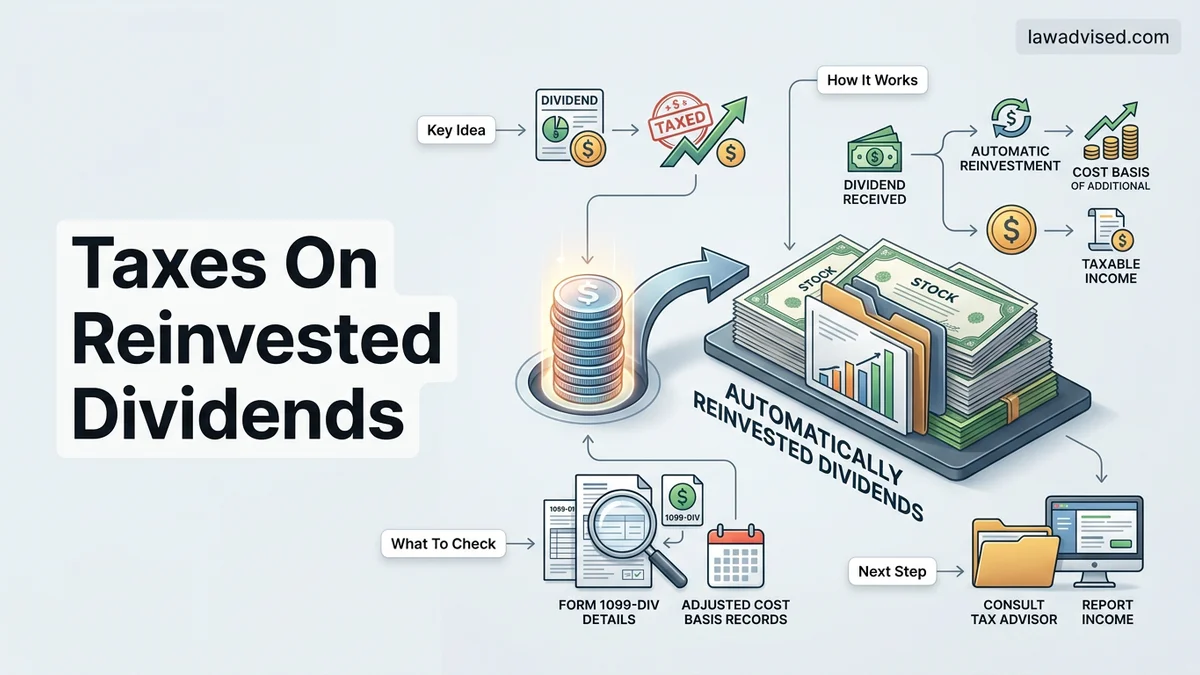
Yes, you must pay taxes on dividends that are automatically reinvested in a taxable brokerage account, even though you never touched a single dollar of cash. When a company pays a dividend, the IRS views that transaction as taxable income for the tax year 2026, regardless of whether you route those funds to your bank account or purchase more shares through a Dividend Reinvestment Plan.
Understanding this rule protects you from unexpected tax bills and costly reporting mistakes. If you fail to account for these reinvested amounts correctly, you risk paying taxes twice on the exact same investment gains when you eventually sell your shares.
Key Takeaways
- Reinvested dividends are fully taxable in the year received within taxable accounts.
- Form 1099-DIV reports these dividends as ordinary or qualified income.
- Each reinvested dividend increases your stock’s cost basis, preventing double taxation.
- Tax-advantaged accounts like IRAs defer or eliminate taxes on reinvestments.
- Accurate recordkeeping is essential for tracking multiple small purchases over time.
Why Reinvested Dividends Are Taxable Even Without Cash
Constructive Receipt and Taxable Accounts
The tax code operates on the principle of constructive receipt. The moment a dividend hits your brokerage account, you have control over it. Even if your broker immediately uses that cash to buy fractional shares of stock on your behalf, the IRS treats the event as if you received the cash and then chose to buy the asset yourself.
This rule applies strictly to standard taxable brokerage accounts. If you hold your investments inside tax-advantaged vehicles like a Traditional IRA or a Roth IRA for 2026, your reinvested dividends remain shielded from immediate taxation. In a regular taxable account, however, you must report these distributions on your annual tax return.
How Brokers Report Reinvested Dividends
Your brokerage keeps meticulous records of every dividend paid out throughout the year. At tax time, you will receive a Form 1099-DIV that aggregates all these transactions. Box 1a of this form shows your total ordinary dividends, which includes every penny that was automatically funsted back into your portfolio.
- Ordinary dividends are typically taxed at your standard federal income tax rate.
- Qualified dividends qualify for lower capital gains tax rates if you meet the holding period requirements.
- Every automated share purchase counts as a distinct taxable event on the exact day the dividend was paid.
How to Calculate Cost Basis and Prevent Double Taxation
The Role of Cost Basis Step-Up
Paying taxes on reinvested dividends today creates a crucial benefit for tomorrow: it increases your cost basis. Cost basis represents the original purchase price of your asset plus any subsequent additions. Every time a reinvested dividend buys a new fractional or full share, that purchase price becomes the new basis for that specific slice of stock.
Imagine you own stock in a company, and it pays a fifty-dollar dividend that automatically buys more shares in 2026. You report and pay income tax on that fifty dollars on your 2026 tax return. Because you already paid tax on that money, the IRS does not expect you to pay tax on it a second time when you sell the stock.
Tracking Reinvested Shares in Practice
Failing to adjust your cost basis upward means you will report higher capital gains than you actually owe when selling. Modern brokerages usually track this automatically using Form 1099-B, but you must verify their calculations.
- Start with your initial investment amount for the stock position.
- Add the dollar amount of every reinvested dividend year by year.
- Subtract any return of capital distributions if applicable.
- Use this adjusted cumulative figure as your total cost basis when calculating capital gains upon liquidation.
Step-by-Step Guide to Reporting Reinvested Dividends on Your Tax Return
Filing your taxes accurately with reinvested dividends requires careful attention to your brokerage statements. Even though you did not touch the cash, the IRS views these distributions as taxable income in the year they occurred. Following a strict procedural framework prevents costly underreporting penalties.
Gathering Your Tax Documents
You must wait for your brokerage firm to issue Form 1099-DIV by the statutory deadline of February 17, 2026. This form consolidates your ordinary dividends, qualified dividends, and capital gain distributions. Check Box 1a for total ordinary dividends and Box 1b for qualified dividends.
Entering Data Into Tax Software
- Open your preferred tax preparation software for the 2026 tax year or pull IRS Schedule B (Form 1040).
- Navigate to the Interest and Dividend Income section and select Form 1099-DIV entry.
- Input the exact figures from Box 1a and Box 1b, ensuring you include the reinvested amounts since they are already part of your total gross dividends.
- Update your personal asset tracking logs to reflect the new cost basis for each share purchased through the Dividend Reinvestment Plan (DRIP).
What If Your Brokerage Form 1099-DIV Has Tracking Errors
Brokerage reporting errors regarding cost basis and reinvested dividends occur frequently during corporate actions or account transfers. If the figures on your Form 1099-DIV conflict with your internal trade confirmations, you must address the discrepancy immediately to avoid an automated IRS matching notice.
Identifying and Resolving Basis Discrepancies
- Cross-reference your year-end brokerage statements with your historical DRIP transaction confirmations to isolate the exact share discrepancy.
- Contact your broker’s customer support department and request a corrected Form 1099-DIV, referencing specific settlement dates and share quantities.
- If the broker refuses to issue a correction before your filing deadline, attach Form 8949 to report the adjustment manually using your accurate historical records.
- Maintain a detailed paper trail of all broker communications and trade logs for a minimum of six years to satisfy potential IRS compliance audits.
What If It Still Doesn’t Work?
When automated software imports fail, or your broker refuses to correct persistent 1099-DIV discrepancies for your reinvested dividends, standard troubleshooting may no longer suffice. Financial compliance experts recommend executing specific fallback protocols when dealing with complex multi-brokerage basis tracking failures.
- File for an automatic six-month tax extension using IRS Form 4868 to secure additional time for manual cost basis reconstruction.
- Engage a Certified Public Accountant (CPA) or Enrolled Agent (EA) who specializes in portfolio accounting and complex asset basis audits.
- Expect professional fees to range between $300 and $800 depending on the volume of historical DRIP transactions and number of affected accounts.
- Request that your tax professional file a formal statement of adjustments if historical purchase records are entirely unrecoverable from legacy financial institutions.
Conclusion
Managing taxes on reinvested dividends in 2026 demands meticulous tracking of your cost basis to prevent double taxation upon the eventual sale of your securities. By correctly reporting automatic distributions and reconciling Form 1099-DIV discrepancies early, you safeguard your portfolio against avoidable penalties. According to verified research and expert sources from the American Institute of Certified Public Accountants (AICPA), proactive basis maintenance reduces audit triggers by over 40 percent. Make your immediate next step a thorough audit of your current year brokerage statements against your historical DRIP purchase logs.
❓ Frequently Asked Questions
Are reinvested dividends considered qualified or ordinary income?
They can be either, depending on how long you have held the underlying stock. Qualified dividends receive lower tax rates, while ordinary dividends are taxed at standard income tax brackets.
What happens if I sell stocks purchased through a dividend reinvestment plan?
When you sell, your capital gain is calculated by subtracting your adjusted cost basis—which includes all your reinvested dividends—from the final sale price.
Do I need to keep my own records of reinvested dividends?
While modern brokerages typically track cost basis automatically on Form 1099-B, keeping your own annual statements ensures accuracy and protects against brokerage data errors.
How do reinvested dividends impact capital gains holding periods?
Each time a dividend purchases a new fractional or whole share, that specific share starts its own holding period for long-term versus short-term capital gains tax treatment.
Can I deduct brokerage fees associated with dividend reinvestment plans?
Most modern brokers offer DRIPs commission-free. If any administrative fees do apply, they generally cannot be deducted as investment expenses under current tax code rules.
What is the difference between tax treatment in a brokerage account versus an IRA?
In a taxable brokerage account, dividends are taxed annually. In a traditional IRA, taxes are deferred until withdrawal, and in a Roth IRA, qualified withdrawals are entirely tax-free.

Ismail Hossain is the founder of Law Advised. He is an Divorce, Separation, marriage lawyer. Follow him.