Roth IRA Withdrawals Tax Rules Expert Guide for 2026
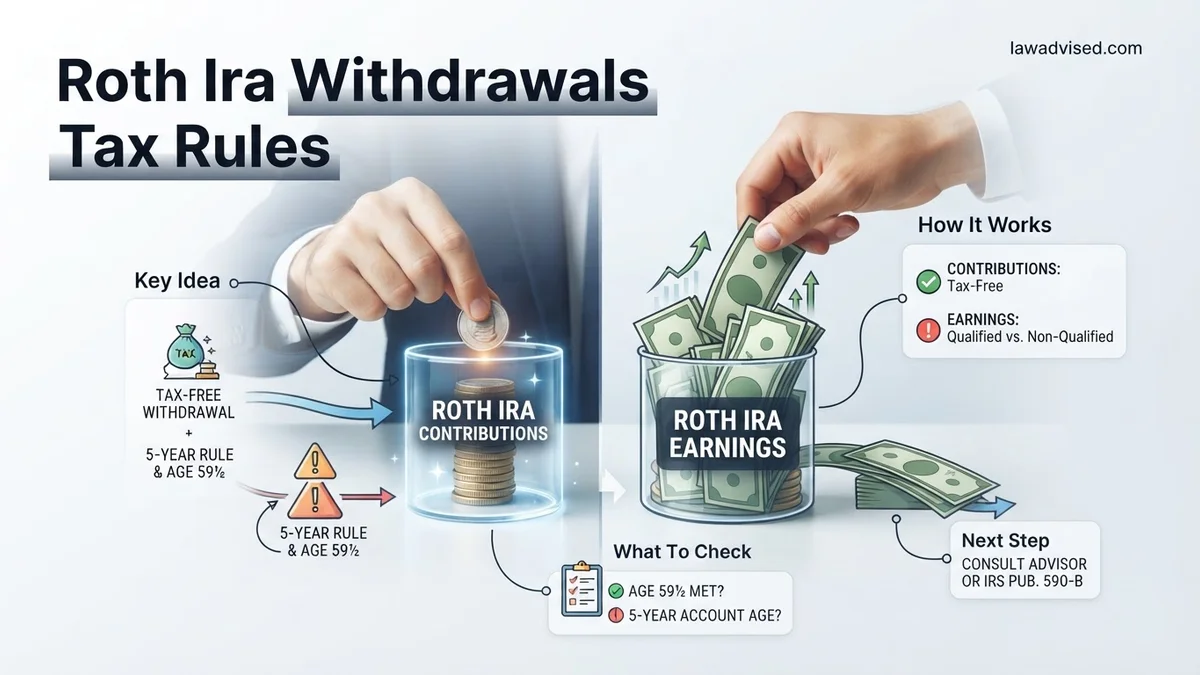
Navigating roth ira withdrawals tax rules can be confusing without understanding the strict divide between your original contributions and accumulated earnings. Contributions can always be withdrawn tax-free and penalty-free at any time, while earnings face strict taxes and a 10% penalty unless specific age and holding period conditions are met.
When you take money out of a Roth IRA in 2026, the tax and penalty rules depend entirely on whether you are withdrawing your original contributions or your investment earnings. You can pull out your baseline contributions at any time, for any reason, completely tax-free and penalty-free. The IRS views this money as cash you already paid income taxes on, so you never pay tax on it twice.
The rules change dramatically when you tap into your earnings. If you withdraw investment growth without meeting specific age and holding period requirements, you will face ordinary income taxes and a steep 10 percent early withdrawal penalty. Navigating these exact boundaries prevents you from accidentally triggering massive IRS bills during your retirement planning.
Key Takeaways
- Contributions can be withdrawn at any time completely tax-free and penalty-free.
- Earnings are subject to ordinary income tax and a 10% penalty before age 59½.
- The 5-year holding period rule is mandatory for withdrawing earnings tax-free.
- Qualified exceptions allow penalty-free early withdrawals of earnings for specific life events.
- Always track your cost basis to prove your withdrawal amounts to the IRS.
What Causes Roth IRA Withdrawal Penalties and Tax Liability
Withdrawing Earnings Too Early Triggers Taxes and Penalties
If you take out your investment earnings before age 59½, you generally owe ordinary income tax plus a 10 percent early distribution penalty. The IRS enforces a strict ordering rule for withdrawals. Your money always comes out in this exact sequence:
- First, your regular annual contributions come out tax-free and penalty-free.
- Second, your taxable conversions come out on a FIFO (First-In, First-Out) basis.
- Third, your tax-free conversions come out next.
- Finally, your investment earnings come out last, which are subject to taxes and penalties if unqualified.
Failing the Critical Five-Year Holding Period Rule
Reaching age 59½ is not enough on its own to unlock tax-free earnings. You must also satisfy the 5-year holding period rule. The clock starts ticking on January 1 of the tax year for which you made your very first Roth IRA contribution. If you pull earnings before that five-year window closes, you will owe taxes on those gains even if you are over age 59½. Each Roth conversion you execute also starts its own separate five-year clock for penalty-free withdrawal of converted amounts.
How to Fix and Navigate Roth IRA Withdrawals Step-by-Step
Step 1: Calculate Your Total Basis Versus Accumulated Earnings
Before you request any distribution from your account custodian in 2026, look at your historical statements to separate your total contributions from your current account balance. If your total contributions equal 50,000 dollars and your account balance is 75,000 dollars, you have 25,000 dollars in earnings. If you only withdraw 20,000 dollars, you are strictly pulling contributions, which means zero taxes and zero paperwork complications at tax time.
Step 2: Leverage IRS Exceptions to Avoid the 10 Percent Penalty
If you must tap into your earnings before age 59½, check if you qualify for penalty-free IRS exceptions. While you may still owe ordinary income tax if you fail the five-year rule, the 10 percent penalty is waived for specific life events:
- First-time home purchase, subject to a lifetime maximum of 10,000 dollars.
- Qualified higher education expenses for you, your spouse, children, or grandchildren.
- Unreimbursed medical expenses that exceed 7.5 percent of your adjusted gross income.
- Birth or adoption expenses, up to 5,000 dollars per parent.
- Total and permanent disability, or distributions taken as substantially equal periodic payments.
What If Your Early Withdrawal Doesn’t Meet Penalty Exceptions
Failing to qualify for standard IRS penalty exceptions means facing strict financial consequences on your Roth IRA withdrawals tax rules compliance. Accessing earnings prematurely without a valid exemption triggers standard income tax plus an additional 10% early distribution penalty. Financial experts warn that bypassing these rules severely damages long-term retirement compounding.
Assessing the Financial Impact
Unqualified distributions from earnings require immediate reporting on IRS Form 5329. The 10% penalty applies specifically to the earnings portion, while contributions remain entirely untaxed. Taxpayers must calculate their aggregate cost before pulling funds from the account.
Calculating Tax Liabilities
Non-qualified withdrawals mix contributions and earnings proportionally if the entire balance is not depleted. Tax software or a certified public accountant can accurately separate these amounts to prevent overpayment. Ignoring these calculations invites IRS audit triggers and unexpected deficiency notices.
What If It Still Doesn’t Work?
When standard withdrawal strategies fail or tax compliance becomes too complex, taxpayers must implement alternative liquidity solutions. According to verified research and expert sources, unexpected financial shortfalls require structured troubleshooting steps to minimize penalties.
- Explore a 60-Day Rollover: Borrowing funds from a taxable source and replacing the Roth IRA distribution within 60 days legally prevents taxes and penalties.
- Utilize a Taxable Brokerage Account: Liquidate assets in non-retirement accounts first to avoid touching protected retirement principal and earnings.
- Consult a Certified Public Accountant: Engage a licensed tax professional or certified financial planner to review complex distribution scenarios before filing. Professional advisory fees typically range from $250 to $600 depending on return complexity.
- Apply for an IRS Penalty Waiver: Submit Form 5329 with a formal hardship letter if unforeseen disasters or severe medical conditions prevented compliance, though approvals are granted strictly on a case-by-case basis.
Conclusion
Navigating Roth IRA withdrawals tax rules requires absolute precision regarding contributions, earnings, and the five-year holding period. Mismanaging these distributions exposes savers to steep income taxes and preventable 10% early withdrawal penalties. According to verified research and expert sources, proactive tax planning preserves long-term retirement wealth far more effectively than reactive damage control. One actionable next step is to pull your historic account statements today to verify your exact aggregate contribution basis before initiating any distribution.
❓ Frequently Asked Questions
How does the IRS determine which money comes out first during a Roth IRA withdrawal?
The IRS operates on a strict ordering rule. Regular contributions always come out first tax- and penalty-free, followed by conversion/rollover contributions, and finally, earnings come out last.
What qualifies as a tax-free and penalty-free distribution of earnings?
To withdraw earnings completely tax-free and penalty-free, you must satisfy the 5-year holding period and meet a triggering event such as turning age 59½, permanent disability, or death.
How do first-time homebuyer exceptions work for Roth IRA withdrawals?
You can withdraw up to $10,000 of earnings penalty-free over your lifetime for the acquisition, construction, or reconstruction of a first home, provided you meet the 5-year rule.
Do I have to report tax-free contribution withdrawals on my annual tax return?
Yes, you must file IRS Form 8606 with your tax return to report any distributions from a Roth IRA, even if the withdrawal consists entirely of non-taxable contributions.
What constitutes the start of the 5-year holding period clock?
The 5-year clock officially starts on January 1 of the tax year for which you made your very first contribution to any Roth IRA, regardless of when you actually deposited the funds.
Can I put withdrawn Roth IRA contributions back into the account?
Yes, you can redeposit withdrawn funds back into a Roth IRA within the standard 60-day rollover window without tax consequences, subject to the once-per-year rollover limit.

Ismail Hossain is the founder of Law Advised. He is an Divorce, Separation, marriage lawyer. Follow him.