Required Minimum Distributions Explained Step-by-Step 2026
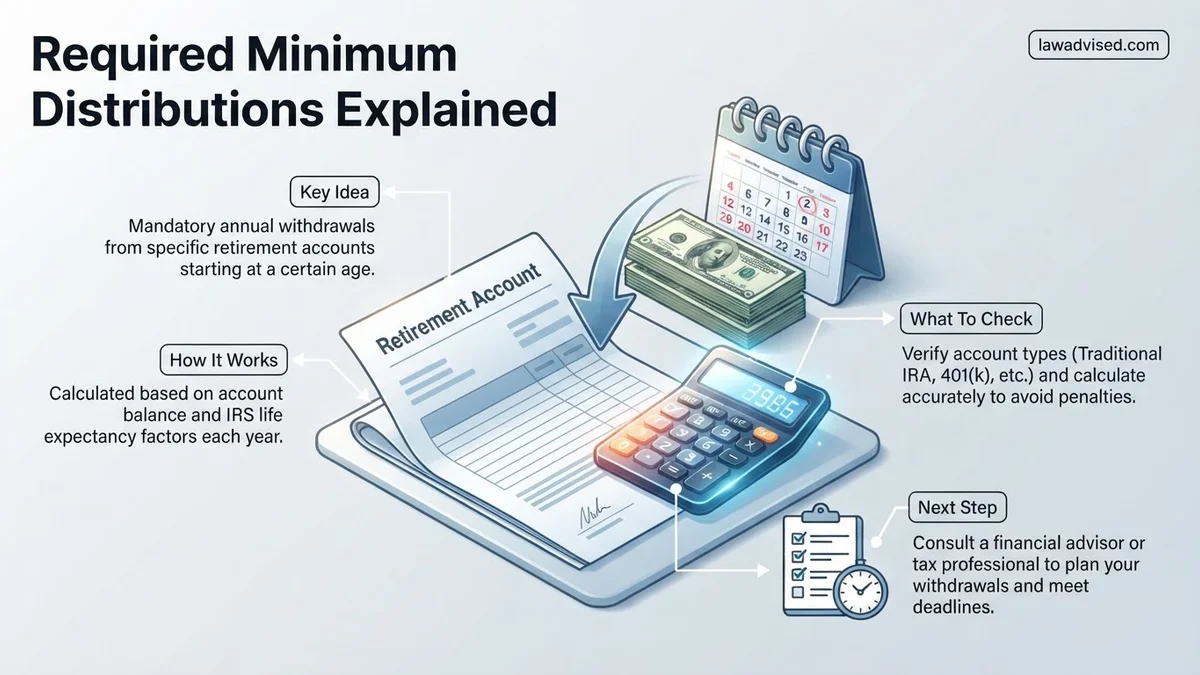
Required minimum distributions (RMDs) are mandatory annual withdrawals you must take from traditional retirement accounts once you reach a specific age. Failing to withdraw the correct amount by the deadline triggers severe IRS tax penalties of up to 25% on the undistributed funds.
Required Minimum Distributions (RMDs) are the minimum amounts you must withdraw from your retirement accounts each year by law. If you fail to take these withdrawals on time, the IRS levies a steep penalty tax of up to 25 percent on the amount you failed to withdraw. Understanding these rules ensures you keep your hard-earned savings rather than surrendering them to unnecessary penalties.
As you navigate retirement planning in 2026, keeping track of your specific age milestones and account types is critical. The government allowed you to defer taxes while your money grew, but RMD rules force that deferred income to finally trigger tax liability so the IRS can collect its share.
Key Takeaways
- RMDs apply to traditional IRAs, 401(k)s, and other pre-tax retirement accounts.
- The starting age for RMDs is 73 under current SECURE 2.0 guidelines.
- Calculate your RMD by dividing your prior year-end balance by your IRS life expectancy factor.
- Your first RMD can be delayed until April 1 of the year following the year you turn 73.
- Missing an RMD deadline results in a hefty IRS excise tax penalty.
What Causes RMD Requirements and Which Accounts Are Affected
Tax-advantaged retirement accounts allow your investments to grow tax-deferred over decades. However, the IRS does not allow you to keep those funds sheltered forever. RMDs exist to ensure the government eventually collects income tax on those pre-tax contributions and their investment gains.
Which Retirement Accounts Require RMDs
Not every retirement account is subject to these mandatory withdrawal rules. You need to know which of your specific accounts fall under the mandate to avoid accidental penalties.
- Traditional IRAs: Subject to RMD rules once you reach the required age.
- SEP and SIMPLE IRAs: Treated similarly to traditional IRAs for mandatory distributions.
- Traditional 401(k), 403(b), and 457(b) plans: Employer-sponsored pre-tax accounts require withdrawals.
- Roth IRAs: Original owners do not have RMDs during their lifetime, making them a powerful tool for tax-free estate planning. Note that inherited Roth IRAs operate under entirely different rules.
The Exact Age and Timeline Rules for 2026
Thanks to legislative changes from SECURE 2.0, the starting age for RMDs depends heavily on your birth year. In 2026, ensuring you look at the correct tier prevents costly errors.
- Born 1951 through 1959: Your RMD age is 73.
- Born 1960 or later: Your RMD age is 75.
- First-Year Deadline Exception: For your very first RMD year, you can delay the actual withdrawal until April 1 of the year following the year you turn the trigger age. However, doing this means you will take two RMDs in a single calendar year, which can spike your taxable income.
How to Calculate and Withdraw Your Required Minimum Distribution Step-by-Step
Calculating your annual RMD requires two simple data points: your account balance at the end of the previous year and a designated IRS life expectancy factor. Getting this math right protects you from severe tax penalties.
Finding the Right IRS Factor
The IRS provides specific tables to help you determine your distribution period based on your age each year. For most individual account owners, the Uniform Lifetime Table is the standard reference point you must use.
- Locate your current age in the IRS Uniform Lifetime Table for the 2026 tax year.
- Find the corresponding distribution period, which is expressed as a number of years.
- As you grow older, this life expectancy factor decreases, meaning the percentage you must withdraw increases annually.
A Concrete Numerical Calculation Example
Let us walk through a practical example to see how the numbers function in real life. Imagine you are 75 years old and calculating your RMD for 2026.
- Step 1: Determine your traditional IRA balance as of December 31, 2025. Assume your balance closed the prior year at $500,000.
- Step 2: Look up age 75 on the IRS Uniform Lifetime Table. The distribution period factor for a 75-year-old is 24.6.
- Step 3: Divide your account balance by the factor ($500,000 divided by 24.6).
- Step 4: Your required withdrawal amount for the year is $20,325.20. You must withdraw at least this total by December 31, 2026.
How to Fix a Missed RMD Deadline and Avoid IRS Penalties
Missing your RMD deadline triggers steep IRS penalties under current tax codes. Fortunately, proactive correction reduces or eliminates these financial consequences. According to IRS guidelines, the penalty for failing to take a full RMD is 25 percent of the shortfall amount, which drops to 10 percent if corrected within a two-year window.
Steps to Correct a Missed Distribution
- Calculate the exact RMD shortfall amount remaining in your applicable retirement accounts for the 2026 tax year.
- Contact your financial custodian immediately to withdraw the remaining balance as a corrective distribution.
- File IRS Form 5329 with your federal tax return to report the missed distribution and request a penalty waiver.
- Attach a letter of explanation detailing the reasonable error that caused the delay, such as severe illness or institutional processing failure.
Financial experts emphasize that documenting your remediation efforts quickly supports your request for penalty relief from the IRS.
What If Your RMD Taxes Are Too High and You Need Advanced Strategies
Taking large RMDs can inadvertently push you into a higher federal income bracket and increase your Medicare Part B and D premium surcharges. Advanced tax planning strategies help mitigate this heavy burden. Financial advisors frequently recommend proactive planning well before your required beginning age to smooth out lifetime tax liability.
Effective Tax Mitigation Techniques
- Execute strategic Roth IRA conversions during lower-income years prior to your RMD start age to permanently reduce future pre-tax balances.
- Utilize Qualified Charitable Distributions (QCDs) once you reach age 70½ to transfer up to $105,000 directly from your IRA to a qualified charity tax-free.
- Bundle your deductions or utilize capital losses in taxable brokerage accounts to offset the taxable income generated by your annual RMDs.
Implementing these advanced tactics requires careful coordination with a certified public accountant or fee-only fiduciary planner to ensure full compliance with current tax regulations.
What If It Still Doesn’t Work?
If self-correction steps fail or your custodian rejects your paperwork, administrative roadblocks require specialized intervention. Take these targeted fallback actions to resolve persistent RMD complications:
- Contact your custodian’s compliance department directly to escalate unresolved processing errors or delayed transfers.
- Engage a certified public accountant (CPA) or a certified financial planner (CFP) to draft formal IRS correspondence. Professional advisory fees typically range from $200 to $500 per hour depending on complexity.
- Submit a formal private letter ruling request to the IRS if institutional disputes threaten substantial asset penalties.
- File an appeal through the IRS Office of Appeals if an initial penalty waiver request is erroneously denied.
Conclusion
Mastering required minimum distributions ensures you avoid harsh penalties while optimizing your retirement cash flow. By calculating exact withdrawal amounts, timing distributions strategically, and utilizing tools like QCDs, you protect your wealth from excessive taxation. According to verified research and expert sources, proactive multi-year tax planning remains the most effective defense against RMD-related tax spikes. Take your next actionable step today by requesting a comprehensive RMD projection report from your financial institution.
❓ Frequently Asked Questions
How do I calculate my exact annual required minimum distribution?
You calculate your RMD by taking the total balance of your applicable retirement accounts as of December 31 of the previous year and dividing it by the distribution period listed in the IRS Uniform Lifetime Table corresponding to your age.
Can I combine my RMDs across multiple accounts?
You can aggregate your RMD amounts for multiple traditional IRAs and withdraw the total from just one or several of those IRAs. However, employer-sponsored plans like 401(k)s generally require you to calculate and take a separate RMD from each specific plan.
What happens if I don’t need the money from my RMD for living expenses?
If you do not need the income, you can reinvest the withdrawal in a taxable brokerage account, use it to pay taxes, or make a Qualified Charitable Distribution (QCD) directly from your IRA to an eligible charity to satisfy your RMD tax-free.
Does the SECURE 2.0 Act change RMD starting ages further?
Yes, under the SECURE 2.0 legislation, the starting age for RMDs increased to 73 in 2023 and is scheduled to rise to age 75 starting in the year 2033.
How is my first RMD deadline different from subsequent years?
For your very first RMD year (the year you turn 73), you have the option to delay taking that specific withdrawal until April 1 of the following calendar year. All subsequent RMDs must still be taken by December 31 of their respective calendar years.
Are inherited IRAs subject to different RMD rules?
Yes, beneficiaries who inherit traditional or Roth IRAs are subject to distinct RMD rules, often requiring the entire account balance to be depleted within a 10-year window depending on the original account owner’s passing date and relationship to the beneficiary.

Ismail Hossain is the founder of Law Advised. He is an Divorce, Separation, marriage lawyer. Follow him.