Rental Property Improvements Tax Treatment Guide for 2026
Navigating rental property improvements tax treatment requires distinguishing between minor repairs that are immediately deductible and major capital improvements that must be depreciated over time. Misclassifying these expenses can trigger IRS penalties or lead to missed tax savings. Proper categorization using IRS Tangible Property Regulations protects your cash flow and ensures tax compliance.
When you make changes to a rental property, tax rules force you to choose between two paths: deducting the cost immediately as a current expense or capitalizing the cost to depreciate it over several decades. Getting this choice wrong triggers IRS penalties, back taxes, and painful audit adjustments.
For the 2026 tax year, understanding the legal dividing line between repairs and improvements protects your cash flow. Repairs keep your property in normal, efficient operating condition and are fully deductible in the year you pay for them. Improvements add permanent value, prolong the property’s life, or adapt it to a new use, requiring you to spread the tax deduction over a 27.5-year residential recovery period.
Key Takeaways
- Repairs maintain property condition and are fully deductible in the current tax year.
- Improvements add value, prolong useful life, or adapt property to new uses and must be capitalized.
- The De Minimis Safe Harbor allows immediate deduction of items costing up to $2,500.
- Residential rental improvements are generally depreciated over 27.5 years using MACRS.
- Depreciation recapture taxes apply to accumulated depreciation when you sell the rental property.
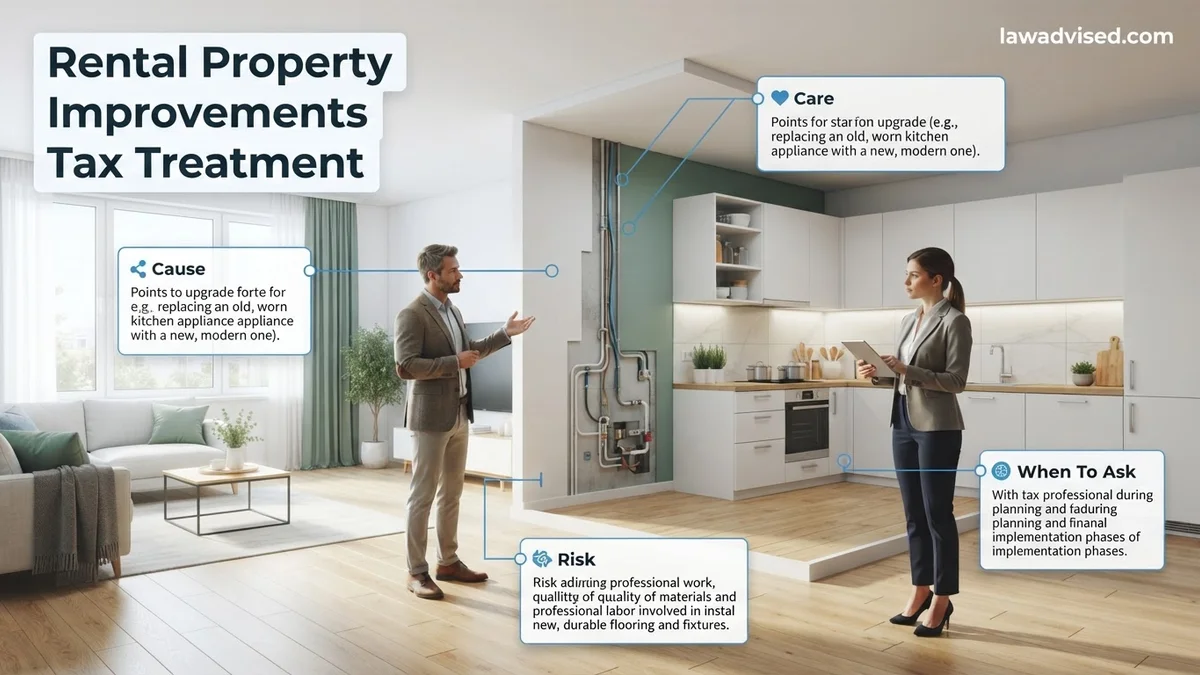
What Causes Confusion in Rental Property Improvements Tax Treatment
The Battle Between Repairs and Capital Improvements
The IRS Tangible Property Regulations create a constant battleground for landlords trying to classify property expenditures. A repair is routine maintenance that fixes minor damage or wear and tear. An improvement falls under the BAR criteria: it is a Betterment, an Adaptation, or a Restoration of the asset.
- Betterment: Materially increases the quality, strength, or capacity of your rental property.
- Adaptation: Transforms the property to a completely different or new use.
- Restoration: Replaces a major structural component or rebuilds the property to a like-new condition.
Real-World Examples of the Tax Divide
Landlords often stumble when comparing similar-sounding projects with vastly different tax treatments. For instance, patching a leaking section of your rental roof is a currently deductible repair because it keeps the roof functioning normally. However, stripping off the old shingles and installing a brand-new roof is a capital improvement. The new roof extends the structural life of the building, meaning you must capitalize the cost and depreciate it on your 2026 tax return.
Similarly, painting a bedroom between tenants is fully deductible maintenance. Gutting that same bedroom and expanding its footprint into a master suite is a capital improvement. Knowing this distinction stops you from accidentally claiming improper deductions that raise your audit risk.
How to Fix Expense Misclassification Using IRS Safe Harbors
The De Minimis Safe Harbor Rule
You can bypass complex capitalization rules entirely by using IRS administrative safe harbors. The De Minimis Safe Harbor lets landlords immediately deduct low-cost property improvements and supplies in the current tax year. For 2026, if you have an applicable financial statement, your threshold is generally 5,000 dollars per invoice or item. Without an applicable financial statement, you can safely expense items up to 2,500 dollars per invoice or item.
- Applies to small tools, appliances, and minor property upgrades.
- Must be elected annually on your federal income tax return.
- Eliminates the need to track depreciation for inexpensive property additions.
The Routine Maintenance Safe Harbor
The Routine Maintenance Safe Harbor provides another clean escape hatch for landlords. Under this rule, you can deduct expenses for recurring activities that you reasonably expect to perform more than once over a ten-year period to keep your rental property in efficient operating condition. If you repaint the exterior every five years or service the HVAC system twice a year, these recurring upkeep costs qualify for an immediate deduction under this safe harbor, shielding you from rigid capitalization requirements.
Step-by-Step Guide to Calculating MACRS Depreciation for Capital Improvements
Calculating the depreciation for a rental property capital improvement requires following the Modified Accelerated Cost Recovery System (MACRS) guidelines. Because tax laws evolve, applying the correct recovery period and convention is essential for accurate 2026 filings.
Step 1: Determine the Asset Classification and Recovery Period
Residential rental property structural improvements generally fall under a 27.5-year recovery period using the straight-line method. However, appliances, carpeting, and furniture classified as personal property within the rental unit typically follow a 5-year MACRS recovery period.
Step 2: Apply the Correct Depreciation Convention
The IRS mandates specific conventions depending on when you place the improvement in service during the tax year. For residential real estate, the mid-month convention applies automatically, meaning the asset is treated as placed in service in the middle of the month regardless of the exact purchase date.
Step 3: Calculate the Annual Depreciation Deduction
- Establish the total basis of the improvement, including purchase price, delivery fees, and installation labor.
- Consult IRS Publication 527 or Form 4562 instructions to find the appropriate MACRS percentage table for a 27.5-year residential asset.
- Multiply the depreciable basis by the applicable table percentage for the current 2026 tax year.
- Record the resulting figure on Schedule E of your federal tax return.
What If It Still Doesn’t Work and You Need to Handle Depreciation Recapture
If standard depreciation calculations fail or you face complications during a property sale, navigating depreciation recapture rules becomes mandatory. When you sell a rental property for more than its adjusted basis, the IRS requires you to pay taxes on the previously claimed depreciation deductions.
If standard tracking methods or software configurations fall short, consider the following fallback steps to ensure compliance for 2026:
- Review past tax returns to audit all previously claimed depreciation amounts and verify that no past deductions were missed or miscalculated.
- Separate the gain on the sale into unrecaptured Section 1250 gain (taxed at a maximum rate of 25 percent) and capital gains.
- Consult a certified public accountant (CPA) or a real estate tax specialist to recompute adjusted basis and recapture liabilities accurately. Professional tax advisory fees typically range from $300 to $1,000 depending on portfolio complexity.
- Explore a Section 1031 exchange as a strategic fallback to defer both capital gains and depreciation recapture taxes by reinvesting proceeds into a like-kind replacement property.
Conclusion
Navigating the tax treatment of rental property improvements in 2026 requires strict adherence to IRS rules separating deductible repairs from capitalized assets. Proper classification maximizes annual deductions and ensures accurate depreciation tracking under MACRS guidelines. According to verified research and expert sources from leading real estate tax authorities, maintaining meticulous records throughout the improvement lifecycle protects landlords from costly audit adjustments. Take your next actionable step today by organizing your current year receipts and consulting a qualified tax professional to evaluate your asset recovery strategy.
❓ Frequently Asked Questions
How do IRS Tangible Property Regulations impact rental property improvements tax treatment?
The IRS Tangible Property Regulations provide clear standards—often called the BAR rules (Betterment, Adaptation, or Restoration)—to help landlords determine whether an expense is a currently deductible repair or a capitalized improvement.
Are painting and routine cleaning considered capital improvements?
No, standard painting, cleaning, and minor patching are classified as routine maintenance and repairs, allowing landlords to fully deduct these expenses in the year they are paid.
What is the Safe Harbor for Small Taxpayers?
The Safe Harbor for Small Taxpayers allows building owners with unadjusted basis under $1 million to deduct annual repairs, maintenance, and improvements up to the lesser of $10,000 or 2% of the unadjusted basis.
Can I use bonus depreciation on rental property improvements?
Bonus depreciation generally applies to qualified improvement property (QIP) with a recovery period of 15 years or less, but standard 27.5-year residential structural improvements do not qualify for bonus depreciation.
What tax form is used to report rental property depreciation?
Landlords report rental income, expenses, and depreciation using IRS Form 8825, and calculate specific asset depreciation schedules on Form 4562.
How does casualty loss affect rental property improvement tax treatment?
If an improvement is damaged or destroyed by a federally declared disaster or casualty event, you must remove the remaining basis of the old asset from your depreciation schedule and capitalize the restoration costs.

Ismail Hossain is the founder of Law Advised. He is an Divorce, Separation, marriage lawyer. Follow him.