Passive Activity Loss Rules Explained 2026 A Clear Guide
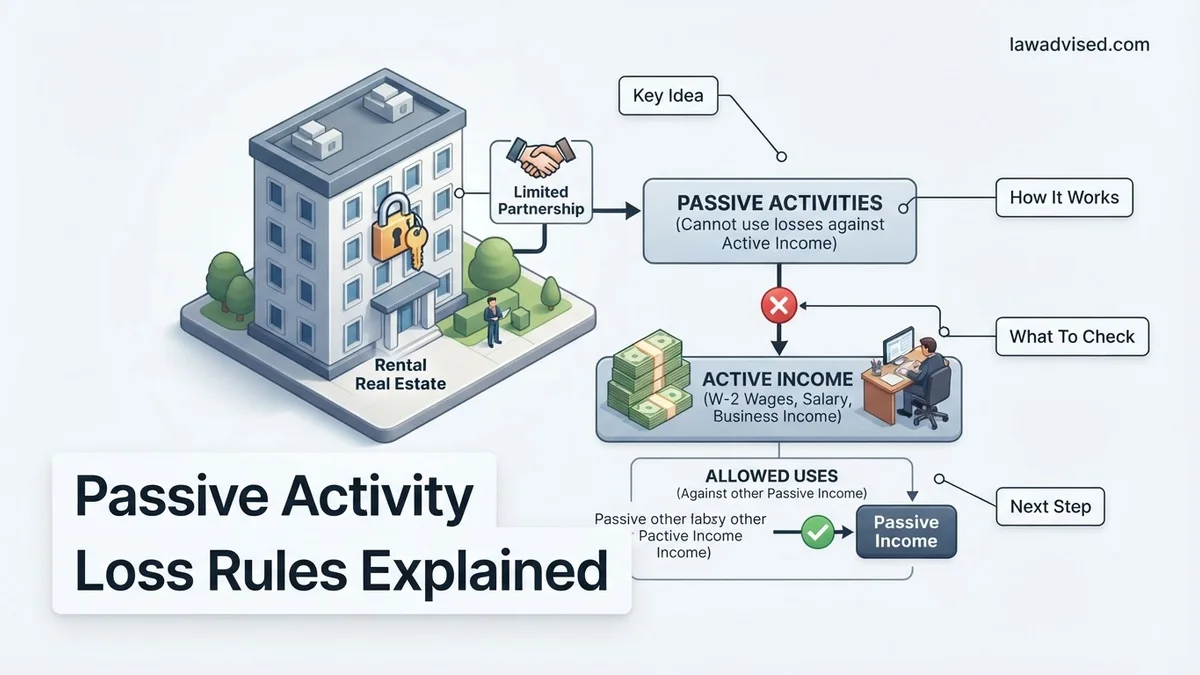
IRS passive activity loss rules restrict your ability to deduct business or rental losses against active income like W-2 wages. Instead, these losses are typically suspended and can only offset passive gains until the property or business is sold.
The IRS passive activity loss rules dictate that you cannot use losses from rental real estate or businesses where you do not materially participate to offset your active wages or portfolio income (like stocks and interest). Instead, these losses are trapped on your tax return as suspended losses, pushed forward year after year until you generate matching passive income or completely dispose of the property.
Navigating these tax hurdles in 2026 requires understanding how the IRS categorizes your income streams. By mastering material participation tests and rental exemptions, you can unlock thousands of dollars in deductions and directly lower your tax liability.
Key Takeaways
- Passive losses generally cannot offset W-2 wages, salaries, or portfolio income.
- Unused losses are suspended and carried forward indefinitely to future tax years.
- Rental real estate is automatically considered passive unless you qualify for specific exceptions.
- Material participation tests allow active business owners to deduct losses against ordinary income.
- Selling your entire interest in a passive activity unlocks all suspended losses.
What Causes Passive Activity Losses to Get Trapped on Your Tax Return
The Three IRS Income Buckets
The tax code divides your annual earnings into three distinct buckets. You must keep them strictly separated:
- Active Income: Wages, salaries, tips, and commissions from a job where you perform personal services.
- Portfolio Income: Interest, dividends, capital gains from selling stocks, and annuities.
- Passive Income: Earnings from any rental activity or any trade or business in which you do not materially participate.
How Suspended Losses Accumulate
When your passive deductions exceed your passive revenues, you trigger a passive activity loss. Under standard IRS rules, you cannot apply these excess losses against your W-2 salary or stock dividends. For example, if your 2026 rental property generates a $10,000 net loss after depreciation and repairs, but you have no other passive income, that $10,000 does not reduce your active taxable income. It becomes a suspended loss, tracked on Form 8582, waiting for a future tax year when your passive activities turn a profit or you sell the asset.
How to Apply Material Participation Tests to Deduct Your Business Losses
The 7 Material Participation Tests
If you own an interest in a business, you can turn a passive loss into an active, deductible loss by proving you materially participate. The IRS uses seven official tests for the 2026 tax year. You only need to meet one of them:
- The 500-Hour Rule: You participate in the activity for more than 500 hours during the year.
- Substantially All Participation: Your participation constitutes substantially all of the participation in the activity by any individual for the year.
- The 100-Hour Rule: You participate for more than 100 hours, and you participate at least as much as any other individual.
- Significant Participation Activity: The activity is a non-rental business where you spend more than 100 hours, and your aggregate time across all such businesses exceeds 500 hours.
Why Documenting Hours Matters
Proving material participation is an audit hot spot. If you claim active status for a side business that generated a $15,000 loss, the IRS will demand a contemporaneous log. Relying on rough estimates or calendar look-backs won’t survive an audit. Keep a digital log of your operational hours, client meetings, and administrative tasks to secure your active deductions.
Step-by-Step Guide to Utilizing the $25,000 Rental Real Estate Exception
Taxpayers actively participating in residential rental real estate can deduct up to $25,000 of passive losses against non-passive income, such as W-2 wages. According to IRS guidelines, this special allowance phases out when Modified Adjusted Gross Income (MAGI) climbs between $100,000 and $150,000.
Assessing Your Active Participation Status
- Verify that you or your spouse own at least 10% of the value of the property.
- Make management decisions in a genuine capacity, such as approving new tenants, deciding on rental terms, and arranging repairs.
- Ensure you do not rely solely on an independent property manager for all major operational choices.
Calculating Your Modified Adjusted Gross Income Phase-Out
- Calculate your total MAGI before factoring in the passive rental losses for the 2026 tax year.
- Subtract $100,000 from your MAGI total if your income falls within the phase-out threshold.
- Multiply that difference by 50 percent to determine the exact reduction in your allowable $25,000 exception.
What If Your Losses Are Still Suspended? Troubleshooting Your Tax Carryforwards
If your MAGI exceeds $150,000 or you lack active participation, your rental losses become suspended passive activity losses. These unused deductions do not disappear permanently. Instead, tax code provisions carry them forward indefinitely to offset future passive income.
Managing Suspended Losses Effectively
- Track every dollar of suspended losses meticulously using IRS Form 8582 across all tax years.
- Generate passive income through alternative streams, such as limited partnerships or profitable rental units, to absorb the backlog.
- Prepare for the complete release of all suspended losses tied to a specific property when you execute a fully taxable disposition to an unrelated third party.
What If It Still Doesn’t Work?
When complex portfolio structures cause passive loss rules to clash with ordinary income limits, standard software may fall short. Implement these fallback steps to resolve persistent reporting errors for 2026:
- Audit your grouping elections under IRC Section 463 to confirm whether combining trade or business activities can legally reclassify your status.
- Gather all historical Form 8582 filings to reconcile any discrepancies in carryover loss balances from prior tax years.
- Consult a Certified Public Accountant (CPA) or a specialized tax attorney to evaluate real estate professional status qualifications. Professional advisory fees typically range from $300 to $600 per hour depending on complexity.
- Request a formal private letter ruling from the IRS if your business model involves unique multi-tiered entity structures.
Conclusion
Navigating passive activity loss rules requires careful tracking of active participation, income thresholds, and grouping elections to unlock valuable deductions. According to verified research and expert tax sources, maintaining meticulous records of your Form 8582 carryforwards prevents permanent loss of legitimate write-offs. Your immediate actionable next step is to review your projected 2026 MAGI against the $100,000 phase-out threshold before filing your quarterly estimates.
❓ Frequently Asked Questions
How do the passive activity loss rules classify my income types?
The IRS categorizes income into three distinct buckets: active income (W-2 wages, bonuses), portfolio income (dividends, interest, capital gains), and passive income (rental properties, businesses where you don’t work). Losses from passive activities can only offset passive income.
What are the specific tests for material participation?
The IRS outlines seven distinct tests to determine material participation. The most common require working more than 500 hours in the activity during the year, doing substantially all the work, or spending more than 100 hours while no one else spends more.
How does the $25,000 rental real estate exception work?
If you actively participate in managing your rental property and your Modified Adjusted Gross Income is under $100,000, you can deduct up to $25,000 of rental losses against ordinary income. This allowance phases out completely as your MAGI rises from $100,000 to $150,000.
Who qualifies for Real Estate Professional Status?
To qualify, you must perform more than 750 services in real property trades or businesses in which you materially participate, and those services must represent more than 50% of your total personal services performed in all trades or businesses during the year.
Do limited partners automatically have passive losses?
Yes, under IRS rules, a limited partner’s interest in a limited partnership is generally treated as an interest in a passive activity, meaning losses are automatically restricted unless specific exceptions apply.
Which IRS form is used to report passive activity losses?
Taxpayers use IRS Form 8582, Passive Activity Loss Limitations, to summarize income and losses from passive activities and calculate the allowable losses to be reported on their main tax return.

Ismail Hossain is the founder of Law Advised. He is an Divorce, Separation, marriage lawyer. Follow him.