Tax on Selling a House in 2026 Expert Guide to Savings
When you sell a home, capital gains tax applies to your profit, but the IRS allows you to exclude up to $250,000 (or $500,000 for married couples) if you meet specific criteria. Understanding the Section 121 exclusion and calculating your accurate cost basis are the keys to legally reducing or eliminating your tax bill.
When you sell a house in 2026, you may owe capital gains tax on your profit, but federal tax law allows most homeowners to exclude up to $250,000 (or $500,000 for married couples filing jointly) of that gain entirely. To qualify for this massive tax break, you simply need to meet specific ownership and residency rules, while any profit exceeding those thresholds gets taxed at capital gains rates ranging from 0% to 20% depending on your income.
Navigating home sale taxes can feel intimidating, but understanding the math and the rules puts you in complete control. By tracking your original purchase price, adding allowable capital improvements, and factoring in selling costs, you can drastically lower your taxable profit or eliminate the tax bill altogether.
Key Takeaways
- Single filers can exclude up to $250,000 of home sale profit from taxes.
- Married couples filing jointly can exclude up to $500,000 of profit.
- You must pass the 2-out-of-5-year ownership and use tests.
- Capital improvements increase your home’s cost basis and lower taxable profit.
- Short-term capital gains apply if you own the home for under a year.
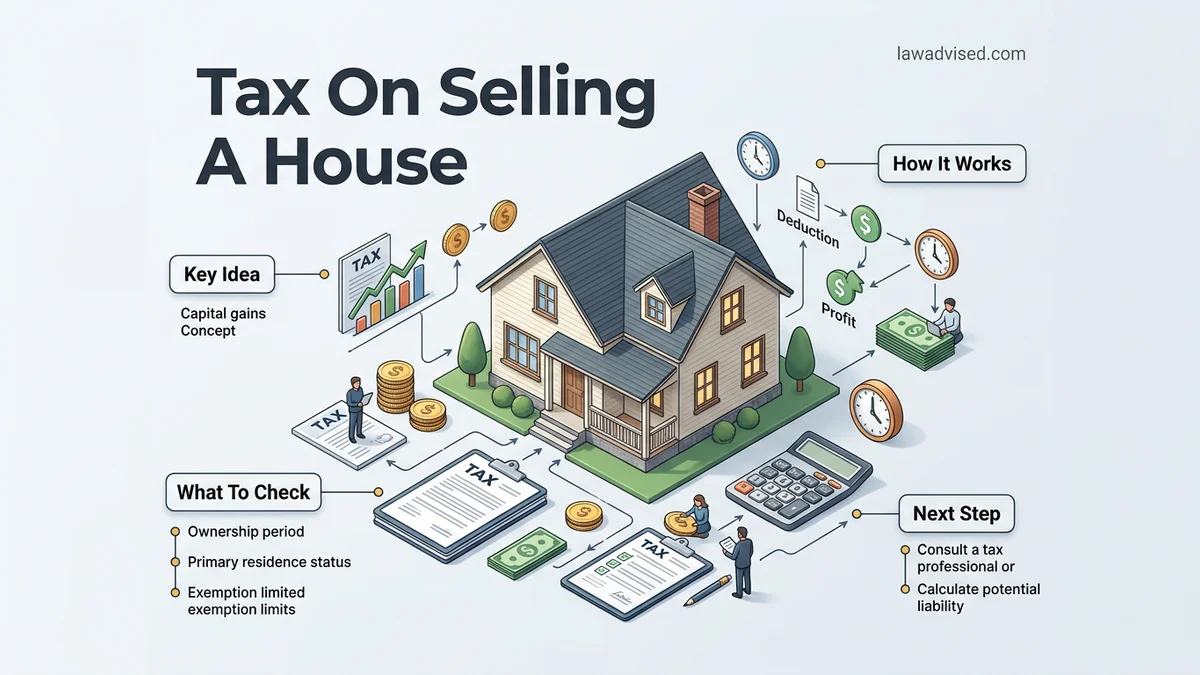
What Causes Tax on Selling a House
The Mechanics of Capital Gains
Selling your home triggers a tax event only if you sell it for more than you paid for it, resulting in a capital gain. The Internal Revenue Service looks at your net profit, not the total sale price hitting your bank account. If your profit stays below the statutory limits, you pay zero tax.
- Short-term capital gains: If you owned the home for less than one year, profits are taxed at ordinary income tax rates.
- Long-term capital gains: If you owned the home for more than one year, profits face preferential capital gains rates of 0%, 15%, or 20%.
- Investment properties: Rental or second homes do not qualify for the primary residence exclusion and face full capital gains taxation plus depreciation recapture.
The Section 121 Exclusion Rules
The Section 121 exclusion is your primary defense against a heavy tax bill when selling a primary residence in 2026. To claim up to $250,000 as a single filer or $500,000 as a married couple, you must pass the strict two-out-of-five-year test.
- Ownership test: You must have owned the property for at least 24 months out of the five years preceding the sale date.
- Use test: You must have lived in the home as your main primary residence for at least 24 months during that same five-year window.
- Frequency limit: You can generally only use this exclusion once every two years.
Step-by-Step Guide to Calculating Your Capital Gains
Determining Your Adjusted Cost Basis
Calculating your accurate capital gain starts with establishing your adjusted cost basis, which is much more than just your original purchase price. You must factor in buying expenses, settlement fees, and most importantly, the money you poured into home improvements over the years.
- Start with the original purchase price you paid for the property.
- Add eligible buying costs such as title insurance, legal fees, and recording charges.
- Add the cost of permanent home improvements that added value or extended the home’s life.
- Subtract any casualty losses or depreciation previously claimed if you used part of the home for business.
Subtracting Selling Expenses From Your Proceeds
Once you know your adjusted cost basis, you compare it against your net selling price. The IRS allows you to subtract direct selling expenses from your gross sale price, which lowers your final profit figure and reduces your tax liability.
- Real estate agent commissions paid to listing and buyer agents.
- Legal and escrow fees required to close the transaction.
- Advertising and marketing costs incurred to sell the house.
- Transfer taxes and mandatory state or local closing fees.
How to Fix and Eliminate Your Tax Bill Using Section 121
The primary legal mechanism to eliminate your tax bill when selling a primary residence in 2026 is IRS Section 121. This code allows eligible homeowners to exclude up to $250,000 of capital gains from their income if filing as single, or up to $500,000 if married filing jointly. To qualify fully in 2026, you must pass two distinct legal tests established by the IRS.
The Ownership and Use Tests
- The Ownership Test: You must have owned the property for at least 24 months out of the 5-year period preceding the exact date of the home sale.
- The Use Test: You must have used the property as your primary, principal residence for at least 24 months out of that same 5-year window.
Calculating Adjusted Basis and Improvements
If your total capital gains exceed the $250,000 or $500,000 Section 121 exclusion limits, you can still reduce your taxable profit by calculating your adjusted basis. According to real estate tax experts, your original purchase price increases when you factor in capital improvements. Major renovations, such as adding a roof, installing a central HVAC system, or building a deck, add directly to your home basis. Keeping meticulous receipts throughout your period of ownership ensures every dollar of improvement reduces your final realized gain before taxes apply.
What If It Still Doesn’t Work and You Owe Capital Gains Tax
Sometimes your profit exceeds the Section 121 exclusion limits, or you fail the ownership and use tests due to unforeseen life events. When standard exemptions fall short, several strategic fallback options remain available to minimize your overall financial liability.
- Claim a Partial Exclusion: If you must sell early due to a change in employment, health issues, or unforeseen circumstances, the IRS may grant a prorated exclusion based on the portion of the 24 months you met the requirements.
- Utilize a 1031 Exchange: If the property was used as a rental or investment property rather than a strict primary residence, you can defer all capital gains taxes by reinvesting the proceeds into a like-kind property.
- Offset Gains with Investment Losses: You can offset your taxable real estate capital gains against capital losses incurred in the stock market or other investments during the 2026 tax year.
- Consult a Certified Public Accountant: Engage a licensed tax professional or CPA specializing in real estate transactions to review your closing documents and identify overlooked deductions. Professional fees for complex real estate tax planning typically range from $300 to $1,500 depending on the scope of the return.
Conclusion
Navigating the tax on selling a house in 2026 requires a firm understanding of IRS Section 121 exclusion limits and your home’s adjusted cost basis. When planned correctly, you can legally eliminate hundreds of thousands of dollars in capital gains liability and protect your hard-earned equity. According to verified research and tax experts, consulting a qualified professional before listing your property remains the most effective way to safeguard your financial outcome. Take action today by gathering your original purchase settlement statement and all receipts for home improvements made during your ownership.
❓ Frequently Asked Questions
How do I calculate my home’s cost basis for tax purposes?
Your cost basis is your original purchase price plus buying costs, major home improvements, and certain legal fees associated with the purchase.
What qualifies as a capital improvement versus routine maintenance?
Capital improvements add value, prolong the home’s life, or adapt it to new uses (like a kitchen remodel). Routine maintenance, such as painting or fixing a leaky faucet, does not count.
Can I use the Section 121 exclusion more than once?
Yes, but generally you can only use it once every two years, provided you meet the ownership and residency requirements for that specific property.
What if I do not meet the 2-year residency requirement due to unforeseen circumstances?
The IRS offers partial exclusions for job relocations, health issues, or unforeseen events like a natural disaster or divorce.
Do I have to pay state taxes on the profit from selling my house?
State capital gains tax depends entirely on where you live. Some states have no income tax, while others tax capital gains as ordinary income.
How do inherited homes get taxed when sold?
Inherited homes benefit from a ‘stepped-up basis,’ meaning the cost basis resets to the home’s market value at the time of the previous owner’s death, often eliminating capital gains tax.

Ismail Hossain is the founder of Law Advised. He is an Divorce, Separation, marriage lawyer. Follow him.