Tax Basis of Property Explained Step-by-Step Guide 2026
Your tax basis of property determines how much capital gain or loss you report when selling an asset, as well as how much depreciation you can claim. Without knowing your accurate baseline, you risk overpaying the IRS on property sales or miscalculating your annual deductions.
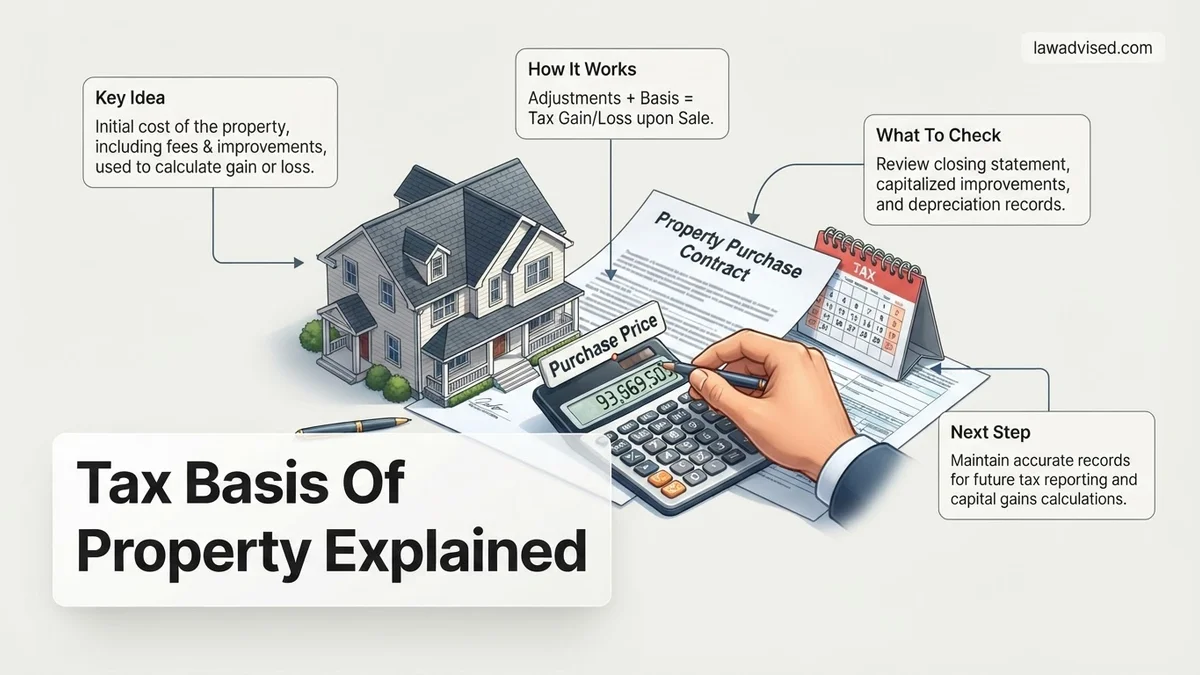
Tax basis is the financial anchor you use to determine your tax liability when you sell, exchange, or depreciate a property. Think of it as your baseline investment in an asset, usually starting with what you paid for it. When you eventually sell that property, the IRS does not tax your total sale price; instead, it taxes your profit, which is calculated by subtracting your tax basis from your net selling price.
Getting your tax basis right is critical for 2026 tax filings because an inaccurate calculation directly distorts your capital gains tax or depreciation deductions. Whether you bought a home, inherited a commercial building, or received land as a gift, knowing your exact starting point and how to track adjustments protects you from overpaying the IRS or triggering an expensive audit.
Key Takeaways
- Tax basis represents your capital investment in a property for IRS tax purposes.
- Purchased property basis starts at the actual purchase price plus closing costs.
- Inherited assets usually receive a stepped-up basis equal to market value at death.
- Capital improvements increase your adjusted basis, lowering future capital gains taxes.
- Depreciation deductions systematically reduce the tax basis of rental and business real estate.
What Causes Capital Gains Surprises: Understanding Tax Basis Errors
The Cost Basis Miscalculation Trap
Many property owners run into trouble because they assume their tax basis is simply the purchase price written on the closing statement. In reality, your initial cost basis includes the purchase price plus acquisition expenses like legal fees, recording fees, transfer taxes, and title insurance. Leaving these closing costs out artificially lowers your basis, which inflates your taxable profit when you sell.
- Purchase price and closing fees form your baseline cost basis
- Omitting settlement charges leads to higher capital gains taxes
- Different acquisition methods—purchases, gifts, and inheritances—use entirely different starting rules
Ignoring the Impact of Adjusted Basis Over Time
Your basis is rarely static. Failing to adjust your basis upward for capital improvements or downward for depreciation causes major tax errors. If you own rental real estate in 2026, you are required to subtract allowable depreciation each year, which lowers your basis. Conversely, adding a new roof or HVAC system increases your basis, reducing your future tax burden.
How to Fix and Calculate Your Property Basis Step-by-Step
Calculating Basis Based on How You Acquired the Property
The method you used to acquire the property dictates how you establish your initial tax basis. You must apply the correct IRS rule set based on your specific scenario:
- Purchased Property: Start with the purchase price, add legal and settlement fees, and include any debt you assumed.
- Gifted Property: Generally, your basis is the donor’s adjusted basis, unless the fair market value at the time of the gift was lower (which triggers complex dual-basis rules).
- Inherited Property: You generally receive a stepped-up basis equal to the fair market value of the property on the date of the previous owner’s death.
Adjusting Your Basis for Improvements and Depreciation
Once you establish your starting basis, you must maintain a clear log of adjustments throughout your ownership period. Keep every receipt for capital improvements, as these permanently add value and extend the property’s life. At the same time, subtract any depreciation you claimed or were allowed to claim on business or rental properties, ensuring your 2026 records match IRS guidelines.
- Add permanent improvements like additions, new roofs, or major landscaping
- Subtract cumulative depreciation deductions taken on business assets
- Retain all records for at least three years after filing the tax return for the property’s sale
How to Adjust Your Basis for Improvements and Depreciation
Your initial tax basis is rarely static. Throughout your ownership period in 2026, events occur that either increase or decrease this starting figure. Calculating these adjustments accurately prevents overpaying capital gains taxes when you finally decide to sell the property.
Increasing Your Basis Through Capital Improvements
Capital improvements add permanent value to your property, prolong its useful life, or adapt it to new uses. Routine repairs and maintenance do not count. To calculate this adjustment, follow these procedural steps:
- Compile all contractor invoices, receipts, and material purchase slips for structural upgrades like a new roof, room addition, or HVAC system replacement.
- Add the total cost of these qualifying improvements to your original cost basis.
- Keep these records securely for at least three years after filing the tax return for the year of the property sale, as mandated by IRS guidelines.
Decreasing Your Basis Through Depreciation
If you use the property for rental or business purposes, you must decrease your basis by the amount of depreciation allowed or allowable each year. According to IRS Publication 527, residential rental property is depreciated over a recovery period of 27.5 years using the straight-line method. Failing to claim depreciation does not exempt you from this requirement; the IRS will still reduce your basis by the allowable amount upon sale, increasing your taxable gain.
What If It Still Doesn’t Work? Handling Missing Records and Inherited Assets
Determining the correct tax basis becomes complicated when historical records disappear or when assets pass through estates. If your initial calculations stall due to missing data or complex acquisition methods, execute these verified fallback steps to establish compliance:
- Order historical property assessment records, tax assessor valuations, or local building permits from municipal archives to estimate the original value or improvement costs.
- Hire a certified independent real estate appraiser to perform a retroactive appraisal, establishing the fair market value for inherited assets on the exact date of the decedent’s death. Expect professional appraisal fees to range from $400 to $900 for standard residential properties in 2026.
- Consult a certified public accountant (CPA) or a specialized tax attorney if records are missing entirely for a property held for decades. Professional tax advisory fees typically average $250 to $500 per hour, but expert intervention mitigates costly audit penalties.
- Utilize safe harbor estimation methods permitted under specific tax code provisions, relying on regional historical appreciation indices published by the Federal Housing Finance Agency (FHFA) when direct purchase documentation is permanently lost.
Conclusion
Mastering the tax basis of property protects your financial equity and ensures compliance with current 2026 tax regulations. By accurately tracking your initial acquisition costs, factoring in capital improvements, and accounting for depreciation, you minimize unexpected tax liabilities upon selling. According to verified research and expert sources from the American Institute of Certified Public Accountants (AICPA), meticulous record-keeping is the single most effective defense against costly IRS discrepancies during property audits. Your actionable next step is to create a dedicated digital archive for your property documents today, ensuring all purchase settlement statements, upgrade receipts, and valuation notices remain instantly accessible for your future tax filings.
❓ Frequently Asked Questions
How is the tax basis calculated for a property received as a gift?
For gifted property, your basis generally depends on the donor’s adjusted basis and the fair market value at the time of the gift. If the property is sold at a gain, you use the donor’s original basis, but if sold at a loss, you may use the fair market value at the time of the gift if it was lower.
What expenses can be added to the purchase price to increase cost basis?
You can add eligible closing costs and settlement fees, including abstract fees, charges for installing utility services, legal and recording fees, survey costs, and transfer taxes. Standard ongoing maintenance and repair costs cannot be added.
How do major home improvements affect my capital gains exclusion?
Capital improvements increase your adjusted tax basis. When you sell your primary residence, you can combine your adjusted basis with the Section 121 exclusion (up to $250,000 for singles or $500,000 for married couples) to further shelter your profits from capital gains tax.
What happens to the tax basis if I inherit a house in a community property state?
In community property states, both halves of a jointly owned property typically receive a full step-up in tax basis to the fair market value at the date of the first spouse’s death, providing significant tax advantages for surviving spouses.
Can I use estimated records if I lost receipts for past home renovations?
While the IRS prefers contemporaneous receipts and contractor invoices, you can use circumstantial evidence and reasonable estimates to reconstruct your home’s improvement history if original records are genuinely unavailable.
Why does depreciation recapture matter when selling rental real estate?
Depreciation recapture requires you to pay taxes on the depreciation deductions you claimed (or could have claimed) over the years at a rate up to 25%, regardless of your ordinary income tax bracket or standard capital gains rates.

Ismail Hossain is the founder of Law Advised. He is an Divorce, Separation, marriage lawyer. Follow him.