Tax Free Scholarships Explained Step-by-Step Guide 2026
Navigating scholarship taxes requires knowing the strict IRS rules separating qualified education expenses from taxable income. This guide breaks down exactly what makes funding tax-exempt and how to calculate your taxable liability for 2026.
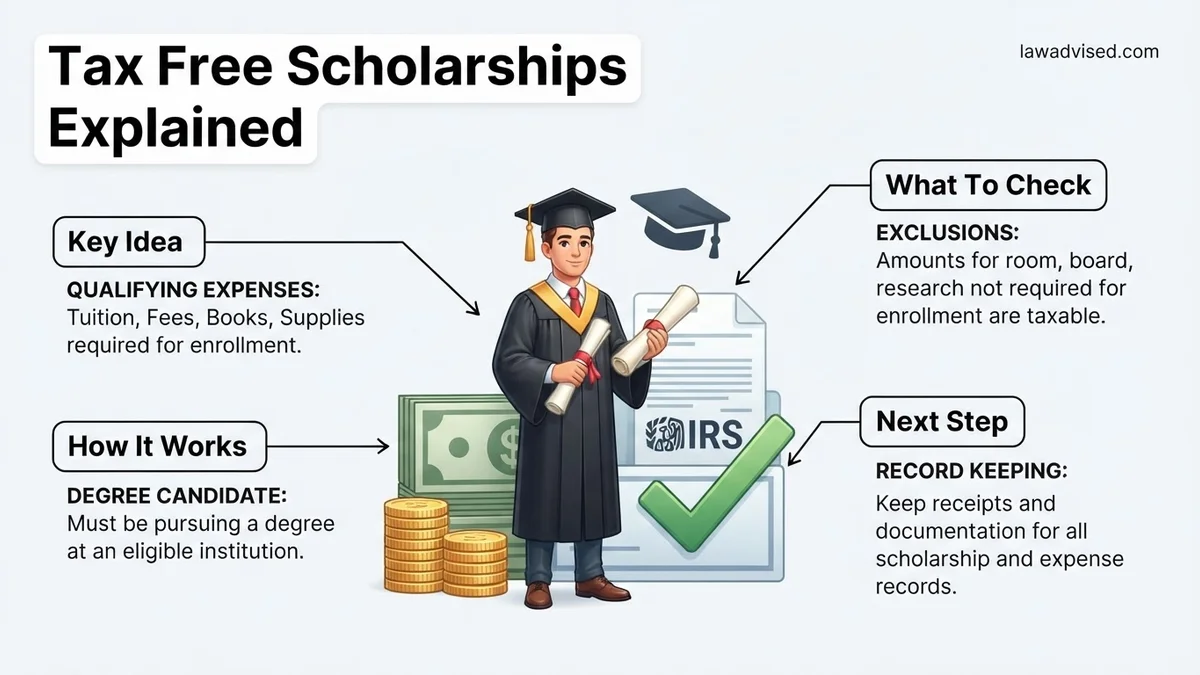
Scholarships are generally tax-free under IRS rules only if you are a degree-candidate at an eligible educational institution, and the funds are used exclusively for qualified education expenses like tuition, mandatory enrollment fees, and required books. Any money spent outside these specific categories becomes taxable income for the 2026 tax year.
Understanding this distinction prevents unexpected tax bills when filing your return. Students often assume all financial aid is tax-exempt, but misapplying funds or receiving awards for non-academic purposes immediately triggers tax liability. Let us look at exactly how the IRS determines what is taxable and how to calculate your exposure.
Key Takeaways
- Scholarships used strictly for tuition, fees, and required books are 100% tax-free.
- Money spent on room, board, and travel is considered taxable income.
- Service-requirement stipends tied to teaching or athletic duties are taxable.
- Your Form 1098-T helps you reconcile eligible expenses with total aid received.
- Taxable scholarships must be reported as earned income on your tax return.
What Causes Scholarship Tax Liability Under IRS Rules
Qualified vs. Non-Qualified Expenses
The IRS draws a strict line between expenses that keep your scholarship tax-free and those that trigger income tax. Qualified expenses are mandatory for enrollment and attendance. Non-qualified expenses are personal costs that happen while you are in school. Here is how they break down for 2026:
- Qualified (Tax-Free): Tuition, required enrollment fees, and course-specific books, supplies, or equipment listed as mandatory on your syllabus.
- Non-Qualified (Taxable): Room and board, travel, research expenses, clerical help, and optional equipment like a general-use laptop not explicitly required for all students in your program.
Service-Requirement Scholarships and Stipends
If your scholarship requires a work service commitment, the tax rules change entirely. Athletic scholarships, teaching assistantships, and service-obligation grants that require you to perform a specific job in exchange for funding are generally considered taxable earned income, even if the money goes directly to your student account for tuition.
- W-2 Processing: Service-based stipends usually have taxes withheld immediately by your university’s payroll department.
- Exceptions: Programs like the National Health Service Corps or specific armed forces health professions scholarships may have unique tax exclusions, but standard athletic or teaching stipends do not qualify as tax-free gift aid.
How to Calculate Your Taxable Scholarship Amount Step-by-Step
Step 1: Inventory Your Total Aid and Qualified Expenses
To find out if you owe taxes on your 2026 funding, you need to pull your 1098-T form from your university and your personal financial records. Compare every dollar of gift aid you received against your actual out-of-pocket qualified educational costs. Do not include loans in this calculation, as loans are borrowed money and are never taxable.
- Add up all grants, scholarships, and tuition waivers received for the calendar year.
- Calculate the total amount paid strictly for tuition, fees, and required books.
- Subtract your qualified expenses from your total scholarship amount.
Step 2: Identify Taxable Residual Amounts
If your total scholarship amount exceeds your qualified education expenses, the difference is considered taxable income. For example, if you receive a $15,000 scholarship, but your mandatory tuition and books total $10,000, you have a $5,000 residual amount. That $5,000 must be reported on your 2026 tax return, even if you used it to pay for your campus housing or grocery shopping.
- Reporting Requirements: Even if your university does not issue a W-2 or 1099 for excess scholarships, you are legally required to report taxable scholarship income on IRS Form 1040.
- Estimated Taxes: If your taxable scholarship amount is large and no taxes were withheld, you may need to make quarterly estimated tax payments to avoid IRS penalties.
How to Handle Service-Required Stipends and Athletic Grants
Navigating financial aid becomes complex when scholarships require a specific work commitment or performance in return. According to IRS guidelines, financial assistance tied directly to services rendered loses its tax-exempt status. Understanding how to categorize these funds prevents unexpected tax bills during the 2026 filing season.
Service-Required Stipends and Teaching Fellowships
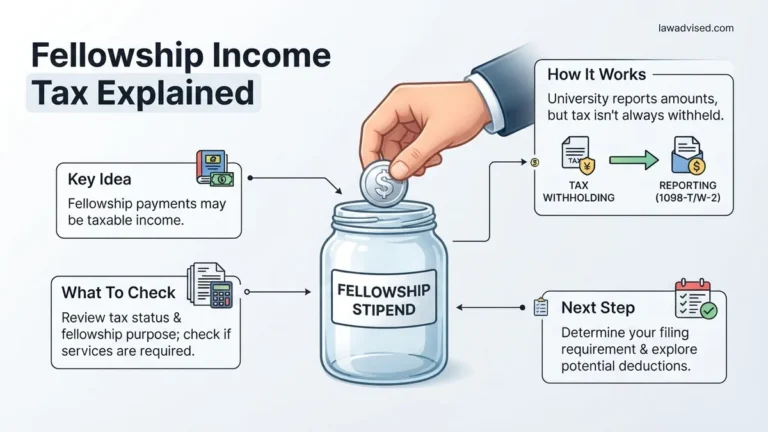
Graduate students often receive stipends for serving as Teaching Assistants (TAs) or Graduate Research Assistants (GRAs). The IRS mandates that any money received as compensation for teaching or research services is fully taxable earned income, even if the service is a strict degree requirement. Educational institutions must report these wages on a Form W-2 rather than a Form 1098-T.
Athletic Grants and Tuition Waivers
Athletic scholarships follow the same strict rules as academic awards regarding qualified tuition and related expenses. However, athletic grants cannot be conditioned on playing a sport or participating in a specific team activity as a required service. If an institution revokes an athletic scholarship due to an athlete quitting a team, the financial aid office reclassifies the remaining balance. Tax experts emphasize reviewing your university agreement annually to separate taxable compensation from tax-free institutional aid.
What If Your Form 1098-T Doesn’t Match Your Records
Discovering discrepancies between your personal financial tracking and the official Form 1098-T issued by your university is a common tax season stressor. Box 1 typically displays payments received for qualified tuition and related expenses, which often differs from the amount you actually billed or paid during the exact calendar year. Follow these steps to resolve the mismatch before submitting your 2026 tax return:
- Pull your detailed student account ledger: Access your university student portal and download the comprehensive, itemized account activity statement for the entire 2026 calendar year.
- Reconcile calendar year versus academic year: Remember that Box 1 reports payments made between January 1 and December 31, 2026, which frequently includes spring payments made in late December 2025 or vice versa.
- Contact the bursar or financial aid office: If a clear mathematical error exists, submit a formal correction request to the university billing department to issue an amended Form 1098-T.
- Attach a explanatory statement: If the university cannot correct the form in time for your filing deadline, attach a detailed reconciliation ledger directly to your tax return to justify the claimed figures.
What If It Still Doesn’t Work?
If reconciling your university statements fails or an IRS notice regarding scholarship income arrives, immediate escalation is required. Utilize these fallback steps to protect your tax standing:
- Consult a certified tax professional: Engage a Certified Public Accountant (CPA) or Enrolled Agent (EA) who specializes in higher education tax credits and fellowship taxation. Professional consultation fees typically range from $200 to $500 depending on complexity.
- Utilize IRS Volunteer Income Tax Assistance: If your adjusted gross income qualifies under current IRS limits, leverage free VITA programs staffed by IRS-certified volunteers for guidance on complex scholarship reporting.
- File for an extension: If waiting on an amended Form 1098-T from your institution, file Form 4868 to request an automatic six-month extension to avoid filing an inaccurate return.
- Respond to IRS notices promptly: If you receive a CP2000 notice matching your tax return against information returns, reply within the designated 30-day window with your verified student ledger as proof.
Conclusion
Understanding the distinction between qualified tuition expenses and taxable living allowances safeguards students from unexpected tax liabilities and costly penalties. By meticulously tracking your qualified expenses and correctly categorizing stipends, you ensure full compliance with current tax laws. According to verified research and expert sources from the IRS and higher education financial associations, proactive record-keeping remains the single most effective defense against reporting errors. Take the next actionable step today by logging into your student portal to download your comprehensive payment ledger for the upcoming tax filing season.
❓ Frequently Asked Questions
How does the IRS determine if a scholarship is tax-free?
The IRS looks strictly at how the scholarship funds are spent. Funds designated for tuition, mandatory enrollment fees, and required books, supplies, or equipment are tax-exempt.
What happens if my scholarship exceeds my tuition costs?
Any portion of a scholarship that exceeds qualified tuition and related expenses—such as funds spent on living expenses or optional equipment—is considered taxable income.
Are stipends for research or teaching assistantships taxable?
Yes, stipends received for teaching, research, or other services required as a condition of receiving the scholarship are taxable, even if the money is used for tuition.
Do I have to file a tax return if my only income is a taxable scholarship?
You must file a tax return if your total taxable income exceeds the standard deduction threshold for single dependents or independent filers for the tax year.
Are computers and software considered qualified tax-free expenses?
They are tax-free only if the educational institution explicitly requires the computer and software for enrollment or attendance in your specific courses.
How do I report taxable scholarship money to the IRS?
Taxable scholarship amounts not reported on a W-2 are typically reported as ‘SCH’ on line 1 of your Form 1040, along with the taxable amount.

Ismail Hossain is the founder of Law Advised. He is an Divorce, Separation, marriage lawyer. Follow him.