Capital Loss Explained Step-by-Step Guide for 2026
A capital loss occurs when you sell an investment for less than its original purchase price, resulting in a financial setback. Fortunately, you can use these losses to offset capital gains and reduce your taxable income. Understanding how to apply these losses properly can significantly lower your tax bill.
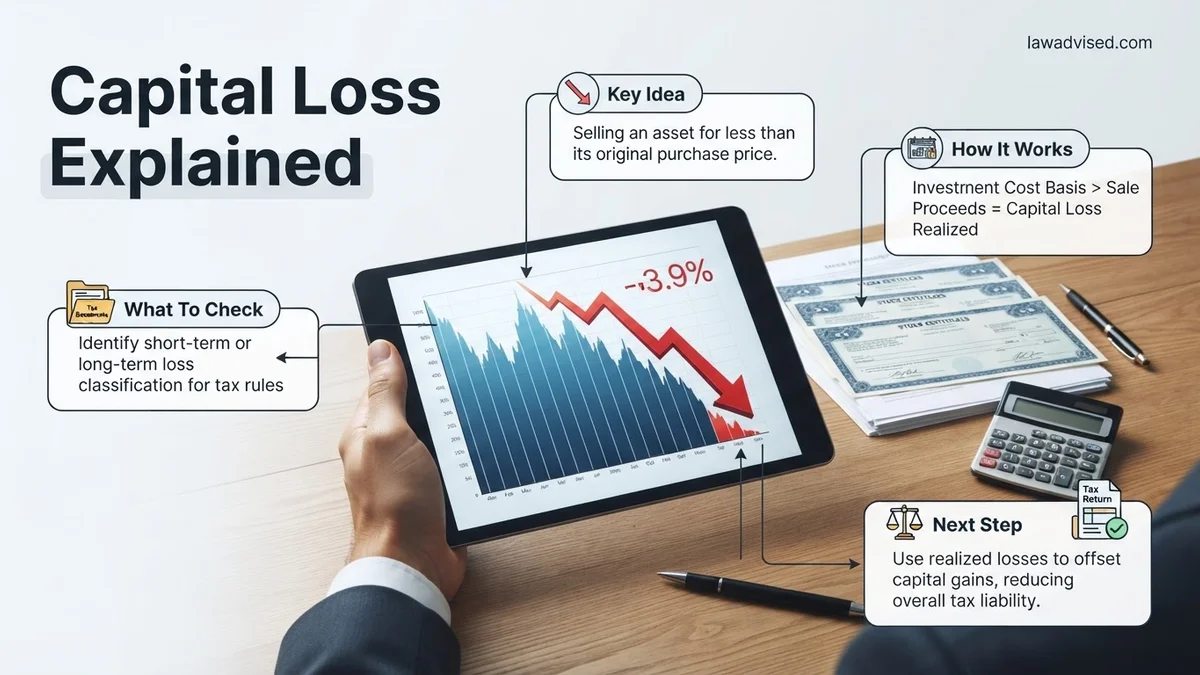
A capital loss happens when you sell an investment, such as a stock, bond, or piece of real estate, for less than its original purchase price. When the sale settles, that drop in value officially becomes a realized loss.
For the 2026 tax year, you can use these realized losses strategically to offset your investment gains and even reduce your ordinary income. Knowing how to calculate and apply these losses turns a bad market day into a smart tax-saving opportunity.
Key Takeaways
- A capital loss happens only when you actually sell an asset for a loss.
- Short-term losses offset short-term gains first before applying to long-term gains.
- You can deduct up to $3,000 of excess capital losses against ordinary income annually.
- Unused losses roll over into future tax years indefinitely as loss carryforwards.
- The IRS wash-sale rule prevents you from claiming losses if you repurchase the same asset within 30 days.
What Causes Capital Losses and How They Work
Capital losses stem directly from market downturns, poor company performance, or selling assets during a pinch. The mechanics are straightforward, but you need to track specific numbers to make them work for you on your 2026 tax return.
Realized Versus Unrealized Losses
- Unrealized loss: Your stock drops in value, but you hold onto the shares. The market value is down, but the loss exists only on paper.
- Realized loss: You sell the asset at that lower price. This triggers the taxable event required by the IRS.
Calculating Your Exact Loss
To find your capital loss, take your adjusted cost basis (what you originally paid plus any commissions or fees) and subtract your net sales proceeds. For example, if you bought tech shares for ten thousand dollars in 2024 and sold them in early 2026 for six thousand dollars, you have a realized capital loss of four thousand dollars.
How to Fix Your Tax Bill Using Step-by-Step Loss Offsetting
The real magic of a capital loss happens when tax season arrives. The IRS allows you to use your investment losses to lower your tax liability through a process called loss netting. Follow this step-by-step workflow to lower your taxable burden for 2026.
Step One: Group Your Gains and Losses
Separate your transactions into short-term assets (held for one year or less) and long-term assets (held for more than one year). Net your short-term gains against your short-term losses. Do the exact same thing for your long-term gains and losses.
Step Two: Cross-Net the Results
If you have a net loss in one category and a net gain in the other, combine them. For instance, if you lost four thousand dollars on short-term stocks but gained two thousand dollars on long-term real estate, your net result is a two thousand dollar short-term capital loss.
Step Three: Deduct Against Ordinary Income
If your total capital losses exceed your capital gains, you can use the leftover loss to wipe out up to three thousand dollars of your ordinary income, such as your salary or freelance wages. Any amount beyond that three thousand dollar limit rolls over into the 2027 tax year.
What If It Still Doesn’t Work and You Have Excess Losses Left Over
Sometimes your realized capital losses exceed the annual $3,000 threshold by a wide margin. Major market downturns in 2026 can leave investors with tens of thousands of dollars in excess losses after offsetting all capital gains. Fortunately, the IRS does not let these losses expire. Understanding how to manage excess capital losses protects your long-term wealth.
Understanding Loss Carryforwards
Any capital loss that exceeds your annual deduction limit rolls over into the next tax year indefinitely. According to Internal Revenue Service regulations, these excess losses retain their character as either short-term or long-term. You will report them on Schedule D of your tax return year after year until the balance reaches zero.
- Calculate your total net capital loss after netting all gains and losses for 2026.
- Subtract the maximum $3,000 ordinary income deduction (or $1,500 if married filing separately) from your total net loss.
- Record the remaining balance on your tax software or IRS Form 1040 Schedule D as your capital loss carryforward for the 2027 tax year.
- Maintain meticulous records of your carryforward amounts, as tax software must track these figures accurately across multiple filing years.
What If It Still Doesn’t Work?
If complex portfolio structures, cryptocurrency wash sales, or inherited asset basis adjustments make your capital loss calculations too difficult to manage independently, fallback measures are necessary. Certified Public Accountants and tax attorneys specializing in investment taxation can resolve intricate reporting errors. Professional tax preparation fees for complex investment portfolios generally range from $500 to $2,500 depending on transaction volume. Consider the following steps if standard offset strategies fail to resolve your tax liability:
- Audit your brokerage statements for potential wash sale rule violations that may have disallowed your loss claims unexpectedly.
- Consult a certified financial planner to restructure your asset location strategy and optimize future capital gain harvesting.
- Hire a licensed CPA or enrolled agent to amend previous tax returns if capital loss carryforwards were miscalculated in prior years.
- Utilize tax-advantaged accounts like IRAs or 401(k) plans for future trading to insulate gains from immediate capital gains taxation.
Conclusion
Mastering capital losses transforms a disappointing investment performance into a powerful tax-saving mechanism. By systematically offsetting capital gains and claiming up to $3,000 of ordinary income deductions, investors successfully lower their annual tax burden. According to verified research from financial economists and leading tax authorities, strategic loss harvesting remains one of the most reliable methods for improving after-tax portfolio returns. The next actionable step is to review your current brokerage statements, identify underperforming assets ripe for strategic sale, and consult tax planning software or a certified professional before the end of the 2026 tax season.
❓ Frequently Asked Questions
How do short-term and long-term capital losses differ on taxes?
Short-term losses apply to assets held for one year or less, while long-term losses apply to assets held for more than a year. Tax rules require you to match short-term losses against short-term gains, and long-term losses against long-term gains, before cross-matching the remainders.
What is the IRS wash-sale rule and how does it affect capital losses?
The wash-sale rule prohibits you from claiming a capital loss if you buy a substantially identical stock or security within 30 days before or after the sale. If triggered, the disallowed loss gets added to the cost basis of your newly purchased replacement asset.
Can I claim capital losses on personal items like my car or home?
Generally, the IRS does not allow you to deduct capital losses on personal-use items, such as your primary residence, personal vehicle, or household furniture. Losses are deductible only for investments, business property, and income-producing assets.
How do I report capital losses on my annual tax return?
You report realized capital gains and losses using IRS Form 8949 and then summarize those figures on Schedule D of your Form 1040. Brokerage firms typically issue a Form 1099-B summarizing your transactions to make this reporting easier.
What happens to my capital losses if I pass away?
Any unused capital loss carryforwards expire in the year of the taxpayer’s death and cannot be transferred to surviving heirs or beneficiaries. However, they can be utilized on the final individual income tax return or a joint return with a surviving spouse.
Can cryptocurrency losses be used for tax-loss harvesting?
Yes, current tax guidelines treat cryptocurrency as property, meaning digital asset sales resulting in losses can offset capital gains. Furthermore, the strict wash-sale rules currently do not apply to cryptocurrencies in the same way they apply to traditional securities.

Ismail Hossain is the founder of Law Advised. He is an Divorce, Separation, marriage lawyer. Follow him.