How to Report 1099 Income Step-by-Step Guide for 2026
Reporting 1099 income requires filing Schedule C to calculate your net business earnings and Schedule SE to pay self-employment tax. Even if you did not receive a physical 1099 form from a client, you are legally required to report all earned freelance or contractor income to the IRS.
Reporting 1099 income on your 2026 tax return means you are operating as an independent contractor, freelancer, or gig worker. Unlike traditional W-2 employees, taxes are not automatically withheld from your paychecks. You must report this income yourself using IRS Schedule C and calculate your self-employment tax using Schedule SE.
Filing correctly ensures you avoid costly IRS penalties while maximizing your legitimate business deductions. Whether you received a stack of forms or tracked your earnings independently, the process requires gathering your totals, matching them to the right tax forms, and filing them alongside your main Form 1040.
Key Takeaways
- Report independent contractor earnings on Schedule C to calculate net business profit.
- Use Schedule SE to calculate and pay your federal self-employment tax.
- You must report all 1099 income even if a client failed to send you the form.
- Deduct ordinary and necessary business expenses to lower your overall taxable income.
- Set aside roughly 25 to 30 percent of your earnings for quarterly estimated taxes.
Understanding Why 1099 Income Requires Special Tax Forms
The Difference Between W-2 and 1099 Tax Handling
When you work a traditional job, your employer handles tax withholdings for federal income tax, Social Security, and Medicare. As a 1099 worker in 2026, you are legally considered a business owner. This means you are responsible for paying both the employee and employer portions of your payroll taxes, which totals 15.3% for self-employment tax alone, alongside your standard income tax bracket.
Common Types of 1099 Forms You Might Receive
Clients and financial institutions issue different 1099 variations depending on the source of your earnings. Knowing where each form goes on your tax return prevents processing delays:
- 1099-NEC: Used for non-employee compensation. This is the primary form for freelancers and independent contractors.
- 1099-MISC: Used for miscellaneous income such as rent, prizes, or awards.
- 1099-INT and 1099-DIV: Issued by banks and brokerages for interest and dividend income.
- 1099-K: Issued by payment apps and platforms like PayPal, Venmo, or Stripe if your gross transactions exceed IRS reporting thresholds for 2026.
How to Report 1099 Income Like a Pro: A Practical Walkthrough
Navigating tax season as an independent contractor, freelancer, or gig worker can feel overwhelming, especially when dealing with multiple 1099 forms. This comprehensive walkthrough is designed to demystify the process of reporting your self-employment income to the IRS. By following these structured actions, you will ensure total compliance, maximize your allowable deductions, and minimize the risk of triggering an audit. Let us dive into the exact process of gathering, calculating, and filing your 1099 earnings accurately.
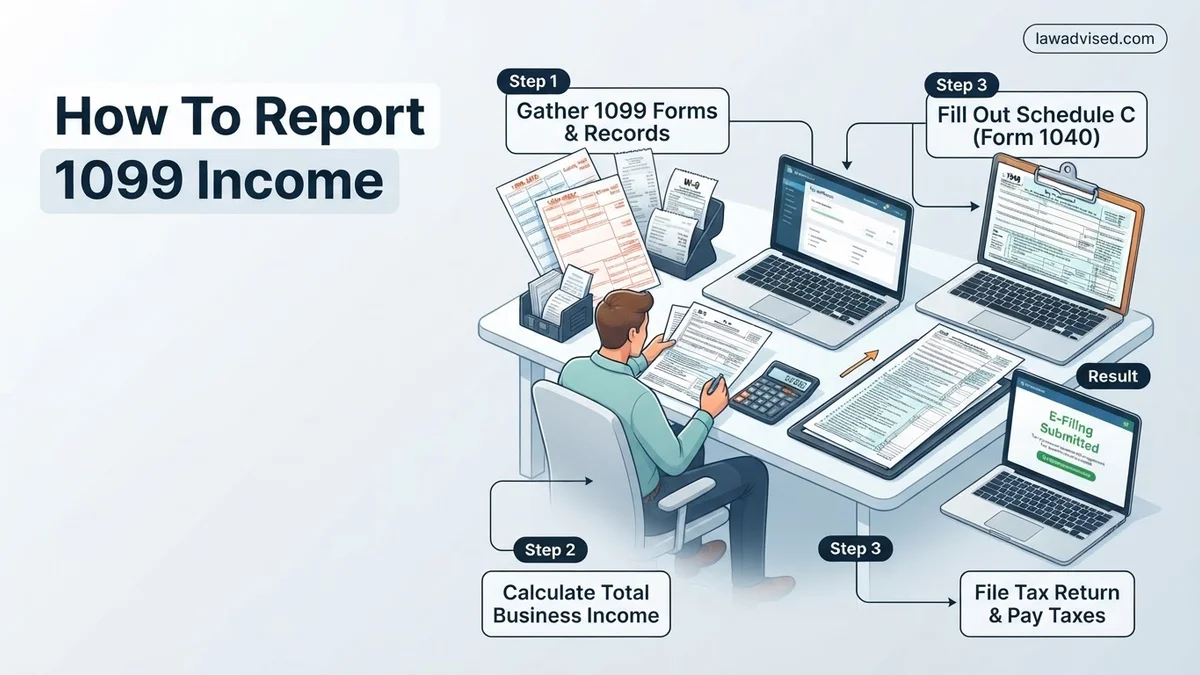
Step 1: Gather All Your 1099 Forms
What you need: A secure folder (digital or physical), a spreadsheet, and all tax forms mailed or emailed to you by clients.
Instructions: By January 31st, any client who paid you $600 or more in the previous calendar year is legally required to send you a Form 1099-NEC (Nonemployee Compensation) or 1099-MISC. Carefully check your physical mail and email inboxes for these documents. Create a master spreadsheet listing each client name, the exact amount stated on the 1099, and whether you received a copy. Do not panic if a client failed to send you a 1099; you are still legally obligated to report all earned income, even if it falls below the $600 threshold or no form was issued.
Pro Tip: Always cross-reference your 1099 forms with your own bank statements and accounting software to ensure the client-reported amounts match your actual receipts.
Step 2: Reconcile Your Income with Bank Statements
What you need: Business bank statements, payment processor reports (PayPal, Stripe, Venmo), and accounting software or a ledger.
Instructions: Sometimes the numbers on your 1099 forms do not match your actual records due to processing fees, retractions, or reporting errors by the client. Go month by month through your business bank accounts and payment gateways. Sum up all payments received from clients for services rendered. If a 1099 amount is higher than what you actually received, contact the issuing client immediately to request a corrected 1099-NEC. If the discrepancy is minor, always report the actual amount of income you received in your business accounts, keeping detailed documentation of the math for your records.
Pro Tip: Keep a paper trail or digital PDF of all communications with clients regarding corrected 1099 forms in case the IRS questions the variance.
Step 3: Compile Your Business Expense Receipts
What you need: Categorized expense records, receipts, mileage logs, and utility bills for home office use.
Instructions: Operating a business incurs costs, and the beauty of 1099 income is that you only pay taxes on your net profit, not your gross revenue. Gather all your deductible business expenses for the year. Common deductions include software subscriptions, advertising costs, professional development, travel, equipment purchases, and a portion of your internet and phone bills. If you used your personal vehicle for business, pull up your mileage log showing total business miles driven. Organize these expenses into standard IRS categories to make tax form entry seamless.
Pro Tip: Never throw away receipts for purchases over $75, and utilize digital scanning apps to store receipts safely to prevent fading and loss.
Step 4: Complete Schedule C (Profit or Loss From Business)
What you need: Your totaled gross income, categorized business expenses, and IRS Form Schedule C.
Instructions: Schedule C is the primary tax form where you report your 1099 earnings and claim your business deductions. In Part I, enter your total gross receipts, combining all amounts from your 1099s plus any non-1099 cash or check income. In Part II through V, input your categorized business expenses (such as advertising, supplies, and legal fees). Subtract your total expenses from your gross income to calculate your net profit. This final net profit number is the figure that will be transferred to your personal Form 1040.
Pro Tip: Double-check your North American Industry Classification System (NAICS) code on the top of Schedule C to ensure you are using the correct industry classification for your business.
Step 5: Calculate and File Schedule SE (Self-Employment Tax)
What you need: Your Schedule C net profit amount and IRS Form Schedule SE.
Instructions: When you work a traditional W-2 job, your employer pays half of your FICA taxes (Social Security and Medicare). As a 1099 independent contractor, you are your own employer, meaning you must pay both the employee and employer portions, totaling 15.3% on your net earnings up to the annual Social Security wage base limit. Transfer your net profit from Schedule C onto Schedule SE and follow the mathematical instructions on the form to calculate your self-employment tax. Fortunately, the IRS allows you to deduct half of your self-employment tax as an adjustment to income on your main Form 1040.
Pro Tip: Do not forget to claim the above-the-line deduction for half of your self-employment tax; missing this will cause you to pay significantly more personal income tax than necessary.
Step 6: Submit Your Tax Return and Pay Estimated Taxes
What you need: Completed Form 1040, Schedule C, Schedule SE, tax preparation software or a CPA, and payment method for any taxes owed.
Instructions: Integrate all your completed business schedules into your personal federal and state tax returns (Form 1040). Review the entire return for accuracy, ensuring your Social Security Number and banking details for direct deposit are correct. Submit your return electronically via IRS Free File or commercial tax software. If you owe taxes, make your payment directly through IRS Direct Pay by the filing deadline (typically April 15th) to avoid penalties and interest. Finally, look ahead to the current year and set up quarterly estimated tax payments if you expect to owe more than $1,000 in taxes.
Pro Tip: Save roughly 25 to 30 percent of every 1099 client payment you receive into a separate savings account throughout the year so you never face a cash-flow crunch at tax time.
✅ Final Checklist
- All 1099-NEC and 1099-MISC forms accounted for and reconciled with bank records.
- Gross income and business expenses properly categorized on Schedule C.
- Self-employment tax accurately calculated and filled out on Schedule SE.
- Half of the self-employment tax deducted on the main Form 1040.
- State and federal tax returns successfully transmitted and confirmation received.
Important Notes:
- Always retain your tax returns, receipts, and supporting 1099 documentation for a minimum of three to seven years in case of an IRS audit.
- Seek professional help from a Certified Public Accountant (CPA) or Enrolled Agent (EA) if your tax situation involves complex multi-state income, inventory, heavy asset depreciation, or past unfiled returns.
- Estimated Time: 3 to 6 hours for document gathering and filing. Estimated Cost: Free using IRS Free File, or $40 to $300+ if utilizing commercial tax software or hiring a professional tax preparer.
Step-by-Step Guide to Filing Schedule C and Schedule SE
Calculating Net Income on Schedule C
Schedule C (Profit or Loss From Business) is where you report all your 1099 earnings and subtract your business expenses. Start by listing your gross receipts on Line 1. Next, deduct ordinary and necessary business expenses such as software subscriptions, home office use, equipment, and professional services.
For example, if you earned 60,000 dollars in freelance writing income and spent 10,000 dollars on approved business expenses, your net profit is 50,000 dollars. This net profit figure (calculated on Line 31) flows directly onto your Form 1040 as taxable income.
Paying Self-Employment Tax Using Schedule SE
Once you know your net profit from Schedule C, you must calculate your self-employment tax using Schedule SE. This tax covers your contributions to Social Security and Medicare. The standard self-employment tax rate is 15.3 percent on your net earnings up to the 2026 wage base limits.
- Multiply your Schedule C net profit by 92.35 percent to find your net earnings subject to self-employment tax.
- Apply the 15.3 percent tax rate to that adjusted figure on Schedule SE.
- Transfer the final calculated self-employment tax amount to your main Form 1040.
- Remember that you can deduct half of your self-employment tax as an adjustment to income on your Form 1040, lowering your overall tax liability.
How to Fix Missing 1099 Forms and Other Reporting Errors
Tax season complications often arise when client payments do not match your official tax documents. According to IRS compliance data, millions of independent contractors discover discrepancies between their bank deposits and issued 1099 forms every year. Resolving these errors quickly protects your filing status and prevents automated IRS mismatch notices.
Steps to Resolve Incorrect 1099 Amounts
- Contact the payer immediately: Request a corrected 1099-NEC or 1099-MISC (Form 1099-COR) directly from the business or platform that issued the original document.
- Report your actual gross income: If the issuer refuses to correct the form, report your true earnings based on your financial records, not the erroneous 1099.
- Attach a explanatory statement: Include a brief letter with your 2026 tax return explaining the discrepancy between your reported income and the IRS copy of the 1099.
Handling Missing 1099 Forms
Payers are legally required to furnish 1099 forms by January 31, 2026. If a client fails to send your form, you are still legally obligated to report the income. Calculate your total earnings from your own bookkeeping software, invoices, and bank statements, then report that exact figure on Schedule C. You do not need the physical form to file your taxes accurately.
What If You Still Owe Taxes or Need to File an Extension
Independent contractors frequently face substantial tax liabilities because self-employment tax and federal income taxes are not withheld automatically throughout the year. If your calculations for 2026 show you owe more than you can pay, or if you need additional time to gather your financial records, specific IRS procedures apply.
Fallback Steps for Unpaid Taxes and Filing Delays
- File Form 4868 by April 15, 2026: This grants an automatic six-month extension to submit your paperwork, though it does not extend the deadline to pay owed taxes.
- Establish an IRS payment plan: Apply for a short-term payment plan (up to 180 days) or an installment agreement directly through the official IRS website to minimize failure-to-pay penalties.
- Consult a licensed tax professional: Engage a Certified Public Accountant (CPA) or Enrolled Agent (EA) if your financial situation involves complex deductions, multi-state income, or severe underpayment penalties. Professional tax preparation fees typically range from $300 to $800 depending on business complexity.
Conclusion
Accurately reporting 1099 income requires careful tracking of gross earnings, diligent deduction management, and precise completion of Schedule C and Schedule SE. According to verified research and tax advisory sources, proactive record-keeping remains the single most effective strategy for avoiding costly IRS audits and minimizing self-employment tax liabilities. Your immediate actionable next step for the 2026 tax season is to aggregate all digital payment statements and client invoices into a centralized ledger today.
❓ Frequently Asked Questions
Where exactly does 1099-NEC income go on a federal tax return?
Income reported on Form 1099-NEC goes on Schedule C (Profit or Loss From Business) as gross receipts or sales. The net profit from Schedule C then flows to Schedule 1 and Schedule 1040.
How do I calculate self-employment tax on my 1099 earnings?
You calculate self-employment tax using Schedule SE, which covers Social Security and Medicare taxes. It is based on your net earnings from self-employment calculated on your Schedule C.
What happens if I forget to report a 1099 form on my taxes?
Failing to report 1099 income can trigger an IRS automated underreporter notice (CP2000), resulting in back taxes, interest, and potential accuracy-related penalties.
Can I deduct my home internet and phone if I work from home?
Yes, you can deduct the business-use percentage of your internet and phone bills as ordinary and necessary expenses on Schedule C if you use them for your independent work.
What if a client reports the wrong amount on my 1099-NEC?
Contact the issuing client immediately and request a corrected 1099 form. If they refuse or cannot fix it in time, report your actual correct income and attach an explanation to your return.
Do I need to file a Schedule C if my 1099 income was very low?
You generally must file a Schedule C and report self-employment earnings if your net earnings from self-employment were $400 or more, though all income should technically be reported.

Ismail Hossain is the founder of Law Advised. He is an Divorce, Separation, marriage lawyer. Follow him.