Stupid Laws in Arkansas 2027 Real Weird Statutes Explained
Arkansas is home to some of the most bizarre and amusing laws ever written, ranging from historical driver regulations to strange rules about livestock. This guide separates real archaic statutes from internet myths to show what lawmakers actually targeted.
Arkansas is home to some of the most baffling, hilarious, and downright bizarre legal statutes still lingering on the books. As we look at the legal landscape in 2027, the Natural State proudly maintains a reputation for laws that make you scratch your head and wonder what lawmakers were thinking.
Understanding these quirky statutes matters because while many are ancient relics that police no longer enforce, a surprising number technically remain active legal code. Knowing the difference between an internet urban legend and a genuine piece of Arkansas legislation keeps you informed and thoroughly entertained.
Key Takeaways
- Many funny Arkansas laws are actually outdated relics from the 19th and early 20th centuries.
- Some widely cited rules, like the pronunciation of Arkansas, are based on official resolutions rather than criminal codes.
- Local municipalities often retain quirky noise and animal ordinances that are rarely enforced.
- Most archaic statutes remain on the books simply because repealing them takes time.
- Understanding these laws provides a fascinating look into early American legislative priorities.
What Causes Stupid Laws in Arkansas to Exist on the Books
The Legacy of Archaic Morality and Safety Fixes
Most ridiculous laws start with a kernel of real concern from decades or even centuries ago. Lawmakers historically tried to regulate hyper-specific situations that were trending at the time. When public sentiment shifted, these emergency fixes were simply forgotten instead of officially repealed.
- Victorian Sensibilities: Many early 20th-century statutes attempted to police public decorum, leading to bizarrely specific bans on everyday behaviors.
- Hyper-Specific Incidents: A single bizarre courtroom case or local accident often prompted a panicked legislator to pass an overly narrow ban.
- Legislative Inertia: Removing a law requires time and a vote, so thousands of dead laws simply accumulate over generations.
Modern Legal Cleanups Versus Tradition
Even in 2027, cleaning up the Arkansas code is a slow-moving administrative process. State officials occasionally sweep through to repeal obsolete mandates, but public affection for these weird laws often keeps them alive in spirit. Legislators sometimes leave harmless oddities alone because locals enjoy the state’s eccentric reputation.
- Symbolic Retention: Some outdated laws stay on the books because nobody wants to spend political capital removing a harmless joke.
- Budget Priorities: Lawmakers focus on taxation, infrastructure, and modern crime rather than hunting down antique prohibitions against cow-tethering.
How to Identify Real Arkansas Statutes Versus Urban Legends
Checking the Official Arkansas Code
You cannot trust everything you read on viral social media posts about strange state laws. In 2027, separating fact from fiction requires looking directly at primary legal sources rather than relying on clickbait articles.
- Search the LexisNexis Database: The official online Arkansas Code Annotated is your best tool to verify if a bizarre law is legally active.
- Look for Repeal Notices: Many popular internet “laws” regarding Arkansas were actually struck down decades ago or were entirely fabricated by internet pranksters.
- Examine Municipal Ordinances: Remember that a weird law might not be a state statute, but rather a hyper-local city rule passed by a small town council.
Common Signs of Fake State Law Myths
Internet rumors love to invent laws that sound just plausible enough to believe about Southern states. If a rule relies on overly cartoonish punishments or targets an impossibly narrow demographic, it is usually a fabrication.
- Absurd Punishments: Statutes that threaten physical torture or ridiculous fines are almost always fake exaggerations of real laws.
- Vague Citations: If an article claims a law exists “somewhere in Arkansas” without providing a specific code section, be skeptical.
Step-by-Step Guide to Verifying Ancient State Laws
Researching bizarre legislation requires a methodical approach to separate genuine active code from urban legends. Legal historians and state archivists recommend a systematic verification process to determine if a statute remains enforceable in 2027.
Step 1: Access the Official Arkansas Code
Navigate directly to the Arkansas State Legislature official portal or LexisNexis database hosting the current Arkansas Code. Avoid third-party trivia websites that recycle unverified internet lore without checking primary legislative databases.
Step 2: Inspect the History Notes
Locate the specific section number and review the historical notes appended to the statute. These notes display the original enactment year, subsequent amendments, and explicit legislative repeal dates.
Step 3: Check for Judicial Invalidation
Cross-reference the statute with recent state supreme court rulings or federal district decisions. According to legal experts, courts frequently invalidate archaic laws on constitutional grounds—such as violations of due process or equal protection—rendering them legally void even if lawmakers never formally removed the text from the books.
What If It Still Doesn’t Make Sense: The Reality of Modern Enforcement
Citizens often discover that analyzing centuries-old legislation yields very few practical answers regarding contemporary policing and municipal enforcement. When municipal codes or state statutes appear entirely nonsensical, standard verification steps may fail to provide clarity. For those navigating complex legal questions or facing unexpected citations based on obscure rules, several fallback strategies can help resolve the confusion.
- Consult the local prosecuting attorney’s office or municipal clerk to confirm whether the specific ordinance has an active enforcement priority in 2027.
- Contact the Arkansas State Library or the UALR William H. Bowen School of Law library for archival assistance regarding historical legislative intent.
- Hire a licensed local attorney specializing in municipal law to review the code compliance risk, with professional consultations typically ranging from $150 to $350 per hour.
- File a formal public records request under the Arkansas Freedom of Information Act to determine how many times, if ever, the citation has been issued in the past decade.
Conclusion
While Arkansas features its share of peculiar statutes and historical anomalies, modern legal frameworks rely heavily on active enforcement priorities and constitutional precedence rather than obsolete text. According to verified research and expert legal sources, most purported “stupid laws” are either heavily modified, superseded by federal rulings, or completely defunct. For your next step, always consult the official state code database before taking internet legal trivia at face value.
❓ Frequently Asked Questions
What is the most famous weird law in Arkansas?
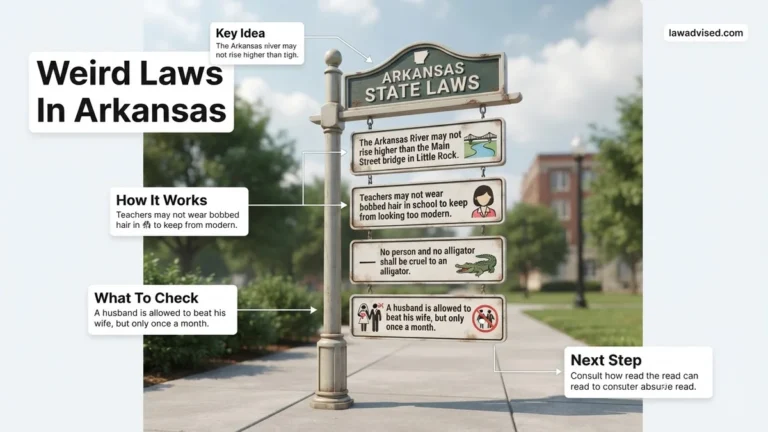
One of the most frequently cited rules involves a historic statute regarding schoolteacher dress codes and the prohibition of bobbed hair for women, though these are entirely obsolete.
Did Arkansas really outlaw the mispronunciation of its name?
The Arkansas General Assembly passed a resolution in 1881 clarifying that the final ‘s’ should be silent, but it carries no penalty or criminal weight.
Are livestock laws still common in rural Arkansas counties?
Yes, many rural jurisdictions maintain specific regulations regarding stray livestock, fencing requirements, and public grazing rights.
Why do so many internet lists feature fake Arkansas laws?
Clickbait articles often exaggerate or completely invent statutes to generate viral amusement, confusing urban legends with actual legal history.
Do police officers enforce any of these silly Arkansas rules?
Law enforcement officers do not enforce archaic or unconstitutional statutes, focusing instead on current criminal and traffic codes.
Where can a person read the actual current Arkansas code?
The official Arkansas Code is publicly accessible online via the state legislature’s website and legal database portals.

Ismail Hossain is the founder of Law Advised. He is an Divorce, Separation, marriage lawyer. Follow him.