Moped Laws in Arkansas 2027 Expert Licensing Guide
Navigating moped laws in Arkansas requires understanding specific engine size limits, licensing mandates, and safety gear requirements. This guide breaks down exactly what the state of Arkansas requires for legal street riding in 2027.
Riding a moped or motorized scooter in Arkansas requires strict adherence to state vehicle codes regarding engine displacement, licensing, and safety gear. If your two-wheeled ride stays at or below 50cc and cannot exceed 30 miles per hour on flat ground, the Natural State classifies it as a motorized bicycle, exempting you from standard motorcycle registration while still demanding a valid driver’s license.
Navigating these regulations correctly prevents costly traffic citations and impoundments in 2027. Whether you are commuting through Little Rock or cruising backroads, understanding the specific legal boundaries keeps you compliant and protected on public streets.
Key Takeaways
- Mopeds must have an engine displacement of 50cc or less.
- A standard driver’s license is required to operate a moped in Arkansas.
- Mopeds cannot exceed a maximum speed of 30 miles per hour on flat ground.
- Operators under the age of 21 must wear a compliant helmet.
- Mopeds must be registered with the Arkansas Department of Finance and Administration.
What Defines a Moped Under Arkansas Legal Standards
Engine Displacement and Speed Thresholds
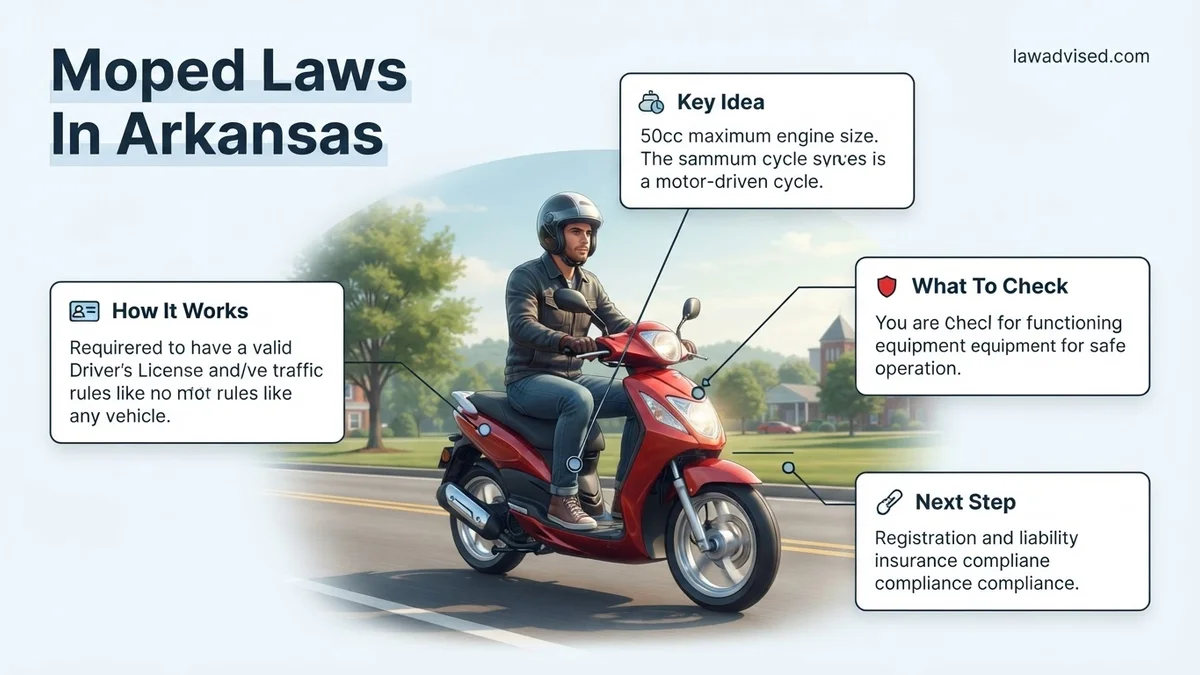
Arkansas law draws a very sharp line based on engineering specs. To legally operate your vehicle as a moped or motorized bicycle without full motorcycle classification, your engine must not exceed 50 cubic centimeters (cc) of piston displacement. Furthermore, the motor must be incapable of propelling the vehicle faster than 30 miles per hour on level pavement. If your scooter has a 150cc engine, the state instantly classifies it as a motorcycle, regardless of how slow you actually ride it.
Pedal Requirements and Transmission Rules
Unlike some states that strictly require functional bicycle pedals for mopeds, Arkansas focuses primarily on motor output and design speed. However, having auxiliary pedals helps prove the vehicle’s motorized bicycle heritage during a traffic stop. Key physical characteristics include:
- Automatic transmission or manual clutch systems are both permitted.
- Power output must remain at or below 2 brake horsepower.
- Electric motors must produce 750 watts or less to qualify.
How to Register Your Moped and Secure Proper Licensing
Driver’s License and Endorsement Mandates
You cannot simply hop on a moped with zero credentials in Arkansas. To legally ride on public roads in 2027, you must possess a valid driver’s license of any class, including a standard Class D automobile license. You do not need a specialized motorcycle endorsement for a true 50cc moped. However, operating the vehicle without any valid driver’s license results in severe penalties, as law enforcement treats it the same as driving a car unlicensed.
State Registration and Title Exemption Realities
One of the biggest perks of staying under the 50cc threshold in Arkansas is the paperwork reduction. Mopeds and motorized bicycles do not require traditional registration, license plates, or titling through the Office of Motor Vehicle. This saves you money on annual renewal fees and property taxes. Because of this exemption, you should always keep your bill of sale and proof of purchase readily available to prove ownership if police ever question the origin of the scooter.
What Rules Govern Helmet Use and Roadway Operation
Operating a moped in Arkansas requires strict adherence to state safety mandates and traffic laws. According to the Arkansas Department of Public Safety, safety gear requirements depend primarily on the operator’s age. Drivers and passengers under the age of twenty-one must wear a DOT-approved protective helmet at all times. Riders aged twenty-one and older are exempt from the mandatory helmet law, though safety experts strongly recommend continuous use for injury prevention.
Roadway positioning and operational restrictions are equally critical for legal compliance in 2027. Mopeds possess significantly lower top speeds than traditional motorcycles, which creates distinct traffic management challenges.
Operational Restrictions and Highway Access
- Interstate Bans: Mopeds are strictly prohibited from operating on federal interstate highways, controlled-access multi-lane freeways, and high-speed state bypasses.
- Lane Positioning: Drivers must ride as far to the right side of the roadway as safely feasible, utilizing standard bicycle lanes only where local municipal ordinances explicitly permit them.
- Passenger Limits: Carrying a passenger is strictly illegal unless the moped was specifically manufactured with a dedicated second seat and factory-installed passenger footpegs.
What If Your Moped Exceeds State Limits and Fails Compliance
If your two-wheeled vehicle exceeds Arkansas statutory limits for displacement, wattage, or speed, it fails standard moped classification. Operating an unregistered, uninsured motorcycle on public roads carries severe legal penalties, including heavy traffic fines and potential vehicle impoundment. Bringing a non-compliant vehicle into regulatory alignment requires immediate, structured mechanical modifications.
How to Reclassify or Modify a Non-Compliant Vehicle
- Inspect the vehicle engine displacement or electric motor output using a certified diagnostic mechanic to identify exact specification overages.
- Install a mechanical throttle restrictor or engine management limiter to cap maximum attainable speed at or below 30 miles per hour.
- Transition the vehicle classification paperwork by applying for a standard motorcycle title, securing proper endorsement, and purchasing mandatory liability insurance.
- Schedule a comprehensive safety inspection with the Arkansas Office of Motor Vehicles to obtain valid motorcycle registration plates.
What If It Still Doesn’t Work?
If DIY modifications fail to bring your vehicle into legal compliance or pass administrative inspection, systematic troubleshooting is required. Resolving persistent registration and mechanical hurdles ensures full adherence to Arkansas statutes:
- Consult a certified powersports technician to evaluate persistent engine or governor malfunctions, with professional diagnostic services typically ranging from $100 to $250.
- Contact the Arkansas Office of Motor Vehicles directly via phone or local branch office to request a formal vehicle classification review for ambiguous builds.
- Engage a legal or licensing expediter if dealing with custom-built or imported motorized bicycles lacking standard Manufacturer Certificates of Origin.
- Consider trading the non-compliant vehicle for a certified, factory-spec 49cc moped or electric equivalent to completely eliminate regulatory ambiguity.
Conclusion
Navigating Arkansas moped laws in 2027 requires careful attention to engine displacement caps, driver licensing prerequisites, and strict roadway operation rules. Failing to properly register your vehicle or adhere to safety mandates risks costly fines and administrative penalties. According to verified research and transportation safety experts, proactive compliance protects riders from legal liability and prevents severe roadway accidents. Your immediate next step is to audit your moped’s technical specifications against current state thresholds and secure the appropriate licensing documentation today.
❓ Frequently Asked Questions
What is the legal definition of a moped in Arkansas?
Arkansas law defines a moped as a motor-driven cycle with an engine displacement of 50cc or less, automatic transmission, and a maximum design speed of 30 mph on flat ground.
Is insurance mandatory for moped riders in Arkansas?
Yes, liability insurance is required for all motor-driven cycles operated on public roads in the state, including standard mopeds and motorized scooters.
Can I ride a moped in bike lanes or sidewalks in Arkansas?
Mopeds are classified as motor vehicles and must be operated on public streets and roadways. Riding on sidewalks or dedicated pedestrian paths is strictly prohibited.
Do I need to pass a safety inspection to register my moped?
Arkansas does not require a formal annual safety inspection for standard mopeds, but the vehicle must be equipped with working headlights, taillights, and brakes.
What happens if my 50cc scooter goes faster than 30 mph?
If your two-wheeled vehicle is capable of exceeding 30 mph, Arkansas reclassifies it as a motorcycle, requiring a proper motorcycle endorsement and additional safety equipment.
Are out-of-state moped visitors subject to Arkansas laws?
Yes, anyone operating a moped on public roads within Arkansas must comply with local speed limits, licensing rules, and helmet mandates regardless of their home state.

Ismail Hossain is the founder of Law Advised. He is an Divorce, Separation, marriage lawyer. Follow him.