Furlough Laws in California 2027 Expert Compliance Guide
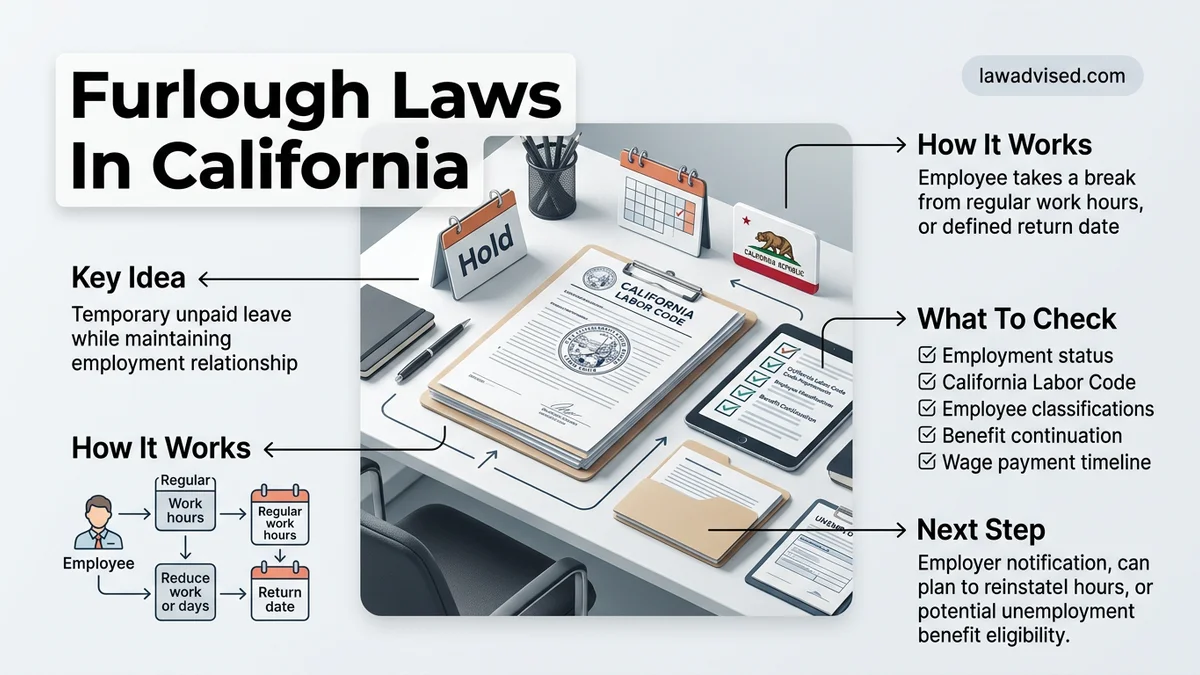
Navigating furlough laws in california requires strict adherence to state labor codes regarding exempt and non-exempt employee pay. Employers must manage salary basis rules, notice requirements, and EDD unemployment eligibility carefully to avoid costly legal violations.
California labor law treats employee furloughs not as a casual scheduling adjustment, but as a temporary reduction in hours or a temporary layoff. To remain compliant under state regulations in 2027, you must navigate strict rules regarding wage and hour laws, the salary basis test for exempt workers, and precise final pay timing.
Violating California furlough mandates exposes your business to severe penalties, including claims for unpaid wages, statutory interest, and private attorney general (PAGA) lawsuits. Knowing how to correctly execute a furlough without triggering misclassification or wrongful termination claims is critical for protecting your bottom line.
Key Takeaways
- Non-exempt employees cannot perform any work while furloughed or unpaid.
- Exempt employees must generally receive full weekly salary if they perform any work.
- California and federal WARN acts may mandate advance notice for mass furloughs.
- Furloughed employees usually qualify for EDD unemployment insurance benefits.
- Zero-hour indefinite reductions may trigger final pay requirements under state law.
What Causes Compliance Failures Under Furlough Laws in California
Misunderstanding Exempt Versus Non-Exempt Rules
The most common compliance failure during a California furlough involves mishandling employee classifications. Under California Labor Code, non-exempt employees only need to be paid for hours actually worked. If you furlough a non-exempt worker, you simply stop paying them for the unworked hours, provided their pay reflects minimum wage requirements for any hours they do work during a partial pay period.
Exempt employees present a much higher legal risk. If you implement a furlough that reduces an exempt employee’s schedule, you must be extremely careful. To maintain exempt status under California law in 2027, the employee must meet specific salary thresholds—tied directly to the state minimum wage—and receive their full predetermined salary for any week in which they perform any work.
Violating the Salary Basis Test
If an exempt employee performs even a single task during a workweek, you generally must pay their full weekly salary. Reducing an exempt employee’s pay mid-week because of a furlough violates the salary basis test. Once you violate this test, you risk destroying the employee’s exempt status, potentially triggering retroactive overtime liabilities for up to four years.
- Full-Week Furloughs: You do not need to pay exempt employees for any workweek in which they perform zero work.
- Partial-Week Furloughs: You cannot make deductions from an exempt employee’s salary for partial-week or partial-day furloughs without risking their exempt classification.
- Alternative Solutions: Many California employers transition exempt staff to non-exempt status temporarily before a furlough, though this requires clear communication and meticulous timekeeping.
How to Fix Employee Classification and Pay Issues During a Furlough
Restructuring Schedules for Exempt Personnel
If you need exempt employees to share the burden of a slowdown, you cannot simply dock their pay by 20 percent for working four-day weeks instead of five. Instead, you must shut down operations entirely for designated full-week blocks. By ensuring the exempt employee performs absolutely no work—including checking email or answering calls—during that entire workweek, you can legally avoid paying their salary for that specific week.
Alternatively, you can officially reclassify the employee as non-exempt before the furlough period begins. This requires you to adjust their hourly rate to match or exceed their previous salary equivalent, ensure they track every minute worked, and pay overtime if they exceed 8 hours in a day or 40 hours in a week when they return.
Auditing Payroll and Timekeeping Practices
Before launching any furlough program in 2027, conduct an internal payroll audit to catch compliance gaps. Ensure your managers understand that furloughed exempt staff must be completely disconnected from company communications. Clear policies prevent accidental work performance that ruins a legally compliant full-week furlough.
- Written Furlough Agreements: Issue clear notices specifying the expected start and end dates of the furlough, or designate it as an indefinite temporary layoff.
- Zero-Work Enforcement: Block system access for furloughed exempt workers to prevent off-the-clock work violations.
- Regular Compliance Checks: Review timecards weekly for non-exempt staff to verify that reduced schedules do not inadvertently drop average hourly earnings below legal mandates.
Step-by-Step Guide to Managing EDD Unemployment Claims for Furloughed Staff
Navigating the California Employment Development Department (EDD) system during a temporary shutdown requires precise administrative tracking. Furloughed employees generally qualify for unemployment benefits because their hours are reduced through no fault of their own. Employers must understand their reporting duties to avoid costly penalties and delays in worker relief.
Submitting Employer Responses Timely
When an employee files a claim, the EDD issues a Notice of Unemployment Insurance Claim Filed. Employers have strictly 10 days from the mail date to respond if they wish to contest the claim or clarify the temporary nature of the separation. Failing to respond accurately can increase your company’s Unemployment Insurance (UI) tax reserve account rate.
- Review the EDD notice immediately upon receipt to verify employee earnings and separation reasons.
- Indicate clearly on the form that the worker is on a temporary furlough with a defined return-to-work date.
- Submit the response through the EDD Employer Portal before the 10-day statutory deadline expires.
What If WARN Act Notice and Final Pay Rules Still Apply to Your Business
Extended furloughs can unexpectedly trigger mass layoff regulations under federal and California state laws. The California Worker Adjustment and Retraining Notification (WARN) Act mandates a strict 60-day advance notice for plant closures or substantial layoffs affecting 50 or more employees within a 30-day period. Crucially, a temporary furlough that extends beyond six months automatically converts into a permanent termination under current employment regulations.
Triggering Mass Layoff Penalties
Failing to provide proper WARN notice exposes employers to severe financial liabilities. Courts can require companies to pay back-pay and benefits for up to 60 days, alongside civil penalties of up to $500 per day of violation. Furthermore, if a furlough is deemed indefinite, California Labor Board standards may require immediate final wage payouts, including accrued paid time off (PTO), on the last active day of work.
- Audit your total workforce numbers and the planned duration of the furlough before implementation.
- Issue formal written WARN notices immediately if the reduction is projected to exceed the six-month statutory threshold.
- Calculate and disburse final wages immediately if the furlough status transitions into a permanent separation.
What If Your Furlough Strategy Still Fails Compliance?
Even with careful planning, unexpected labor disputes or exemption misclassifications can disrupt your reduction strategy. If standard compliance measures fail to resolve internal grievances, organizations must execute immediate corrective fallback procedures.
- Audit all active employee classifications immediately to verify whether exempt staff performed non-exempt tasks during the reduced schedule.
- Consult an employment law specialist or certified labor attorney to review complex, multi-site reduction plans. Expect professional legal consultations to range from $300 to $650 per hour depending on firm specialization.
- Engage professional HR mediation services to resolve pending wage claims or EDD disputes before formal litigation begins.
- Retroactively correct payroll discrepancies and issue back-pay adjustments within 48 hours of identifying a miscalculation.
Conclusion
Managing California furlough laws in 2027 demands absolute adherence to strict wage, hour, and notice regulations. Employers who fail to balance exempt salary thresholds and EDD compliance risk steep state penalties. According to verified research and expert sources from the California Labor and Workforce Development Agency, proactive legal auditing remains the most effective defense against costly wrongful termination claims. Take your next actionable step today by scheduling a comprehensive employment compliance review with your human resources team.
❓ Frequently Asked Questions
How do California furlough laws treat exempt versus non-exempt employees differently?
Non-exempt employees are paid hourly and receive no pay during unpaid furloughs, meaning they must perform zero work. Exempt employees receive a salary and must be paid their full weekly salary if they perform any work at all during that specific workweek.
Can an employer reduce an exempt employee’s salary for a full-week furlough?
Yes, an employer can reduce an exempt employee’s salary for a full workweek during a pre-planned furlough, provided the employee performs zero work during that entire week and the reduction was not ad-hoc.
Are California employers required to pay out accrued vacation during a furlough?
California law does not explicitly require employers to cash out accrued vacation time during a temporary furlough unless the employment relationship is officially terminated or the company policy mandates it.
How do employees apply for EDD benefits during a temporary furlough in California?
Furloughed employees can file an unemployment insurance claim online through the California Employment Development Department (EDD) website, providing details about their employer and temporary reduction in hours.
What happens if a furlough is extended indefinitely in California?
If a temporary furlough is extended indefinitely or turns into a permanent layoff, the employer may trigger final pay requirements and WARN Act obligations depending on the number of impacted staff.
Can employers dictate when employees use paid time off during a furlough?
Yes, California employers generally have the right to require employees to use their accrued vacation time during a temporary shutdown or furlough period, subject to company policy.

Ismail Hossain is the founder of Law Advised. He is an Divorce, Separation, marriage lawyer. Follow him.