Sex in Car Laws in California 2027 Expert Legal Guide
Having sex in a car in California is not explicitly illegal by name, but engaging in sexual acts inside a vehicle frequently violates several state criminal statutes. Depending on the location, visibility, and consent of property owners, individuals can face serious charges ranging from disorderly conduct to indecent exposure.
Yes, having sex in a car in California can be strictly illegal depending entirely on where your vehicle is parked and whether anyone else can see you. While romantic spontaneity in a vehicle is a common trope, California law does not carve out an exception for cars parked on public streets or state property. If law enforcement catches you, you will not just face a minor citation for a parking violation; you could face misdemeanor criminal charges that carry steep financial penalties and, in severe cases, mandatory sex offender registration.
Navigating the legal reality of California in 2027 requires knowing the exact statutes prosecutors use to file charges. Local law enforcement agencies routinely patrol scenic overlooks, highway rest stops, and public beach parking lots specifically looking for occupied vehicles with fogged windows. Understanding the precise penal codes at play will help you see why this romantic endeavor carries life-altering legal risks.
Key Takeaways
- Car sex is not a specific crime, but related public acts violate California Penal Code.
- Public visibility is the primary factor that triggers criminal charges like disorderly conduct.
- Parked cars on public property carry a much higher risk of legal penalties.
- Indecent exposure charges under PC 314 can result in mandatory sex offender registration.
- Trespassing charges apply if the vehicle is parked on private property without permission.
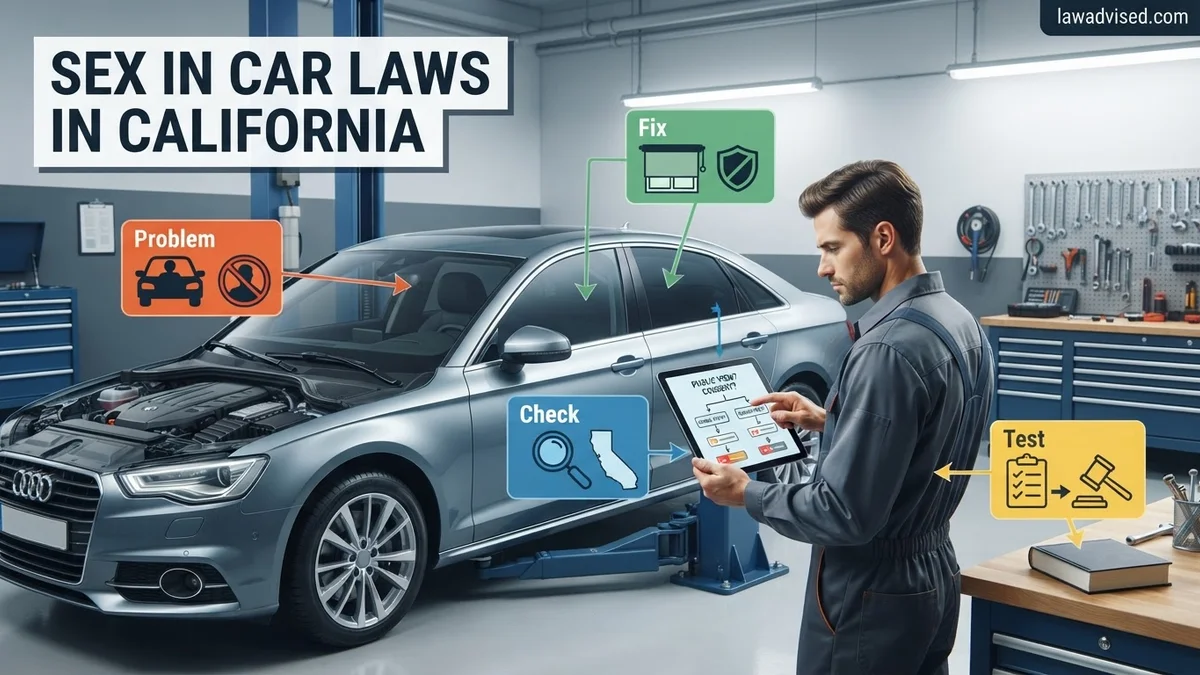
What Causes Legal Trouble With Sex in Cars in California
California Penal Code 647(a) Disorderly Conduct
The most common charge you will face for having sex in a car is disorderly conduct under California Penal Code 647(a). This statute makes it illegal to engage in lewd or dissolute conduct in any public place or in any place open to the public or exposed to public view. Prosecutors do not need to prove that a crowd watched you. They only need to show that you were in a location where a member of the public could have seen you.
- Public View Standard: Parking on a public street or a dark beach lot satisfies this requirement if an officer or passerby can walk up and peer through your windows.
- Misdemeanor Penalties: A conviction under PC 647(a) is classified as a misdemeanor. You face up to six months in county jail and fines reaching $1,000.
California Penal Code 314 Indecent Exposure
If you take off your clothes and officers determine that your actions were meant to gratify sexual desire while displaying your body to unwilling observers, you could be charged under California Penal Code 314 for indecent exposure. This is a far more serious criminal offense that elevates your legal exposure significantly.
- Intent Factor: The prosecution must prove willful intent to direct public attention to your exposed private parts.
- Registry Consequences: A conviction under PC 314 often triggers mandatory registration on the California Sex Offender Registry (Megan’s Law), permanently altering your employment and housing prospects.
How to Fix and Prevent Legal Violations Under California Law
The Private Property Exception
The primary legal defense against public sexual conduct charges relies on the location of your vehicle. California law penalizes public exposure and conduct, meaning that strictly private property operates under different rules. However, you must meet exact legal standards to claim this defense.
- True Private Spaces: Parking inside a private, fully enclosed home garage or on private residential property well away from public view generally eliminates the “public place” element of PC 647(a).
- The Driveway Trap: Be cautious of front-facing residential driveways. If your car is visible from a public sidewalk or street, police can still argue the location was exposed to public view.
Mitigating Charges and Legal Defense Steps
If you or someone you know receives a citation or faces arrest for car-based activity in 2027, immediate legal intervention is necessary. Prosecutors sometimes overcharge these offenses, leveraging the threat of the sex offender registry to force plea deals on lesser charges.
- Challenging Visibility: A skilled defense attorney will examine whether the vehicle had completely blocked windows, or whether law enforcement violated your Fourth Amendment rights by shining flashlights into the car without probable cause.
- Plea Bargaining: Attorneys frequently negotiate to reduce a 647(a) charge down to a simple non-sexual infraction, such as disturbing the peace or a local municipal code violation, thereby avoiding jail time and criminal records.
Step-by-Step Breakdown of Public Versus Private Property Rules
California law treats vehicular intimacy differently depending on exact geographic jurisdiction and property ownership status. Navigating these legal boundaries requires understanding how municipal codes intersect with state penal statutes in 2027.
Public Parking Lots and Streets
State and local authorities maintain strict jurisdiction over public thoroughfares, municipal parks, and government-owned parking structures. Intimacy in these zones almost invariably triggers public exposure or disorderly conduct citations, regardless of window tinting or vehicle placement.
- Law enforcement officers patrol these areas frequently, increasing the statistical probability of immediate intervention.
- Municipal codes often carry additional local fines that stack on top of standard state misdemeanor charges.
- Even if the vehicle is legally parked, the public nature of the property strips away reasonable expectations of privacy.
Private Property and Residential Driveways
Private property offers significantly more legal protection under California privacy expectations, though vulnerabilities still exist. Vehicles parked inside private residential garages or on private property with owner consent generally satisfy privacy requirements.
- The property owner must grant explicit permission for the vehicle to remain parked and occupied on the premises.
- If the vehicle remains visible from public sidewalks or neighboring yards without obstruction, police may still investigate for disturbing the peace.
- Commercial private lots, such as shopping mall parking structures, occupy a legal gray area where private ownership rules apply, but public access laws often override owner leniency.
What If Charges Still Apply Despite Obstructed Windows
Drivers frequently assume that completely blocking out light and visibility shields them from all legal liability. According to California criminal defense data, law enforcement routinely issues citations even when occupants take extensive measures to obscure the vehicle interior.
Common Fallback Scenarios and Defenses
When primary indecency charges fail to stick due to privacy measures, prosecutors frequently pivot to alternative statutory violations. Legal experts note that secondary infractions often carry unexpected financial and administrative penalties.
- Review the exact statutory code cited on the citation, as officers frequently misapply California Penal Code Section 647(a) when privacy screens are present.
- Assess whether the vehicle violated California Vehicle Code regulations regarding illegal window tinting or sun-shading materials obstructing the driver’s immediate view.
- Consult with a qualified criminal defense attorney specializing in California public morals and vehicle code violations immediately. Professional legal representation for misdemeanor charges typically ranges from $1,500 to $5,000 depending on court appearances required.
- Request formal police dashcam and body-worn camera footage through legal discovery to contest the officer’s assertion of public visibility.
Conclusion
Navigating the complex intersection of California privacy expectations and vehicle occupancy laws demands strict adherence to property boundaries and statutory definitions. According to verified research and expert legal sources, assuming immunity based solely on window coverings or remote parking locations remains a costly legal mistake in 2027. The most actionable next step for anyone facing unexpected citations is to schedule a consultation with a licensed California defense attorney to evaluate the specific jurisdictional facts of the case.
❓ Frequently Asked Questions
What specific criminal charges apply to having sex in a car in California?
Law enforcement commonly cites individuals under California Penal Code 647(a) for disorderly conduct or lewd conduct. If the acts are openly exposed to passersby, prosecutors may pursue Penal Code 314 for indecent exposure, which carries severe misdemeanor or felony penalties.
Does the location of the vehicle make a difference in California?
Yes, location is critical. Vehicles parked on public streets, highway rest stops, public parks, or beaches are considered public places. Private property offers more legal protection, provided you have permission to park there and the act cannot be seen by the public.
Are tinted windows or sunshades a legal defense against public indecency charges?
Tinted windows reduce visibility, which can make it harder for police to prove public exposure. However, if officers or citizens can clearly see through the windows, or if police investigate a suspicious vehicle and witness the act, window tinting will not prevent a citation.
What are the potential penalties for a disorderly conduct conviction under PC 647(a)?
A conviction for disorderly conduct involving lewd acts is typically classified as a misdemeanor. Penalties can include up to six months in county jail, informal probation, and fines reaching up to $1,000.
Can police search your car just because you are parked in a remote area?
Police generally need probable cause or your consent to search the interior of your vehicle. Simply being parked or engaging in consensual activity does not automatically grant officers the right to search without a warrant, though they may check your identification.
What should you do if police approach your car while parked?
Remain calm, keep your hands visible, and comply with basic law enforcement requests such as providing identification. If questioned about your activities, you have the right to remain silent and request an attorney before answering detailed inquiries.

Ismail Hossain is the founder of Law Advised. He is an Divorce, Separation, marriage lawyer. Follow him.