Motorcycle Laws in Arizona 2027 Expert Legal Guide
Navigating motorcycle laws in Arizona requires understanding specific statutes regarding safety gear, equipment, and the state’s legal lane filtering rules. Riders must comply with age-based helmet mandates, mandatory equipment standards, and proper licensing requirements to ensure lawful operation on public roads.
Arizona operates under specific statutory frameworks for motorcycle riders, balancing rider freedom with strict safety and operational mandates. If you ride in the Grand Canyon State as of 2027, you must comply with exact statutes regarding universal helmet mandates by age, strict equipment configurations, and precise lane filtering protocols.
Failing to understand these rules can result in costly traffic citations, increased insurance premiums, and severe liability complications if you are involved in a collision. Knowing the exact legal boundaries keeps you on the right side of the law and protects your financial recovery rights.
Key Takeaways
- Helps riders under 18 comply with mandatory state helmet laws.
- Clarifies legal requirements for lane filtering under Arizona statute SB 1273.
- Outlines required street-legal equipment including mirrors, lights, and exhaust systems.
- Details minimum insurance and licensing thresholds for operators.
- Prevents costly traffic citations by detailing passenger and handlebar regulations.
What Causes Legal Violations Under Motorcycle Laws in Arizona
Helmet Requirements and Minor Compliance
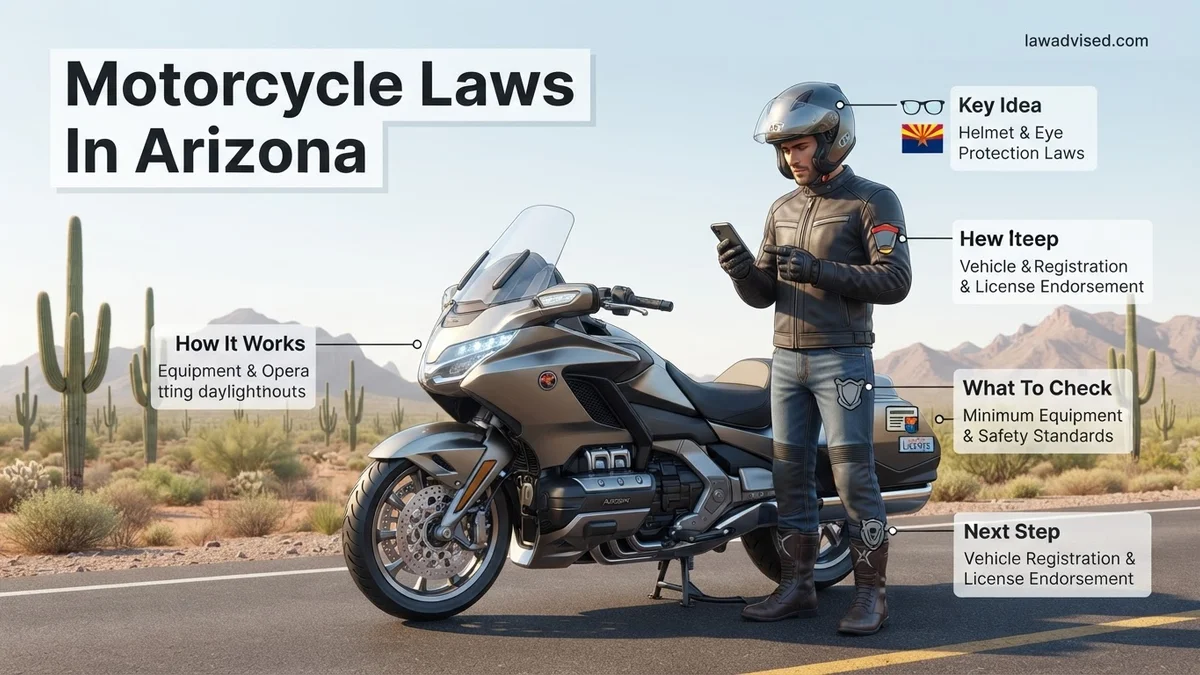
Arizona Revised Statute ARS 28-964 dictates that anyone under the age of 18 must wear a securely fastened DOT-approved helmet while operating or riding as a passenger on a motorcycle. Riders 18 and older may legally choose to ride without a helmet, but doing so shifts specific liability considerations in personal injury claims.
-
Core compliance rules:
- Operators and passengers under 18 require a DOT-certified helmet.
- Protective eyewear is legally mandated for all riders unless the motorcycle features a permanent windshield.
- Failing to provide eye protection while operating without a windshield results in a primary traffic violation.
Lane Filtering Regulations Under SB 1273
Arizona permits motorcycle lane filtering, which allows riders to move past stopped traffic safely under strict, regulated conditions. You cannot simply weave through traffic at highway speeds; you must adhere to the parameters established by Senate Bill 1273.
-
Strict conditions for legal filtering:
- Traffic must be completely stopped or traveling at speeds of 10 mph or less.
- Your motorcycle cannot exceed a maximum speed of 15 mph while filtering.
- Filtering is restricted to roads with a speed limit of 45 mph or higher, featuring at least two adjacent lanes in the same direction.
- You cannot filter on the shoulder or in oncoming traffic lanes.
How to Comply With Equipment and Safety Mandates
Mandatory Physical Equipment for Street Legality
Your motorcycle must feature specific mechanical components to pass state inspection and avoid arbitrary stops by law enforcement. Operating a custom or minimalist build requires careful attention to these non-negotiable statutory equipment minimums.
-
Required street components:
- At least one rearview mirror mounted on the left handlebar to monitor traffic behind you.
- A working headlight that remains illuminated at all times while the engine operates.
- A functional rear red taillight and a visible license plate illumination light.
- Properly functioning front and rear brakes capable of stopping the motorcycle within statutory deceleration limits.
- An exhaust system equipped with a muffler to prevent excessive or unusual noise.
Passenger Accommodation and Seating Rules
Carrying a passenger on your motorcycle in Arizona requires more than just an extra seat. The bike must be structurally equipped from the factory or properly modified to safely accommodate a secondary rider without compromising balance or control.
-
Passenger legal requirements:
- Your motorcycle must feature designated passenger footpegs or footrests.
- A proper passenger seat or a securely extended dual-rider saddle is mandatory.
- Children under the age of 18 must still wear a DOT-approved helmet regardless of whether they ride behind the operator or in a sidecar.
- The operator must ensure the passenger does not interfere with the handlebars or the safe operation of the vehicle.
How to Execute Legal Lane Filtering in Arizona
Arizona law permits motorcycle lane filtering under specific statutory conditions. To execute this maneuver legally, riders must follow exact operational rules established by the Arizona Department of Transportation. Misinterpreting these parameters can result in moving violations and increased liability during traffic collisions.
Operational Requirements for Filtering
Riders must adhere strictly to environmental and speed restrictions when filtering through queued traffic. According to state traffic statutes, lane filtering is only lawful under the following verified conditions:
- The roadway must feature two or more adjacent lanes traveling in the same direction with a marked speed limit of 45 miles per hour or greater.
- Traffic must be completely stopped or moving at a speed of 15 miles per hour or less.
- The motorcycle must not exceed a maximum speed of 15 miles per hour while filtering through the congestion.
- The maneuver must be performed safely and without forcing other vehicles to take evasive action.
What If Your Motorcycle Fails Inspection or Licensing Requirements
Failing to meet state equipment standards or licensing prerequisites during a traffic stop or registration renewal in 2027 carries immediate legal consequences. Riders facing equipment citations or administrative hurdles must take corrective action quickly to avoid steep fines or vehicle impoundment.
Corrective Steps for Compliance Failures
If your motorcycle fails to meet legal requirements or if you face administrative penalties, complete these troubleshooting steps:
- Review the specific equipment or licensing violation listed on the citation or inspection report to identify the exact statutory deficiency.
- Schedule a certified safety and emissions inspection at an authorized Arizona testing facility to correct mechanical or exhaust infractions.
- Procure replacement parts that comply with Federal Motor Vehicle Safety Standards (FMVSS) if aftermarket modifications caused the failure.
- Visit the Arizona MVD to submit proof of correction, where fix-it ticket dismissals typically incur administrative processing fees ranging from $25 to $50.
- Consult a qualified traffic attorney if your license suspension involves complex points or DUI-related infractions, with legal representation fees averaging $500 to $1,500.
Conclusion
Navigating Arizona motorcycle laws in 2027 requires strict adherence to equipment standards, licensing tiers, and lane filtering protocols. Failing to comply with state regulations can lead to costly fines, insurance penalties, and heightened legal liability on the road. According to verified research and expert legal sources, proactive maintenance and strict adherence to traffic statutes remain the most effective ways to protect your riding privileges. Review your current vehicle setup and licensing status today to ensure complete compliance with Arizona law.
❓ Frequently Asked Questions
What exact conditions make lane filtering legal in Arizona?
Under Arizona law SB 1273, a motorcycle can filter past stopped traffic on roads with a speed limit of 45 mph or less, provided traffic is completely stopped and the filtering speed does not exceed 15 mph.
What eye protection is legally required if I am not wearing a helmet?
If operating a motorcycle without a windshield, riders must wear protective glasses, goggles, or a transparent face shield meeting safety standards.
Are rearview mirrors mandatory on motorcycles in Arizona?
Yes, every motorcycle registered in Arizona must be equipped with at least one rearview mirror mounted on the left side to provide a clear view of the highway behind.
What are the passenger requirements for motorcycles in Arizona?
Passengers must be provided with dedicated footpegs and a secure seat. Additionally, passengers under 18 must wear an approved safety helmet.
Do I need a motorcycle endorsement on my driver’s license?
Yes, operating a motorcycle on Arizona public roads requires either a valid Class M motorcycle license endorsement or a motorcycle-only license.
Are aftermarket exhaust pipes legal if they are loud?
Exhaust systems must be equipped with a muffler to prevent excessive or unusual noise. Straight pipes or modified exhausts that exceed local noise ordinances can result in citations.

Ismail Hossain is the founder of Law Advised. He is an Divorce, Separation, marriage lawyer. Follow him.