Recording Laws in Arizona 2027 Expert Step-by-Step Guide
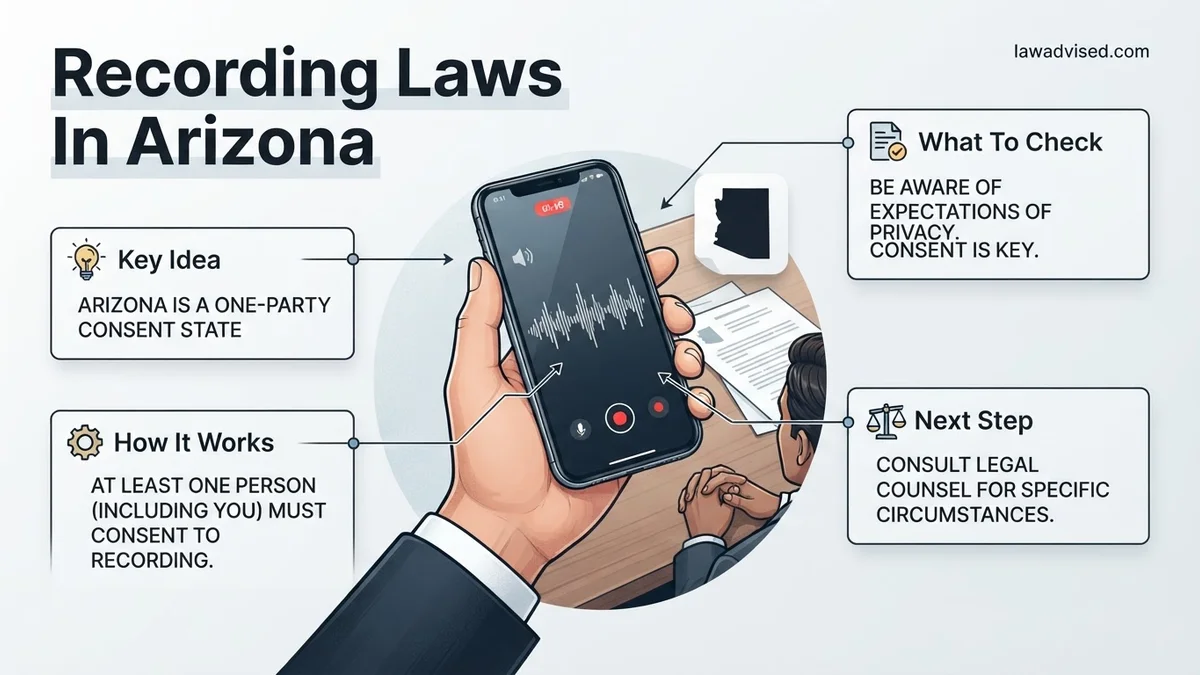
Arizona is a one-party consent state under A.R.S. § 13-3005 and § 13-3012, meaning only one person involved in a conversation needs to agree to the recording. This rule applies to in-person talks and phone calls as long as the recording party is a participant. However, illegal recordings or violations of privacy in private spaces can result in serious legal consequences.
Yes, it is legal to record conversations, phone calls, and video in Arizona without the other person’s consent, provided you are a participant in that conversation. Under Arizona statutes A.R.S. § 13-3005 and § 13-3012, the state operates strictly as a one-party consent jurisdiction. This means only a single individual involved in the communication needs to agree to the recording, and that person can legally be you.
Navigating these laws correctly in 2027 protects you from severe legal penalties, civil lawsuits, and inadmissible evidence in court. Whether you are recording a contentious business meeting, a phone call, or public interactions, knowing the precise boundaries of one-party consent keeps your actions entirely lawful.
Key Takeaways
- Arizona requires only one participant’s consent to legally record a conversation.
- You can record any phone call or in-person talk if you are part of it.
- Public spaces generally carry no reasonable expectation of privacy for audio or video.
- Recording police officers performing official duties in public is fully legal.
- Secretly recording conversations where you are not a participant is a felony.
What Causes Legal Violations Under Arizona Recording Laws
Recording Conversations Without Participation
The most common legal violation occurs when individuals attempt to record private conversations they are not actively participating in. If you plant a recording device in a room to listen to a conversation between two other people, you violate Arizona wiretapping laws. You must be a party to the dialogue.
- Placing hidden bugs in a spouse’s car or office without participating in the discussion.
- Leaving a voice recorder running in an empty conference room to catch colleagues talking behind your back.
- Remotely hacking a third-party phone line to intercept private calls.
Ignoring the Reasonable Expectation of Privacy
Even with one-party consent, you can cross legal lines if you record individuals in spaces where they hold a high, legally protected expectation of privacy. Public streets offer zero expectation of privacy, but private spaces drastically change the legal calculus.
- Recording video or audio inside a residential bathroom, bedroom, or private doctor’s office.
- Peering through residential windows with recording equipment from public property.
- Ignoring explicit property rules or lease agreements that ban recording devices on private business premises.
How to Fix and Ensure Compliance When Recording Conversations in Arizona
Verifying Your Status as an Active Participant
Before hitting record on your smartphone or digital device in 2027, confirm that you are an active, conversational participant in the interaction. If you are part of the exchange, your own consent satisfies the legal requirement under Arizona law.
- Participate directly in the verbal exchange rather than acting as a silent, remote observer.
- Ensure your microphone captures your voice alongside the other party to establish your presence.
- Review state boundaries if your phone call crosses state lines, as multi-state calls can trigger stricter all-party consent rules from the other jurisdiction.
Assessing Public Versus Private Locations
To stay fully compliant, evaluate the physical location of your recording. Public spaces generally permit open recording, but private venues require caution.
- Confirm you are standing in a public area, such as a sidewalk, park, or open government building, where people lack privacy expectations.
- Obtain explicit permission if you are recording inside a privately owned business that enforces a strict no-recording policy.
- Stop recording immediately if you move from a public space into a private area where expectations of privacy instantly apply.
Step-by-Step Guide to Recording Public Spaces and Law Enforcement Legally
Navigating the active recording landscape in Arizona requires adhering to specific legal protocols, especially when interacting with law enforcement officers performing their official duties. According to civil liberties data updated for 2027, citizens maintain a constitutionally protected right to film police in public spaces, provided they do not physically interfere with ongoing operations.
Sub-step 1: Establish Your Legal Position
- Position yourself at a safe, reasonable distance from the officer, typically maintaining a buffer of at least 8 feet if ordered by law enforcement for safety reasons.
- Ensure your recording device remains clearly visible and that you do not make sudden physical movements toward the officers or detained individuals.
- State clearly that you are documenting public servants performing public duties if questioned about your intentions by bystanders or security personnel.
Sub-step 2: Managing Interference Claims
- Never block pathways, touch officers, or loudly shout commands that drown out lawful police orders during the interaction.
- Keep your audio and video running continuously to capture the entirety of the exchange without selective editing that could be contested later.
- Comply immediately with lawful safety directives while verbally asserting your right to record from a permitted vantage point.
What If It Still Doesn’t Work: Handling Disputed Recordings and Privacy Claims
If you encounter unlawful confiscation of your recording device, deletion demands, or threats of arrest despite complying with Arizona single-party consent and public space laws, immediate procedural escalation is necessary. Local law enforcement agencies and private parties may push back improperly, requiring structured fallback steps to protect your media assets and legal standing.
- Secure Cloud Backup Immediately: Ensure your recording automatically syncs to an encrypted cloud server in real-time so that physical device seizure cannot destroy the evidence.
- Document Badge and Patrol Numbers: Record the specific identifying details, vehicle numbers, and agency affiliations of any personnel who unlawfully demand deletion of your files.
- File an Internal Affairs or ACLU Complaint: Submit a formal misconduct report to the local police department oversight board or civil rights organizations within 48 hours of the incident.
- Retain a Civil Rights Attorney: If your First or Fourth Amendment rights were violated through wrongful arrest or device seizure, consult a licensed attorney. Professional legal representation for initial demand letters and constitutional violation lawsuits typically ranges from $2,500 to $7,500 depending on the complexity of the case.
Conclusion
Mastering Arizona recording laws in 2027 hinges on understanding the strict boundaries between one-party consent phone calls, private property expectations, and protected public surveillance of law enforcement. When disputes arise over device confiscation or privacy claims, prompt documentation and cloud backups serve as critical safeguards. According to verified research and expert legal sources, proactive compliance paired with firm assertion of constitutional rights remains the most effective strategy for hassle-free documentation. Take the next step by reviewing local municipal ordinances to ensure your recording gear meets all current 2027 state standards.
❓ Frequently Asked Questions
What does Arizona’s one-party consent law actually mean for everyday citizens?
Under A.R.S. § 13-3005, it means that as long as you are part of a conversation, you can record it without notifying or getting permission from the other participants. This applies to both face-to-face dialogues and telephone calls.
Can my employer record my workplace conversations in Arizona?
Employers can often record workplace communications if a company policy outlines it or if a management representative is part of the conversation. However, hidden cameras in areas with a high expectation of privacy, like restrooms, remain strictly illegal.
Does the one-party consent law apply across state lines during phone calls?
Interstate phone calls can complicate legal rules because other states enforce strict all-party consent laws. It is generally safest to obtain consent from all parties if you are calling someone in a two-party consent state.
Can I use a secretly recorded conversation in an Arizona court?
Generally, if you are a participant in the conversation, the recording is admissible as evidence, provided it meets other standard rules of evidence and was not obtained through criminal extortion.
Where is it illegal to use video surveillance or audio recording in Arizona?
You cannot record in private spaces where individuals have a reasonable expectation of privacy, such as locker rooms, restrooms, bedrooms, or private homes where you have no legal right to be.
What should I do if someone accuses me of illegally recording them?
Review whether you were a participant in the conversation and whether the recording occurred in a public or private space. If criminal charges or civil disputes arise, consult a qualified attorney immediately.

Ismail Hossain is the founder of Law Advised. He is an Divorce, Separation, marriage lawyer. Follow him.