Traffic Laws in Arizona 2027 Expert Guide to Rules & Fines
Navigating traffic laws in Arizona requires strict adherence to state statutes regarding speed limits, hands-free mobile device usage, and unique local weather laws. Drivers who fail to follow Title 28 regulations face severe fines, license point accumulations, and potential criminal charges.
Arizona enforces strict traffic laws designed to manage rapid population growth and highway congestion across the Grand Canyon State in 2027. If you drive through Phoenix, Tucson, or rural stretches of Interstate 10, you must navigate a specific set of rules governing speed, mobile device usage, and right-of-way that differ significantly from other states.
Understanding these regulations protects you from escalating fines and helps you avoid accumulating the mandatory points that trigger driver’s license suspensions. Law enforcement agencies across Arizona utilize advanced speed cameras and automated systems, making strict compliance essential for every motorist on the road today.
Key Takeaways
- Arizona strictly bans holding or supporting any mobile device while driving.
- Speeding fines escalate rapidly, and exceeding 85 mph is classified as a criminal misdemeanor.
- Drivers must yield the entire lane to bicyclists when passing on roads with single lanes.
- Dust storm safety laws require motorists to pull off the highway entirely and turn off lights.
- Accumulating 8 or more points on your driving record triggers mandatory MVD intervention.
What Causes Traffic Violations and Common Citations in Arizona
The Absolute Ban on Handheld Mobile Devices
Arizona’s distracted driving laws prohibit all drivers from holding or supporting a mobile electronic device while operating a vehicle. You cannot read, write, or send text-based communications, nor can you watch video content. First-time violations carry fines ranging from 75 to 250 dollars, while subsequent offenses increase the financial penalty and add points to your motor vehicle record. You are only permitted to use your phone in hands-free mode or during an emergency call to safety services.
Speeding Violations and Criminal Speeding Thresholds
Exceeding posted limits is the most frequent citation issued by the Arizona Department of Public Safety. However, Arizona uniquely classifies excessive speed as a criminal misdemeanor rather than a simple civil infraction. Driving faster than 85 miles per hour anywhere in the state—regardless of the posted maximum—automatically constitutes criminal speeding. The same applies if you exceed a posted limit by more than 20 miles per hour. A criminal speeding ticket can result in mandatory court appearances, hefty fines, and potential jail time.
How to Comply with Arizona Rules of the Road and Speed Limits
Understanding Statutory and Posted Speed Limits
Arizona relies on both posted signs and statutory limits to govern vehicular velocity. Unless otherwise posted, the statutory speed limit is 15 miles per hour in alleys, 25 miles per hour in residential and business districts, and 65 miles per hour on state and federal highways. On rural interstate highways, maximum limits are typically posted at 75 miles per hour. You must adjust your speed downward during severe desert dust storms or monsoon downpours to maintain safe control of your vehicle.
Right-of-Way and Passing Regulations
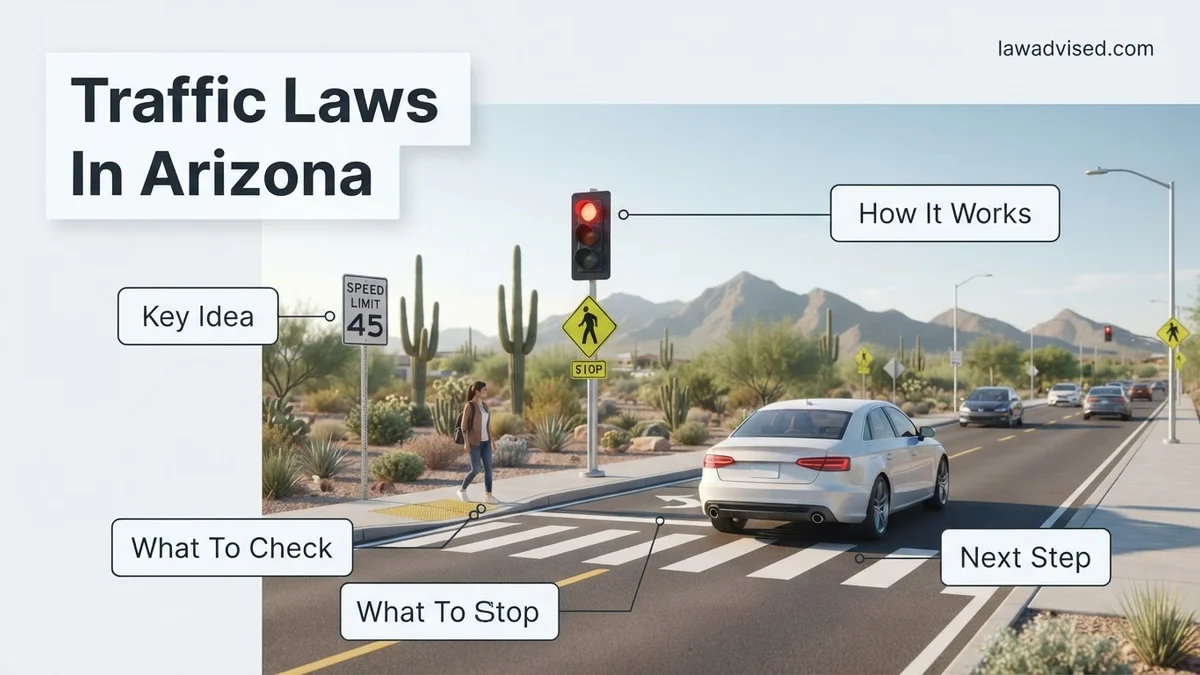
Navigating intersections and multi-lane highways safely requires strict adherence to Arizona right-of-way statutes. You must yield to pedestrians in marked and unmarked crosswalks. When turning left at an intersection without a dedicated green arrow, you must yield to oncoming traffic. On multi-lane highways, you must use the left lane strictly for passing slower vehicles; lingering in the passing lane can result in a civil traffic citation and a fine.
- Yield the right-of-way to emergency vehicles by pulling safely to the extreme right edge of the road.
- Pass only on the left side of a vehicle traveling in the same direction, unless the road features two or more marked lanes for travel in one direction.
- Stop completely behind the school bus stop arm, regardless of which direction you are approaching from on undivided roadways.
Step-by-Step Guide to Managing Traffic Tickets and Point Reductions
Receiving a traffic citation in Arizona requires swift action to prevent severe financial penalties and license suspension. According to the Arizona Department of Transportation, drivers have specific administrative windows to respond to civil traffic violations.
Defensive Driving School Enrollment
- Verify eligibility. Drivers are generally eligible to attend a defensive driving school for ticket dismissal once every 24 months for a single violation.
- Select an ADOT-approved online or in-person school at least seven days before the court date listed on the citation.
- Complete the course and pay the required school fees, which typically range from $150 to $200 including court diversion fees.
- Confirm that the school electronically transmits the completion certificate to the appropriate municipal or justice court.
Requesting a Court Hearing
- Plead not responsible in writing or in person before the scheduled court appearance date on the citation.
- Post any required bond or bail amounts if mandated by the specific local court jurisdiction.
- Attend the scheduled hearing to present evidence, cross-examine the citing officer, and argue the case before a judge or hearing officer.
What If Your License Is Suspended and You Need a Special Restricted Permit
An administrative or points-based license suspension can drastically disrupt daily life in Arizona. Fortunately, ADOT provides legal pathways for qualifying drivers to maintain basic mobility under strict conditions.
Applying for a Special Ignition Interlock Restricted Permit
- Verify that the suspension qualifies for restricted driving privileges under current Arizona Revised Statutes.
- Install a certified ignition interlock device on any vehicle operated by the driver, with installation costs averaging $70 to $150 and monthly monitoring fees near $60 to $90.
- Obtain official proof of financial responsibility, typically in the form of an SR-22 insurance filing maintained continuously for the mandated period.
- Submit the formal application and required fees directly to the Motor Vehicle Division to secure the restricted permit document.
What If It Still Doesn’t Work?
Drivers facing compounding legal obstacles or rejected administrative requests must pursue advanced escalation paths to resolve their status. Consider the following fallback measures:
- Consult a Traffic Attorney: When standard appeals fail or multiple serious violations threaten permanent revocation, retaining a licensed attorney is essential. Professional legal representation generally costs between $500 and $2,500 depending on court complexity.
- Petition for a Formal MVD Hearing: File a written request for an administrative hearing to challenge discretionary suspensions or medical revocations directly through the executive office.
- Request a Hardship Review: Submit documented proof of extreme economic or medical necessity to an administrative law judge for specialized driving allowances.
- Clear Outstanding Warrants: Address any failure-to-appear notices immediately by posting bond and resetting court dates to lift secondary license blocks.
Conclusion
Navigating Arizona traffic laws in 2027 requires strict adherence to legal timelines, fee deadlines, and point management protocols. According to verified research and expert legal sources, proactive compliance through defensive driving courses or restricted permit applications prevents long-term financial hardship. Take the actionable next step today by checking your official MVD driving record online to verify your current point total and compliance status.
❓ Frequently Asked Questions
What are the penalties for excessive speeding in Arizona?
Exceeding the posted speed limit by more than 20 mph, or driving over 85 mph anywhere in the state, is classified as a criminal misdemeanor. Penalties include heavy fines, mandatory court appearances, and potential jail time.
How do Arizona traffic cameras affect my driving record?
Photo enforcement citations are typically mailed to the vehicle’s registered owner. Proper service of process is required by Arizona law, and ignoring a valid photo radar ticket can lead to a default judgment and license suspension.
Can I attend traffic school to dismiss a ticket in Arizona?
Most drivers with eligible minor civil traffic violations can complete Arizona’s Defensive Driving School program once every 12 months. Successful completion dismisses the ticket and prevents points from appearing on your MVD record.
What is the legal passing distance for bicycles on Arizona roads?
Motorists must provide a safe distance of at least three feet when passing a bicyclist traveling in the same direction. Drivers may cross double yellow lines safely to pass if the opposing lane is clear.
How does the Arizona driver’s license points system work?
Different traffic infractions carry specific point values ranging from 2 to 8 points. Minor violations like speeding add 3 points, while reckless driving or hit-and-run incidents add the maximum of 8 points.
What are the rules regarding school buses and stopping in Arizona?
Drivers traveling on undivided roadways must stop in both directions when a school bus displays flashing red lights and a stop sign arm. On divided highways separated by a physical barrier, only traffic following the bus must stop.

Ismail Hossain is the founder of Law Advised. He is an Divorce, Separation, marriage lawyer. Follow him.