Sick Leave Laws in Arizona 2027 Expert Compliance Guide
Under the Fair Wages and Healthy Families Act, nearly all Arizona employees accrue paid sick leave at a rate of at least 1 hour for every 30 hours worked. Employers must understand compliance, tracking, and usage rules to avoid costly legal penalties and protect worker rights.
Under Arizona’s Fair Wages and Healthy Families Act, virtually all employers in the state must provide earned paid sick time to their workers. Whether your business operates in Phoenix, Tucson, or a smaller community, employees accrue a minimum of one hour of paid sick leave for every 30 hours worked, starting on their very first day of employment in 2027.
Navigating these labor mandates requires strict attention to detail regarding accrual caps, carryover rules, and qualifying reasons for absence. Failing to align your payroll systems and employee handbooks with state requirements exposes your organization to costly Industrial Commission of Arizona audits, back-pay claims, and statutory penalties.
Key Takeaways
- Employees accrue 1 hour of paid sick leave per 30 hours worked.
- Larger employers (15+ employees) cap annual usage at 40 hours.
- Smaller employers (under 15 employees) cap annual paid leave at 24 hours.
- Sick leave can be used for personal illness, caregiving, or public health closures.
- Retaliating against employees for using sick leave is strictly prohibited.
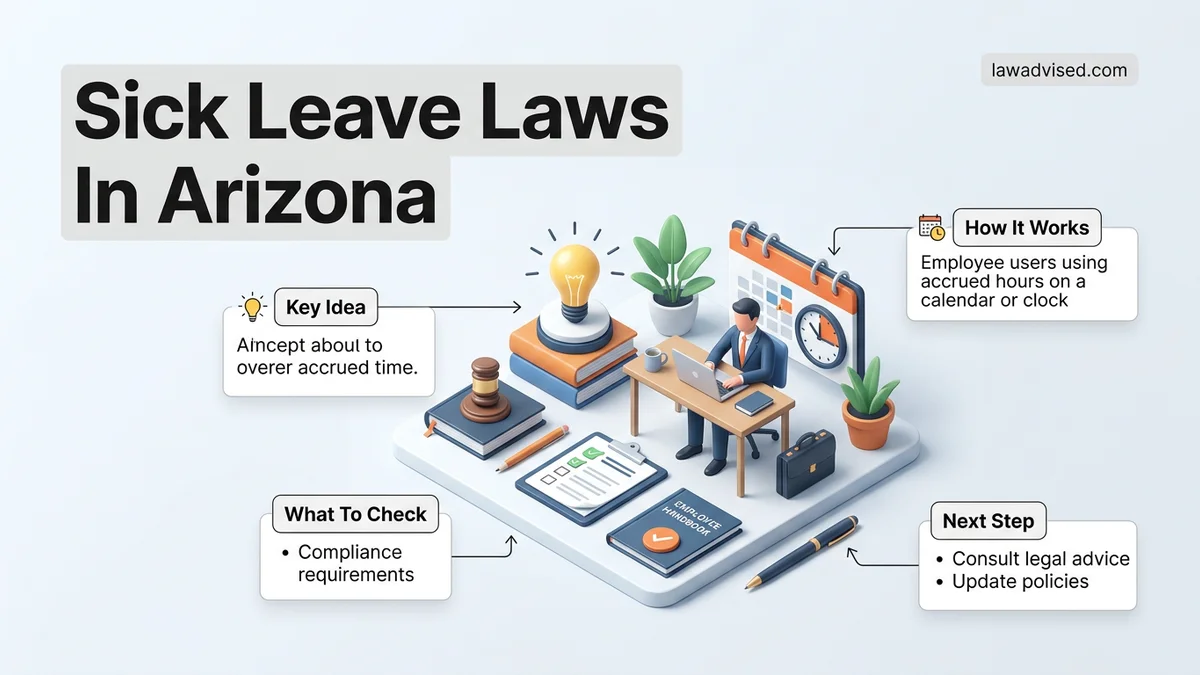
What Causes Compliance Failures with Sick Leave Laws in Arizona
Misunderstanding Employee Eligibility and Waiting Periods
Many business owners mistakenly assume that new hires must complete a 90-day probationary period before they can start earning or using paid sick leave. Under Arizona law, accrual begins on day one of employment. While you can restrict employees from using their accumulated leave until their 90th calendar day on the job, the hours must still accumulate during that initial window. Failing to track this from the start creates immediate compliance vulnerabilities.
Botched Tracking of Exempt Versus Non-Exempt Workers
Tracking hours for hourly employees is straightforward, but exempt salaried staff present a common compliance pitfall. Unless you explicitly classify salaried employees as exempt from overtime and apply the alternative tracking method, you must assume they work 40 hours per workweek for sick leave accrual purposes. If an exempt employee works a fluctuating schedule, failing to account for their actual hours or applying the standard 40-hour assumption incorrectly can result in under-accrual violations.
How to Calculate Accrual Rates and Enforce Usage Caps
Standard Accrual Formulas and Frontloading Options
You have two primary methods to fulfill your sick leave obligations in Arizona. The first is the standard accrual method where employees earn 1 hour of paid sick time for every 30 hours worked. Alternatively, you can frontload the entire allotment of sick leave—such as 24 or 40 hours—at the beginning of the year. If you choose the frontloading route, you do not need to allow carryover of unused hours into the following year, provided you issue a fresh frontloaded batch on day one of the next cycle.
Managing Annual Caps and Carryover Rules
When using the standard hourly accrual method, you are legally permitted to cap employee usage at 24 hours per year for businesses with fewer than 15 employees, and 40 hours per year for businesses with 15 or more employees. However, you must allow employees to carry over their unused accrued hours into the next calendar year, subject to those same annual usage caps.
- Small Employers (under 15 staff): Cap use at 24 hours per year.
- Mid-to-Large Employers (15+ staff): Cap use at 40 hours per year.
- Carryover Mandate: Unused hours roll over, but you can still limit total usage within a single year to the statutory caps.
Step-by-Step Guide to Managing Employee Eligibility and Documentation
Navigating Arizona earned paid sick time mandates requires a systematic approach to tracking hours and managing documentation. According to the Industrial Commission of Arizona (ICA), employers must implement reliable tracking systems by 2027 to prevent costly compliance audits. Compliance experts recommend establishing clear, standardized administrative protocols across all business locations.
Calculating Employee Hours and Accrual Rates
Employers must calculate accrued sick time precisely based on actual hours worked or approved paid time off. Under state standards, employees earn at least one hour of paid sick leave for every 30 hours worked. Automated payroll software ensures fractional hours are calculated correctly without rounding errors that could trigger regulatory penalties.
- Review current payroll software configurations to ensure the accrual formula of 1 hour per 30 hours worked is active.
- Establish a clear definition of a covered employee, including part-time, temporary, and seasonal staff who perform work within Arizona.
- Audit employee timecards monthly to verify that newly hired staff begin accruing leave immediately upon starting employment.
- Apply statutory caps accurately, ensuring employees are not blocked from accruing up to 40 hours per year unless company policy provides a higher threshold.
Retaining Accurate Records
Maintaining meticulous documentation protects organizations during state-level investigations or employee disputes. Federal and state labor guidelines mandate that employers retain all sick leave accrual, usage, and payout records for a minimum of four years. These records must be readily accessible for inspection by the ICA upon request.
- Centralize all sick leave requests, approvals, and medical verification documents within a secure, encrypted human resources information system.
- Ensure employee pay stubs clearly display current available sick time balances, hours used during the pay period, and year-to-date totals.
- Document any legitimate reasons for denying sick leave use, such as failure to provide proper notice for foreseeable absences.
- Schedule quarterly internal audits to cross-reference time-off logs with actual payroll disbursements and tax filings.
What If Your Sick Leave Policies Still Do Not Meet State Standards?
Despite best efforts to update handbooks and software, organizations occasionally discover compliance gaps during internal reviews or after receiving a notice from the Industrial Commission of Arizona. When standard fixes fail to resolve systemic tracking or accrual errors, targeted escalation steps are necessary. Expert labor attorneys and human resources compliance consultants suggest the following fallback procedures to mitigate legal exposure and financial liability in 2027:
- Conduct a comprehensive retroactive payroll audit covering the past 24 to 48 months to identify any under-accrued or unpaid sick time for current and former employees.
- Consult with a qualified Arizona employment law attorney to review existing company policies, draft corrective addendums, and negotiate potential self-reporting options with state regulators. Expect legal consulting fees to range from $250 to $500 per hour depending on firm size.
- Engage a certified public accountant (CPA) or specialized payroll service provider to correct historical wage statements and calculate retroactive payouts, with project costs typically ranging between $1,500 and $5,000.
- Implement mandatory compliance training for all managers and human resources personnel to prevent recurring policy enforcement errors across operational departments.
Conclusion
Failing to align with Arizona sick leave laws exposes businesses to severe financial penalties, back-pay liabilities, and reputational damage. The definitive fix involves updating employee handbooks, adopting automated accrual tracking, and conducting regular internal audits. According to verified research and expert labor sources, proactive compliance significantly reduces the risk of costly state investigations and employee litigation. Take action today by scheduling a comprehensive policy review with an accredited employment compliance specialist.
❓ Frequently Asked Questions
What are the primary reasons an employee can use earned paid sick time in Arizona?
Employees can use sick time for their own mental or physical illness, injury, or health condition, to care for a family member, for medical appointments, or for absences related to domestic violence, sexual violence, abuse, or stalking.
How do Arizona sick leave laws apply to remote employees working out-of-state?
Generally, Arizona labor laws apply to employees who primarily perform their work within the state of Arizona, regardless of where the employer’s headquarters are located.
Can employers frontload sick leave instead of using an accrual system?
Yes, employers may choose to frontload the full amount of sick leave (24 or 40 hours) at the beginning of the year instead of tracking hourly accruals, provided it meets or exceeds statutory minimums.
What constitutes a family member under Arizona sick leave regulations?
Family members include a spouse, child, parent, grandparent, grandchild, or sibling, as well as any other individual related by blood or affinity whose close association is equivalent to a family relationship.
What penalties do Arizona employers face for violating sick leave laws?
Employers that fail to provide required sick leave or retaliate against employees can face civil penalties, mandatory back pay, and lawsuits for damages enforced by the Industrial Commission of Arizona.
Are any types of employers exempt from providing paid sick leave in Arizona?
Federal government employers and certain independent contractors are exempt, but nearly all private-sector employers operating within Arizona must comply with the Fair Wages and Healthy Families Act.

Ismail Hossain is the founder of Law Advised. He is an Divorce, Separation, marriage lawyer. Follow him.