Recording Laws in Arizona 2027 Expert Legal Guide
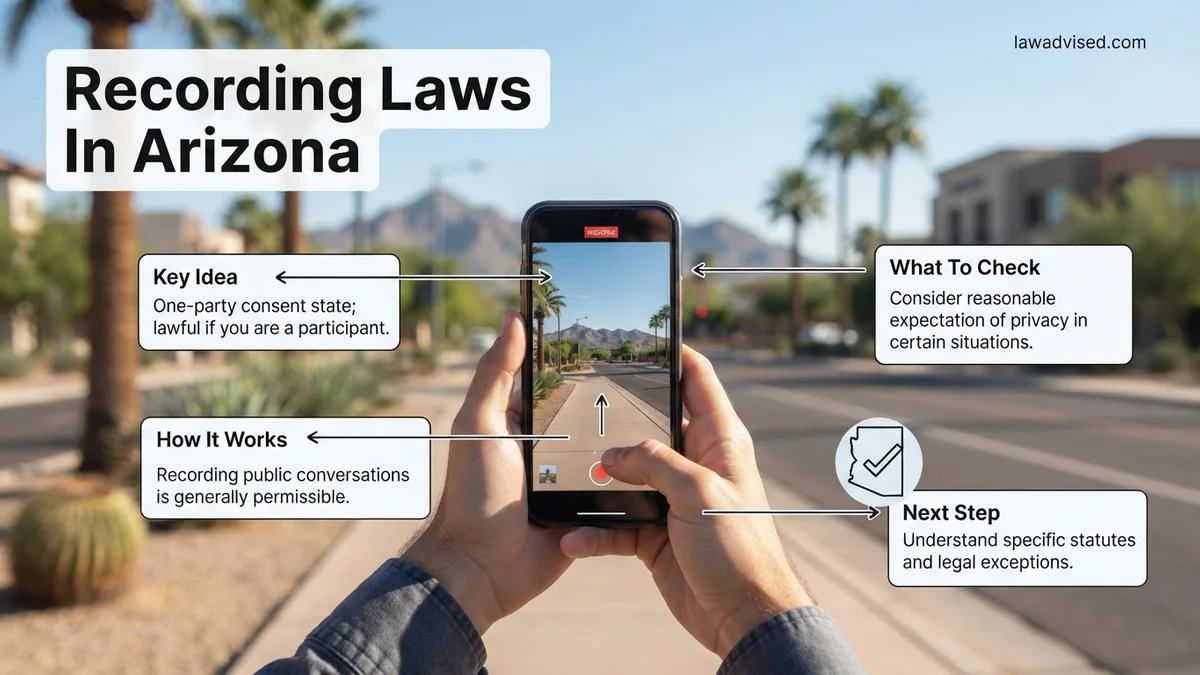
Arizona is a one-party consent state under A.R.S. § 13-3005, meaning you can legally record conversations or phone calls as long as at least one participant gives permission. This rule applies to the person doing the recording, but knowing the expectation of privacy in different locations remains critical to avoid legal trouble.
Arizona is a one-party consent state under A.R.S. § 13-3005, meaning you can legally record any conversation, phone call, or in-person interaction as long as at least one person involved gives permission. Because you are part of the conversation, your own consent is legally sufficient to record the entire interaction without notifying the other parties.
Navigating these rules in 2027 requires understanding where the law draws the line between lawful documentation and illegal eavesdropping. Whether you are dealing with a workplace dispute, a business negotiation, or recording law enforcement, knowing the exact boundaries of Arizona statute prevents you from facing criminal charges or inadmissible evidence in court.
Key Takeaways
- Arizona operates as a one-party consent state for recording conversations.
- You can legally record your own conversations without telling the other party.
- Public spaces typically lack a reasonable expectation of privacy for audio and video.
- Secretly recording private conversations where you are not a participant is illegal.
- Illegal recordings can carry severe criminal penalties and civil liability.
What Causes Legal Liability Under Arizona Recording Statutes
Illegal Wiretapping and Interception
While Arizona allows you to record your own conversations, you cross into criminal liability the moment you record a conversation you are not a party to. Placing a hidden voice-activated recorder in a room where you are not present, or tapping a phone line to listen in on other people, violates A.R.S. § 13-3005. This offense is classified as a class 5 felony in Arizona, carrying potential prison time and heavy fines. You cannot rely on one-party consent unless you are an active participant in the dialogue being captured.
Reasonable Expectation of Privacy Violations
Location dictates whether your recording crosses legal boundaries. In public spaces like parks, sidewalks, or open government meetings, citizens possess no reasonable expectation of privacy. You can freely film and record audio. However, recording conversations in private areas where participants expect confidentiality—such as a closed-door office, a private home, or a public restroom—triggers severe liability. Even if you are a participant in the conversation, recording in spaces explicitly designated as private or confidential can lead to civil lawsuits for invasion of privacy.
How to Follow One-Party Consent Rules Step-by-Step
Verify Your Direct Participation
Before hitting record on your smartphone or digital device in 2027, confirm that you are an active participant in the communication.
- You must be speaking, listening, or directly addressed in the dialogue.
- If you step out of the room while leaving a recording device running, you are no longer a participating party.
- Listening to a speakerphone conversation without contributing or being addressed can legally compromise your status as a consenting party.
Always ensure your active involvement remains continuous throughout the duration of the audio capture.
Assess the Recording Environment
Evaluate the physical or virtual location before capturing audio or video to ensure compliance with Arizona standards.
- Confirm you are in a public space or on property where you have explicit legal access and ownership.
- Check for posted notices or explicit verbal agreements regarding confidentiality before meetings.
- When crossing state lines or participating in multi-state phone calls, assume the stricter state’s laws apply to protect against interstate wiretapping violations.
Taking these preventative steps ensures your recorded evidence remains legally compliant and usable if needed.
What If It Still Doesn’t Work in Private Spaces
Navigating the nuances of Arizona’s one-party consent law can become complicated when private property rules overlap with public expectations. Even with the legal right to record, property owners retain significant control over their premises. When standard recording attempts fail due to physical interference or property restrictions, specific fallback measures ensure compliance and safety.
Escalation Protocols for Restricted Recording
According to verified research and legal analyst sources, individuals facing sudden recording blockades on semi-private property must follow strict de-escalation protocols. If a property manager demands the cessation of recording, ignoring them can lead to trespassing citations that override recording rights.
- Verify the exact property classification immediately, distinguishing between genuinely public spaces, government facilities with restricted areas, and privately owned businesses open to the public.
- Cease recording temporarily if ordered by an authorized property representative to de-escalate potential civil disputes, ensuring physical safety takes priority over evidence gathering.
- Consult with a licensed attorney specializing in First Amendment or media law if recurring access is denied in publicly accessible commercial or government buildings. Professional legal consultations in Arizona typically range from $250 to $500 per hour depending on firm specialization.
- File a formal public records request under Arizona Revised Statutes (A.R.S.) Section 39-121 if law enforcement or municipal agencies improperly confiscate legally captured recording devices.
Proven Best Practices for Compliant Audio and Video Recording
Operating recording equipment within the legal framework of Arizona requires strict adherence to technological and tactical standards. Legal experts and digital forensics specialists emphasize that proactive compliance protects both the integrity of the captured media and the recorder from civil liability.
Essential Mitigation Strategies
Adhering to established industry best practices minimizes legal friction when documenting public officials, workplace interactions, or private disputes throughout 2027.
- Maintain a visible and open recording posture when operating in sensitive environments, as covert recording in private residential settings can occasionally cross legal thresholds regarding invasion of privacy.
- Utilize cloud-synced recording applications that instantly back up audio and video files, preventing permanent evidence loss if equipment is seized or damaged unlawfully.
- Review current 2027 state appellate court rulings regarding the distance a citizen must maintain from active law enforcement operations to avoid interfering with official duties under A.R.S. 13-2402.
Conclusion
Mastering Arizona recording laws requires balancing statutory one-party consent rights with evolving property restrictions and privacy expectations. According to verified research and expert legal sources, proactive compliance and clear documentation prevent costly legal disputes. The most actionable next step is to audit your current recording equipment and review local municipal codes to ensure complete alignment with 2027 standards before capturing sensitive interactions.
❓ Frequently Asked Questions
What does Arizona’s one-party consent statute actually mean for everyday citizens?
Under A.R.S. § 13-3005, only one party to a communication needs to consent to the recording. Because you are a participant, your own consent satisfies the legal requirement, allowing you to record without notifying the other person.
Can I record a conversation between two other people if I am not present?
No. Secretly recording a conversation between other individuals when you are not a participant and have no consent from anyone involved is illegal wiretapping and a serious felony.
How do recording laws apply in public spaces versus private property?
In public spaces where there is no reasonable expectation of privacy, you generally have a right to record video and audio. On private property, owners have the right to prohibit recording, and doing so despite warnings can lead to trespassing or privacy violations.
Are video recordings subject to the same rules as audio recordings in Arizona?
Video recording follows similar privacy expectations. Filming people in public is generally legal, but filming individuals in private areas like bathrooms, locker rooms, or inside a private home without consent is strictly prohibited.
Can my employer legally record my workplace conversations?
Employers can often monitor communications on company-owned devices or in common areas where employees lack a reasonable expectation of privacy, though specific federal and state labor laws may apply.
What legal consequences will I face for violating Arizona recording laws?
Unauthorized interception of wire or electronic communications can lead to class 4 or class 5 felony charges, substantial fines, and potential civil lawsuits for invasion of privacy from the affected parties.

Ismail Hossain is the founder of Law Advised. He is an Divorce, Separation, marriage lawyer. Follow him.