Squatting Laws in California 2027 Step-by-Step Legal Guide
Navigating squatting laws in california requires property owners to follow strict legal eviction procedures rather than using self-help measures. Understanding the legal differences between trespassers, squatters, and holdover tenants prevents costly delays and legal liabilities.
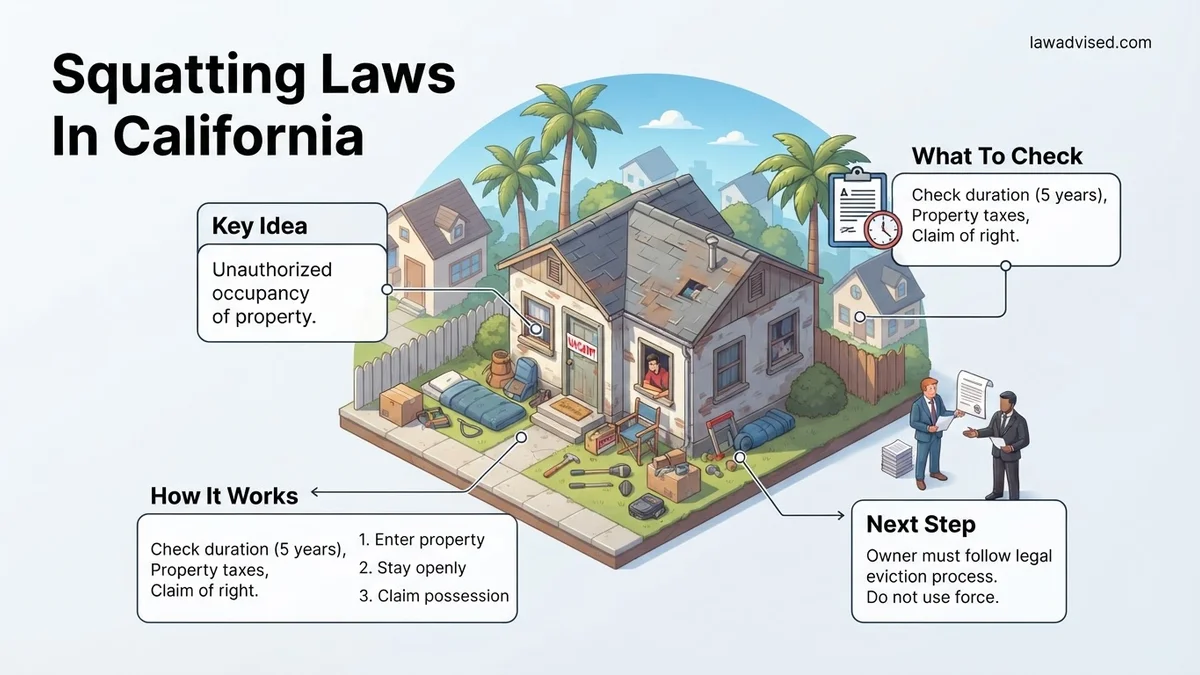
Removing a squatter from your California property requires a strict judicial eviction process, as self-help methods like changing locks or shutting off utilities remain strictly illegal under 2027 state laws. Property owners cannot simply toss out unauthorized occupants who have established residency, even if they entered illegally.
Navigating this legal landscape efficiently protects you from expensive civil lawsuits while ensuring unauthorized occupants leave as quickly as possible. Knowing the precise boundaries between trespassers and squatters dictates your immediate course of action.
Key Takeaways
- Self-help evictions like cutting utilities or changing locks are strictly illegal in California.
- Squatters must occupy a property openly and continuously for 5 years to claim adverse possession.
- Property owners must file an unlawful detainer lawsuit to legally remove unauthorized occupants.
- Trespassers can often be removed immediately by local law enforcement if reported early.
- Securing vacant properties with cameras and secure locks prevents most squatting incidents.
What Causes Property Vulnerability Under Squatting Laws in California
Vacant Properties and Neglected Maintenance
Unoccupied homes, vacation properties, and fix-and-flips face the highest risk of unauthorized occupation. When mail piles up, yards go unmaintained, and windows stay dark for weeks, opportunistic individuals notice. Squatters actively target properties where absentee owners fail to check in regularly.
Blurring the Lines Between Trespassers and Tenants
California law distinguishes sharply between a trespasser and a squatter, and this distinction dictates your speed of removal. Trespassers have no claim to the property and can often be removed by local law enforcement within hours. However, once a squatter moves in furniture, receives mail at the address, or stays for more than a few days without immediate challenge, police often classify the matter as a civil property dispute. At that point, law enforcement will refuse to intervene without a court order, leaving you vulnerable.
- Delayed property inspections create windows of opportunity for unauthorized entry.
- Failing to report unauthorized entry immediately can convert a trespasser into a squatter with civil rights.
- Weak perimeter security invites opportunistic breaches.
How to Fix a Squatter Situation Step-by-Step
Step 1: Serve Notice and File an Unlawful Detainer
You must begin the formal legal eviction process immediately upon discovering unauthorized occupants. Serving a formal Notice to Quit kicks off the official timeline. If the squatter refuses to vacate after the notice period expires, you must file an Unlawful Detainer lawsuit in your local California superior court. Do not attempt to force them out yourself, as cutting off utilities or changing the locks results in heavy financial penalties and damages awarded to the squatter.
Step 2: Navigate the Court Process and Enforce the Writ
The court timeline in 2027 typically spans 30 to 60 days depending on court backlogs and whether the squatter contests the filing. Once the judge rules in your favor, the court issues a Writ of Possession. The local sheriff will then post a final notice giving the occupants five days to vacate voluntarily. If they remain, the sheriff physically removes them, and you can finally secure your property legally.
- Never use physical force or threats to remove occupants.
- Document all communications and legal filings meticulously.
- Hire an eviction attorney familiar with local municipal ordinances.
What If the Squatter Refuses to Leave After Notice
When a squatter ignores official eviction notices or refuses to vacate the premises voluntarily, property owners must escalate the situation through the formal California judicial system. Attempting self-help methods, such as shutting off utilities or changing locks, violates California Civil Code Section 789.3 and exposes the owner to severe civil liability and statutory damages.
Filing an Unlawful Detainer Lawsuit
- File an Unlawful Detainer summons and complaint at the local California superior court having jurisdiction over the property.
- Serve the legal paperwork properly to the occupant using a professional process server or local law enforcement agency.
- Wait for the mandatory response window, which is typically five business days from the date of formal service.
Securing a Court Judgment and Writ of Possession
- Request a default judgment from the court if the squatter fails to file a legal response within the allotted timeframe.
- Attend the scheduled court hearing to present your deed, property tax records, and proof of proper notice to the judge.
- Obtain a Writ of Possession directing the local sheriff to physically remove the unauthorized occupants and restore property control.
Proven Prevention Tactics to Secure California Real Estate
Securing vacant residential or commercial property remains the most effective defense against unlawful occupants in 2027. According to real estate asset management experts, proactive security investments dramatically reduce the risk of illegal occupation and costly legal battles.
Physical Security Upgrades
- Install heavy-duty deadbolts, window security bars, and reinforced exterior doors on all access points of vacant structures.
- Maintain active utility accounts in the owner’s name to provide immediate evidence of active property management.
- Secure all perimeter gates, garage doors, and secondary entryways with tamper-resistant padlocks and chains.
Digital Monitoring and Community Outreach
- Deploy cellular-connected security camera systems with live motion-detection alerts sent directly to your mobile device.
- Establish a formal relationship with trusted neighbors or local property management firms to conduct weekly physical inspections.
- Post highly visible ‘No Trespassing’ and private property warning signs referencing local penal codes along the property boundaries.
What If It Still Doesn’t Work?
If standard legal notices and initial court filings stall, property owners face complex procedural hurdles that require specialized intervention. According to recent legal industry data from 2027, navigating stubborn unlawful detainer cases often requires adaptive strategies. Here are fallback steps to take when standard removal efforts fail:
- Retain a specialized eviction attorney: Hire legal counsel experienced specifically in California landlord-tenant law and squatting disputes to handle complex court motions. Professional legal representation typically costs between $3,000 and $7,000 depending on contestation levels.
- Engage private property recovery services: Hire licensed security consultants or specialized civil process runners to fast-track service and coordinate directly with local sheriff departments.
- File for emergency injunctive relief: Request an expedited court hearing for immediate possession if property damage or illegal commercial activity is actively occurring on-site.
- Conduct a comprehensive title audit: Verify that no fraudulent deeds or forged quitclaim documents have been filed against the property in county records.
Conclusion
Addressing a squatting situation in California requires strict adherence to legal statutes, precise documentation, and prompt escalation through the court system. Property owners must avoid unlawful self-help measures and instead rely on formal eviction processes to regain control. According to verified research and expert property management sources, proactive physical security combined with swift legal action remains the definitive solution for protecting real estate investments. Take the crucial next step today by auditing your vacant property’s security measures and consulting with a qualified real estate attorney.
❓ Frequently Asked Questions
What is the exact legal definition of a squatter under California law?
A squatter is an unauthorized person who settles on someone else’s unoccupied or abandoned property without legal title, lease, or permission from the owner.
How does an unlawful detainer lawsuit work against squatters in California?
If a squatter ignores the initial notice to vacate, the owner must file an unlawful detainer lawsuit in local court to obtain a court-ordered writ of possession for the sheriff to execute.
What are the strict criteria required for adverse possession in California?
To claim adverse possession, a squatter must prove hostile, actual, open, notorious, exclusive, and continuous possession for 5 years, alongside paying all local property taxes.
How can landlords distinguish between a holdover tenant and a squatter?
A holdover tenant entered the property with a legitimate lease agreement that has now expired, whereas a squatter never had a lease or owner permission from the beginning.
What should a property owner do immediately upon discovering a squatter?
Contact local law enforcement to file a trespassing report, gather documentation proving ownership, and consult a real estate attorney to begin the formal notice process.
Are there fast-track laws in California for removing unauthorized occupants?
California enacted laws allowing property owners to expedite the removal of unauthorized persons through an expedited affidavit process if law enforcement verifies the illegal occupancy.

Ismail Hossain is the founder of Law Advised. He is an Divorce, Separation, marriage lawyer. Follow him.