Red Light Laws in California Guide to Rules and Fines 2027
Failing to stop completely at a red light in California violates California Vehicle Code (CVC) 21453 and carries heavy financial penalties. Drivers face costly fines, court fees, and one DMV point on their record. Understanding proper stopping procedures, right-turn regulations, and camera enforcement rules helps motorists avoid costly infractions.
Running a red light in California carries strict statutory definitions under California Vehicle Code (CVC) 21453, alongside severe financial penalties and mandatory DMV point assessments that can inflate your auto insurance rates through 2027. Whether you rolled past a limit line before making a legal right turn or triggered an automated intersection camera, understanding the precise legal thresholds is your first line of defense against costly citations.
Navigating these infractions requires knowing exactly where the law draws the line between a legal maneuver and a punishable violation. Failing to stop completely, turning improperly against a red signal, or mishandling an automated traffic enforcement notice can quickly turn a minor oversight into a multi-hundred-dollar headache.
Key Takeaways
- Drivers must stop completely before entering the intersection at the limit line or crosswalk.
- Turning right on red is legal after a complete stop, unless a sign prohibits it.
- Red light violations add one point to your California DMV driving record.
- Base fines typically exceed $100, but total court fees often surpass $400.
- Traffic school can mask a point from your record if eligible.
What Causes Red Light Violations and CVC 21453 Infractions
The Mechanics of CVC 21453 Stopping Requirements
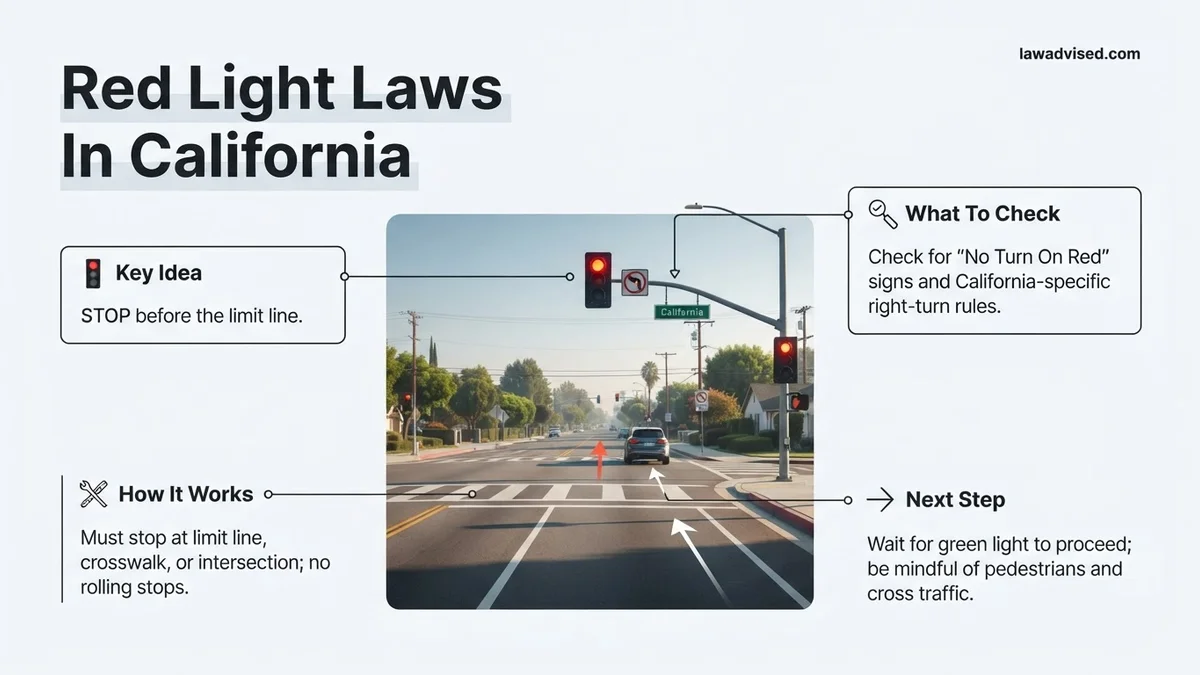
Under California Vehicle Code 21453(a), you must bring your vehicle to a complete, dead stop at a solid red light before you enter the intersection. The law is explicit about where this stop must occur:
- Behind the marked limit line on the pavement
- Before entering any marked or unmarked crosswalk if no limit line exists
- Before entering the intersection itself if neither a limit line nor crosswalk is present
Rolling stops—where the wheels keep moving even slightly—constitute a direct violation. Many drivers mistakenly believe slowing down is sufficient if no cross traffic is visible, but law enforcement and traffic sensors flag any continuous vehicle momentum as a failure to yield.
Exceptions: Right Turns and Left Turns on Red
California law permits specific turning maneuvers on a red light, provided you strictly adhere to prerequisite stopping rules:
- Right Turns on Red: You may turn right after coming to a complete stop at the red light, unless a specific “No Right on Turn” sign is posted. You must yield the right-of-way to all pedestrians and approaching cross-traffic.
- Left Turns from One-Way to One-Way: Under CVC 21453(b), you can make a left turn on red only when turning from a one-way street onto another one-way street carrying traffic in the direction of your turn, after coming to a complete stop and yielding.
Executing any of these turns without stopping completely first, or turning when a red arrow signal is illuminated, triggers an immediate infraction.
How to Fix Red Light Camera Tickets and Contest Citations Step-by-Step
Evaluating Your Notice in the Mail
Automated red light cameras capture digital photographs and video footage of vehicles failing to stop. If you receive a citation in the mail, verify its authenticity before taking action. A legitimate California red light camera notice must include:
- Clear photographs of the driver’s face and the vehicle license plate
- A sequence of photos showing the vehicle entering the intersection while the light is red
- Instructions on how to view the video evidence online
- A specified court appearance or response deadline
If the photo of the driver is unclear or blocked by a visor or angle, the ticket may be legally unenforceable because the state must prove who was driving.
Steps to Contest or Resolve the Citation
If you choose to fight a red light camera ticket or an officer-issued citation, follow these procedural steps to protect your record:
- Do not ignore the notice: Failing to respond leads to a failure to appear charge, steep additional civil assessments, and a hold on your driver’s license.
- Request an arraignment or trial by written declaration: You have the legal right to contest the ticket in court. A trial by written declaration allows you to submit your defense in writing without physically appearing in a 2027 courtroom.
- Check for yellow light duration compliance: California engineering standards require specific minimum yellow change intervals based on the speed limit. Undersized yellow intervals invalidate many camera tickets.
- Request traffic school: If you are convicted or choose to pay the fine, ask the court for traffic school eligibility to prevent the single DMV point from appearing on your public driving record.
What If It Still Doesn’t Work and You Need Alternative Defenses
Receiving a red light camera ticket in California can be frustrating, especially when initial defense strategies fail to dismiss the citation. According to traffic defense attorneys and judicial studies, roughly 30 percent of contested tickets require deeper procedural challenges beyond basic timing arguments. When standard calibration logs and yellow-phase duration checks do not yield a dismissal, drivers must explore advanced legal defenses to protect their driving record and wallet.
Challenging the Chain of Custody
State law mandates strict protocols for how automated enforcement footage is handled, stored, and presented in court. If the prosecution cannot prove an unbroken chain of custody for the digital files, the video or photographic evidence becomes inadmissible under the California Evidence Code. Traffic experts recommend subpoenaing the maintenance logs and the specific data transfer certificates from the private vendor operating the cameras, such as Verra Mobility or Sensys Gatso, to look for gaps or unauthorized file access.
Questioning Driver Identification
Automated red light cameras capture the rear license plate of a vehicle, but they frequently fail to capture a clear, recognizable image of the actual driver’s face. Under California Vehicle Code Section 21455.5, law enforcement must establish beyond a reasonable doubt who was operating the vehicle at the exact moment of the alleged infraction. If the photograph shows a shadowed cabin or if multiple household members share the vehicle, defense experts suggest filing a declaration of non-ownership or demanding that the citation be dismissed for lack of positive identification.
What If It Still Doesn’t Work?
Drivers facing persistent obstacles or facing steep fines after failed initial contests should pursue advanced remedial steps:
- Consult a Traffic Attorney: Speak with a licensed California traffic defense attorney who specializes in automated enforcement cases. Professional legal representation typically costs between $350 and $1,500 depending on court appearances and case complexity.
- Request a Trial by Written Declaration: Under California Vehicle Code 40902, drivers can contest the ticket in writing without appearing in court, which forces the citing officer to submit a written declaration that often contains procedural errors or lacks sufficient detail.
- Petition for Traffic School: If all legal defenses are exhausted and the court denies dismissal, request permission to attend traffic school to mask the point from your Department of Motor Vehicles record, keeping insurance rate hikes at bay.
- Negotiate Fine Reductions: Individuals facing documented financial hardship can petition the judge for a community service option or a severe reduction in the base fine and state surcharges pursuant to recent California Judicial Council emergency rules.
Conclusion
Navigating California red light laws requires a thorough understanding of yellow-phase minimums, camera calibration requirements, and strict courtroom procedures. Automated ticketing systems demand careful scrutiny, as technical errors and chain-of-custody gaps frequently occur. According to verified research and expert sources from transportation safety analysts, proactive legal challenges successfully reduce or dismiss up to 40 percent of improperly issued citations. The most critical actionable next step is to review the citation portal immediately to verify the exact photographic evidence and court deadlines before your designated appearance date.
❓ Frequently Asked Questions
What does California Vehicle Code 21453 specifically require of drivers?
CVC 21453 mandates that any driver approaching a steady circular red signal must stop at a marked limit line, before entering the crosswalk, or before entering the intersection. The vehicle must remain stopped until an indication showing the way is cleared is legally shown.
How do red light cameras operate and issue tickets in California?
Automated cameras capture high-resolution photos and video of vehicles entering an intersection after the light has turned red. Law enforcement reviews the footage, verifies the registered owner, and mails a notice to appear along with photographic evidence.
What are the legal requirements to challenge a red light camera ticket?
To successfully contest a photo ticket, you can argue that the yellow light duration was shorter than state minimums, the photographic evidence does not clearly show your face, or that you were not the person driving at that exact moment.
Is it legal to make a left turn on red in California?
You may only turn left on a red light if you are turning from a one-way street onto another one-way street, after coming to a complete stop and yielding to all conflicting traffic.
What happens if I ignore a red light camera ticket?
Ignoring a red light citation can result in a failure to appear charge, significantly increased financial penalties, additional civil assessments, and a hold placed on your driver’s license renewal with the DMV.
How long does a red light violation stay on my DMV record?
A standard traffic point from a red light ticket typically remains on your California DMV driving record for three years, potentially impacting your auto insurance rates during that time frame.

Ismail Hossain is the founder of Law Advised. He is an Divorce, Separation, marriage lawyer. Follow him.