
How Is Income Tax Calculated in USA 2026 Step-by-Step Guide
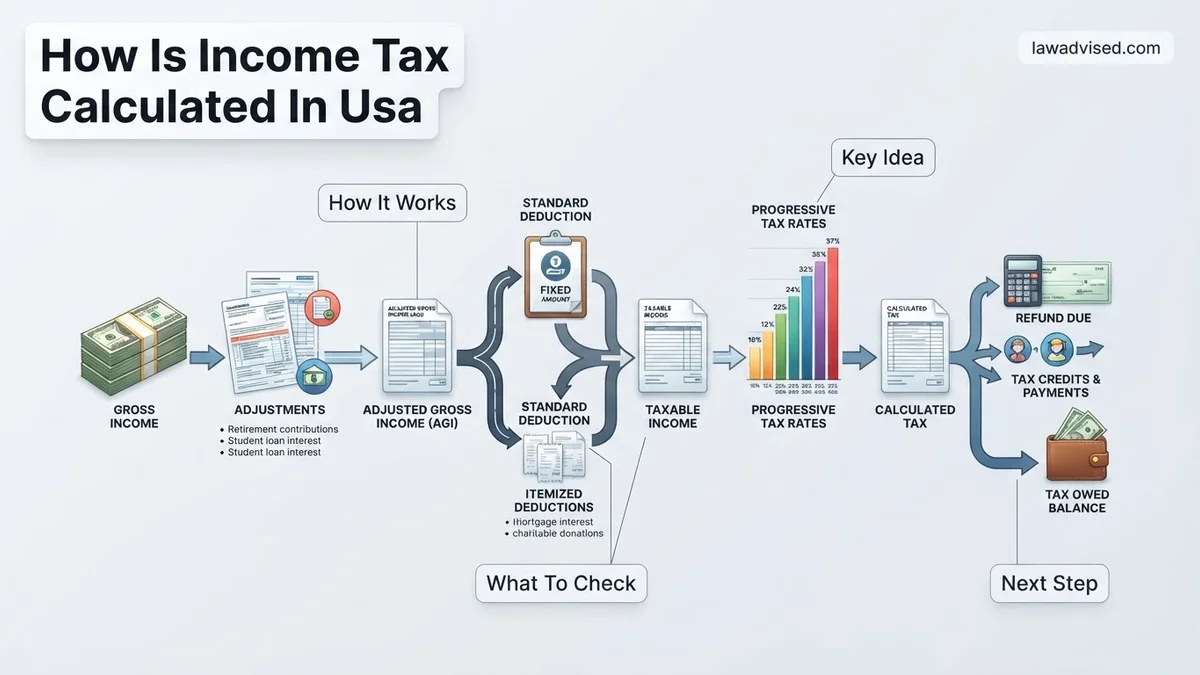
Understanding how income tax is calculated in the USA requires following a clear financial path from your total earnings down to your final tax liability. By taking your gross income, adjusting it, applying deductions, and running it through progressive tax brackets, you determine the exact amount you owe the government.
The United States uses a progressive federal income tax system. This means the government determines the exact tax you owe by taking your total earnings, subtracting specific deductions to find your taxable income, and then applying tiered tax rates to distinct portions of that income.
Navigating this math in 2026 requires understanding how your gross earnings transform into a final tax liability through a precise mathematical sequence. Knowing these mechanics helps you spot tax-saving opportunities and removes the mystery from your annual IRS bill.
Key Takeaways
- Gross income includes all the money you earn from wages, freelance work, investments, and other sources.
- Your Adjusted Gross Income (AGI) is calculated by subtracting specific above-the-line deductions from your gross income.
- Taxable income is your AGI minus either the standard deduction or your total itemized deductions.
- The US uses a progressive tax system, meaning different portions of your income are taxed at different marginal rates.
- Tax credits directly reduce your final tax bill dollar-for-dollar, making them more powerful than deductions.
What Causes Confusion in How US Income Tax Is Calculated
The Myth of the Single Tax Bracket
Many people mistakenly believe that entering a higher tax bracket means every dollar you earn gets taxed at that higher rate. This misconception causes unnecessary panic during tax season. In reality, the US system applies different tax percentages to different slices of your income.
Gross Income Versus Taxable Income
Another major point of confusion is mixing up what you earn with what you actually pay taxes on. Your employer reports your total compensation, but the IRS rarely taxes that exact number. A maze of pre-tax contributions and deductions stands between your paycheck and your final tax bill, which alters your calculation starting point.
How to Calculate Your US Income Tax Step-by-Step
Step 1: Determine Your Adjusted Gross Income (AGI)
Your calculation always starts with your gross income, which includes your salary, freelance earnings, interest, and investment dividends. You then subtract adjustments to income, also known as above-the-line deductions, such as contributions to a traditional IRA or student loan interest. The resulting number is your Adjusted Gross Income, or AGI.
Step 2: Arrive at Your Final Taxable Income
Once you have your AGI, you must subtract either the standard deduction or your total itemized deductions. For the 2026 tax year, the standard deduction shields a substantial portion of your income from federal taxation depending on your filing status. What remains after subtracting your chosen deduction is your official taxable income, which serves as the base for the next step.
- Gross Income: Total money earned from all sources.
- AGI: Gross income minus specific adjustments like retirement contributions.
- Taxable Income: AGI minus the standard or itemized deduction.
How to Apply Marginal Tax Brackets Without Falling for Myths
Many taxpayers misunderstand how marginal tax brackets work in the United States. A common myth suggests that earning a higher income and moving into a higher tax bracket causes your entire salary to be taxed at that elevated rate. Fortunately, the U.S. progressive tax system does not operate this way for 2026.
Understanding Progressive Bracket Allocation
Federal income tax is levied in layers, meaning each portion of your taxable income falls into a specific bracket and is taxed only at that bracket’s designated rate. When you cross a threshold into a higher tax bracket, only the dollars earned above that threshold face the higher percentage.
- Identify your total taxable income after subtracting your standard deduction or itemized deductions for the 2026 tax year.
- Locate the IRS tax bracket thresholds corresponding to your filing status, such as single, married filing jointly, or head of household.
- Calculate the tax owed on the first tier of income using the lowest percentage rate.
- Apply the next incremental tax rate only to the portion of income that spills over into the subsequent bracket.
- Sum the tax amounts calculated across all applicable tiers to determine your final total federal income tax liability.
What If Your Withholdings Don’t Match Your Final Tax Calculation
Discrepancies often arise between the taxes withheld from your paychecks throughout the year and your actual 2026 tax calculation. These gaps can result in either an unexpected tax bill or a large refund when you file your return.
Troubleshooting Withholding Discrepancies
If your end-of-year calculations deviate significantly from your expectations, systematic troubleshooting can help you adjust your strategy and avoid penalties.
- Review your recent paystubs to verify the exact federal income tax withheld year-to-date by your employer.
- Examine your Form W-4 or Form W-4P to ensure your personal allowances, dependents, and extra withholding requests were entered accurately.
- Utilize the official IRS Tax Withholding Estimator online tool to input your updated 2026 income and life changes.
- Submit a revised Form W-4 to your employer’s payroll department to immediately increase or decrease your per-paycheck withholding.
- Consult a certified public accountant (CPA) or enrolled agent if complex investments, self-employment income, or multiple jobs distort your estimates. Professional tax advisory fees typically range from $200 to $600 depending on complexity.
Conclusion
Calculating your income tax in 2026 requires subtracting your deductions from your gross income, determining your taxable base, and applying progressive marginal brackets. Taking control of this calculation prevents surprises and optimizes your financial planning. According to verified research and expert sources from the IRS and certified tax professionals, proactively reviewing your withholdings and bracket thresholds is the single most effective way to manage your annual tax burden. One actionable next step is to run your projected 2026 figures through the IRS Tax Withholding Estimator today to align your paycheck deductions.
❓ Frequently Asked Questions
What is the very first step in calculating US income tax?
The first step is determining your total gross income, which encompasses all worldwide income earned during the tax year from jobs, self-employment, investments, and other taxable sources.
How do above-the-line deductions lower your Adjusted Gross Income?
Above-the-line deductions, officially known as adjustments to income, allow you to subtract specific expenses like retirement contributions or student loan interest directly from your gross income without needing to itemize.
What is the difference between a tax deduction and a tax credit?
A tax deduction lowers the amount of your income that is subject to tax, whereas a tax credit directly subtracts from the actual tax you owe, providing a dollar-for-dollar reduction.
How do marginal tax brackets actually work in practice?
Under a progressive tax system, your income is taxed in chunks or slices; the first slice is taxed at the lowest rate, the next slice at the next rate, and so on up to your highest bracket.
Why do people misunderstand how tax brackets work?
Many people mistakenly believe that entering a higher tax bracket means every dollar they earn is suddenly taxed at that higher rate, rather than just the dollars that fall into that specific bracket.
What happens if my employer withheld too much or too little tax?
If your employer withheld too much compared to your final calculated tax liability, you receive a tax refund; if they withheld too little, you will owe the difference to the IRS.

Ismail Hossain is the founder of Law Advised. He is an Divorce, Separation, marriage lawyer. Follow him.