Who Has to Pay Income Tax in USA 2026 Expert Guide
Federal income tax obligations in the U.S. depend on your gross income, filing status, age, and residency status rather than just whether you have a job. Understanding the exact IRS thresholds prevents unexpected penalties and clarifies whether you are legally required to file a return.
In the United States, whether you legally have to pay federal income tax depends entirely on your total gross income, your filing status, and your age. If your income stays below specific IRS thresholds for the 2026 tax year, you generally do not have to file a federal return or pay income tax.
Knowing these exact rules keeps you compliant with the IRS while ensuring you do not waste time filing unnecessary paperwork. Let us look at what triggers this legal obligation and the exact income boundaries you need to know for 2026.
Key Takeaways
- Filing requirements depend primarily on your total gross income and filing status.
- Self-employed individuals must file if net earnings reach $400 or more.
- U.S. citizens and green card holders are taxed on worldwide income.
- Dependents face strict lower income thresholds for filing their own returns.
- Having tax withheld does not automatically mean you are required to file.
What Triggers the Legal Requirement to Pay Income Tax in the USA
The Residency and Citizenship Rule
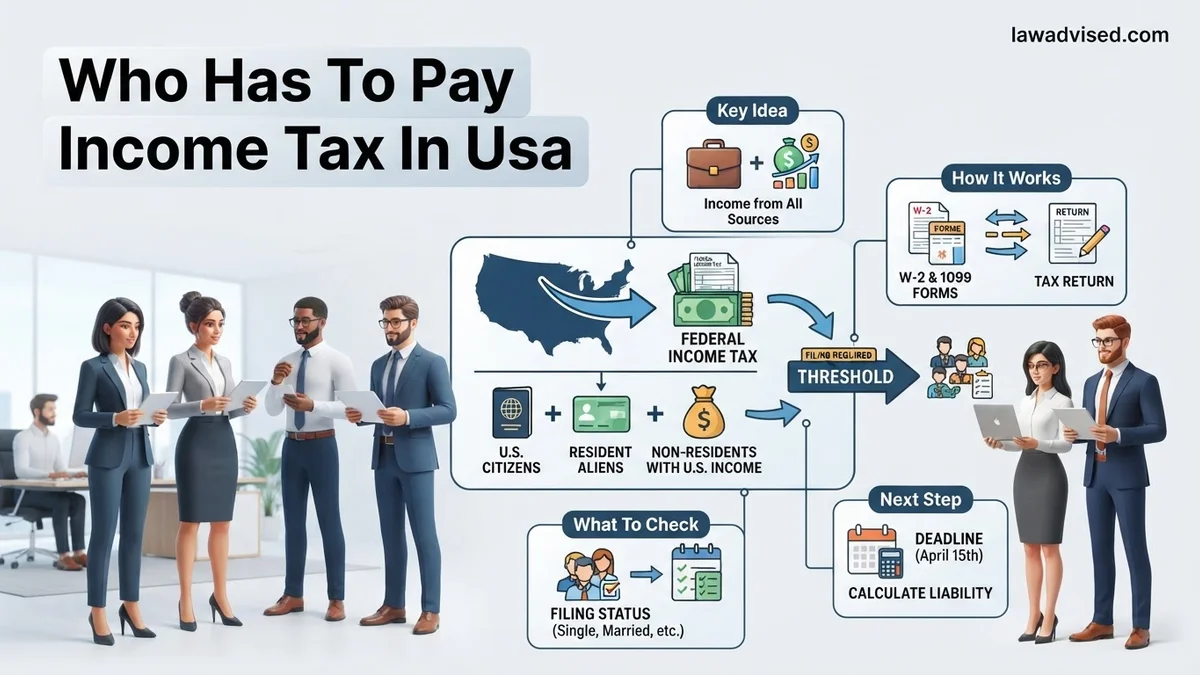
Your journey with the IRS starts with your legal status in the country. United States citizens and resident aliens must pay federal income tax on all worldwide income, no matter where they live.
- Citizens: Must file and pay taxes on global earnings.
- Resident Aliens (Green Card Holders): Subject to the same global income tax rules as U.S. citizens.
- Non-Resident Aliens: Only pay U.S. income tax on income sourced directly within the United States.
The Gross Income Threshold Rule
Even if you meet residency requirements, you only trigger a tax filing obligation if your gross income crosses the IRS threshold for your specific demographic. Gross income includes all taxable money you receive in the form of wages, tips, interest, dividends, and gains, minus any excluded income. If your earnings stay under the limit for 2026, the federal government does not require you to file.
How to Fix Filing Confusion by Checking 2026 IRS Income Thresholds
Standard Filing Status Thresholds for 2026
The IRS sets different income caps based on how you file your taxes. For the 2026 tax year, you must pay and file if your gross income meets or exceeds these baseline numbers:
- Single: $15,000
- Married Filing Jointly: $30,000
- Head of Household: $22,500
- Married Filing Separately: $5 (regardless of age)
- Qualifying Surviving Spouse: $30,000
Practical Example: If you are a single filer under 65 making $16,500 in 2026, you cross the threshold and must file. If you make $14,000, you are legally exempt from filing.
Age Adjustments for Older Taxpayers
The IRS gives a helpful break to older adults. If you reach age 65 before the close of the 2026 tax year, your gross income threshold increases because you get an extra standard deduction. For instance, a single filer aged 65 or older enjoys a higher income limit of $16,700 before a tax filing becomes mandatory.
Step-by-Step Guide to Determining Your Personal Tax Obligations
Determining your exact 2026 tax obligations requires a systematic evaluation of your gross income, filing status, and specific residency or dependency criteria. Following a structured procedure prevents costly calculation errors and ensures compliance with the Internal Revenue Service (IRS).
1. Calculate Your Total Gross Income
Compile every source of earned and unearned income received throughout the 2026 tax year. This includes wages from W-2 forms, self-employment earnings, investment dividends, and rental revenue. Compare this aggregate total against the newly adjusted 2026 IRS standard deduction thresholds for your specific filing status.
2. Verify Your Filing Status and Dependency Rules
Identify whether you qualify as single, married filing jointly, married filing separately, or head of household. Review current Internal Revenue Service dependency guidelines to confirm if anyone else can claim you as a dependent, which completely alters your personal tax-exempt thresholds.
3. Assess Self-Employment and State-Specific Criteria
Calculate your net self-employment earnings if you operated a freelance business or side hustle in 2026. Remember that independent contractors must file a federal return if net earnings exceed $400, regardless of whether they meet standard wage-based filing thresholds. Finally, check individual state tax guidelines, as local filing requirements frequently differ from federal mandates.
What If Your Income Status Changes or You Fail to File on Time
Life events during 2026—such as mid-year job loss, marriage, or sudden inheritance—can drastically alter your tax bracket and filing requirements. Failing to submit a required return on time triggers severe financial penalties from the federal government.
Penalties for Late Filing and Non-Payment
According to Internal Revenue Service compliance guidelines, the failure-to-file penalty typically costs 5 percent of unpaid taxes for each month the return is late. The separate failure-to-pay penalty adds another 0.5 percent per month. Promptly addressing income changes prevents these compounding statutory fees from accumulating rapidly.
What If It Still Doesn’t Work?
If calculating your 2026 tax liability remains confusing due to complex investments, international income, or sudden status shifts, you should deploy the following troubleshooting steps:
- Utilize the official IRS Interactive Tax Assistant tool online to input your specific 2026 financial scenario for automated verification.
- Gather all end-of-year tax documents, including Form W-2, 1099s, and brokerage statements, to eliminate missing data errors.
- Schedule a consultation with a certified public accountant (CPA) or an Enrolled Agent to review complex multi-state or self-employment statuses. Professional tax preparation fees typically range from $250 to $800 depending on business complexity.
- Contact the IRS direct taxpayer assistance line or visit a local Taxpayer Assistance Center for official guidance on unfiled historical returns.
Conclusion
Navigating who has to pay income tax in the USA for 2026 depends on accurately tracking gross earnings against updated federal thresholds and filing statuses. According to verified research and expert tax sources, proactively determining your obligation prevents severe compounding penalties and legal scrutiny. Your actionable next step is to tally your total 2026 earnings today and compare them against the latest IRS standard deduction limits to confirm your filing requirement.
❓ Frequently Asked Questions
What is the difference between having to file a tax return and actually owing tax?
Filing a return is a legal obligation triggered when your income crosses IRS thresholds. Owing tax depends on whether your total tax liability exceeds the amount of tax already withheld from your paychecks throughout the year.
Do U.S. citizens living abroad still have to pay U.S. income tax?
Yes, U.S. citizens and lawful permanent residents are taxed on their worldwide income, regardless of where they live, though exclusions and credits can mitigate double taxation.
What counts as gross income for tax filing thresholds?
Gross income includes all income you receive in the form of money, goods, property, and services that is not exempt from tax, including wages, dividends, capital gains, and business revenue.
How do age and blindness affect income tax thresholds?
Taxpayers aged 65 or older, or those who are legally blind, receive an increased standard deduction, which raises the gross income threshold required before they must file a tax return.
What happens if I meet the income threshold but do not file a tax return?
Failing to file when required can result in IRS failure-to-file penalties, interest charges, and potential legal consequences, even if you do not owe any actual tax.
Are unearned incomes like investment dividends subject to the same rules?
Unearned income such as interest, dividends, and capital gains is included in gross income calculations and has much lower filing thresholds for dependents compared to earned wages.

Ismail Hossain is the founder of Law Advised. He is an Divorce, Separation, marriage lawyer. Follow him.