How Does Income Tax Work in USA A 2026 Step-by-Step Guide
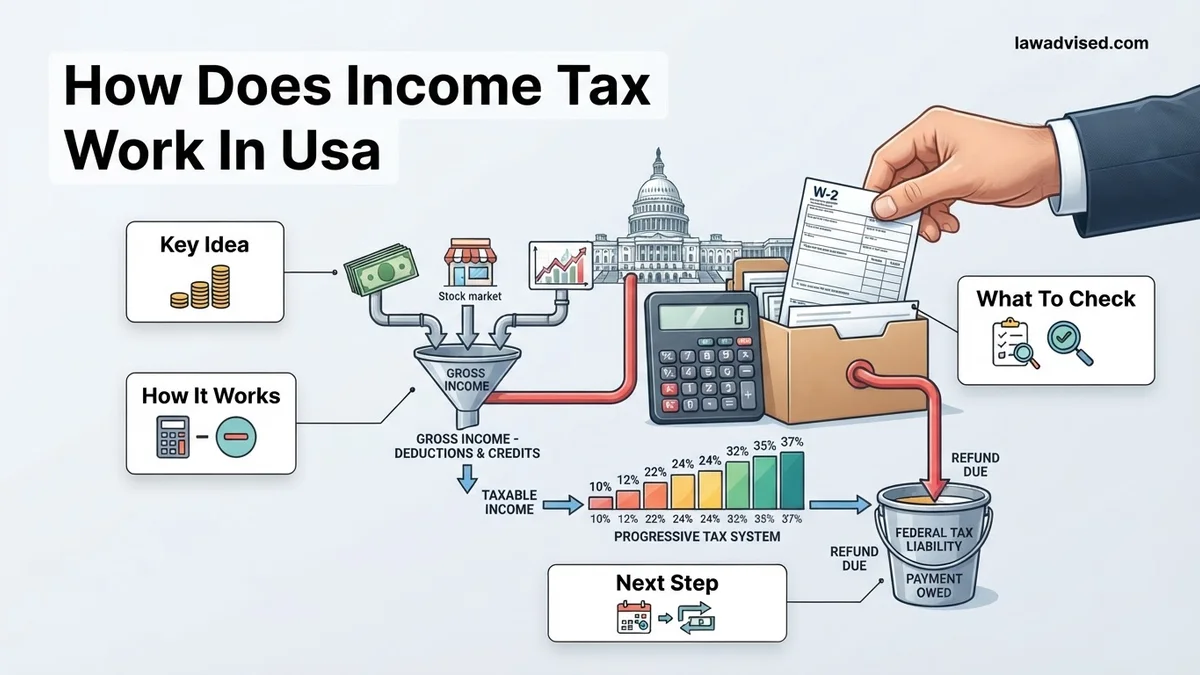
The U.S. federal income tax system is a progressive system, meaning tax rates increase as your income increases. Throughout the year, taxes are withheld directly from your paychecks, and an annual tax return is filed in April to settle the final amount owed or trigger a refund.
Income tax in the United States is a pay-as-you-go system where money is deducted directly from your paycheck throughout the year or paid via quarterly estimates if you are self-employed. At its core, the system uses a progressive tax structure, meaning the percentage of tax you pay increases as your income rises. Every filing season, you reconcile what you already paid against your actual tax liability to determine if you get a refund or owe a balance.
Navigating this system is essential for your personal financial health in 2026. Without a clear grasp of how your earnings are calculated, taxed, and collected, you risk overpaying the government or facing unexpected penalties. By breaking down the process from gross earnings to final taxable income, you can take control of your take-home pay and legally minimize your tax burden.
Key Takeaways
- Income tax is progressive, utilizing marginal tax brackets rather than taxing your entire income at one rate.
- Your Adjusted Gross Income (AGI) is calculated by taking your gross income and subtracting specific adjustments.
- You can choose between the standard deduction or itemized deductions to lower your taxable income.
- Paycheck withholding via the W-4 form ensures taxes are paid incrementally throughout the working year.
- Filing an annual tax return reconciles your total tax liability against what was already paid.
What Causes Tax Confusion: Understanding the U.S. Tax System
The Progressive Tax Bracket Misconception
The biggest myth in American taxation is that moving into a higher tax bracket means every dollar you earn is suddenly taxed at that higher rate. This misconception causes unnecessary anxiety and leads people to turn down raises or additional work. In reality, the U.S. uses a marginal tax system. Your income is sliced into chunks, and each chunk is taxed at its own specific rate.
- Your first dollars earned are taxed at the lowest marginal rate.
- Only the money that pushes past a specific threshold enters a higher bracket.
- Moving up a bracket never results in taking home less total money.
Marginal Rates vs. Effective Tax Rates
You need to know the difference between your marginal tax rate and your effective tax rate. Your marginal rate is simply the highest tax bracket your last dollar falls into for 2026. Your effective tax rate is your true average—the actual percentage of your total income that goes to the IRS after all brackets are applied. For example, a single filer in 2026 making $100,000 might hit a marginal rate of 24 percent, but their effective tax rate will be significantly lower because the first tiers of their income were taxed at 10, 12, and 22 percent.
Master US Income Tax in 7 Simple Steps
Navigating the United States tax system can feel overwhelming, but breaking the process down into logical phases transforms a daunting annual chore into a manageable financial routine. This comprehensive guide walks you through the entire US income tax process, from understanding how your earnings are taxed to filing your return and potentially securing a refund. Whether you are a fresh-faced W-2 employee or managing multiple income streams, following these steps ensures you remain compliant while keeping your hard-earned money safely in your pocket.
Step 1: Determine Your Filing Status
What you need: Your marital status as of December 31 of the tax year, and details regarding your household and dependents.
Instructions: Your filing status dictates your tax bracket, standard deduction amount, and eligibility for specific credits. You must choose one of five categories: Single, Married Filing Jointly, Married Filing Separately, Head of Household, or Qualifying Surviving Spouse. For instance, if you are unmarried and pay more than half the cost of keeping up a home for a qualifying dependent, you likely qualify as Head of Household, which offers a higher standard deduction than filing as Single.
Pro Tip: Choosing the wrong filing status is a major red flag for the IRS and can lead to processing delays or costly amendments. Always evaluate whether filing jointly or separately makes more financial sense if you are married.
Step 2: Gather All Income Documents
What you need: Forms W-2 (from employers), 1099s (from freelance work, investments, or gig apps), and records of any other income.
Instructions: Throughout January and February, employers and financial institutions issue tax documents reporting what you were paid during the previous calendar year. Collect every Form W-2 for traditional employment, Form 1099-NEC for independent contracting, Form 1099-INT for bank interest, and any other income reporting statements. If you operate a cash business or earned side-hustle income without a formal 1099, review your bank statements and accounting software to compile an accurate ledger of your total gross receipts.
Pro Tip: The IRS receives copies of all your W-2s and 1099s. Failing to report an income document will almost certainly trigger an automated IRS mismatch notice and a recalculated tax bill.
Step 3: Calculate Your Adjusted Gross Income (AGI)
What you need: Your total gross income figures and receipts or records for “above-the-line” deductions.
Instructions: Start by summing up all your earned and unearned income to find your gross total. Next, subtract your “above-the-line” adjustments to income (officially known as adjustments to income). These include eligible student loan interest payments, contributions to a traditional IRA or Health Savings Account (HSA), and self-employed health insurance premiums. The resulting figure is your Adjusted Gross Income (AGI), which serves as the foundational metric used by the IRS to determine your tax liabilities and limits on various credits.
Pro Tip: Above-the-line deductions are especially powerful because you can claim them even if you opt for the standard deduction rather than itemizing your expenses.
Step 4: Choose Between the Standard Deduction and Itemizing
What you need: Your AGI, and receipts for potential itemized deductions such as mortgage interest, state and local taxes (SALT), and charitable donations.
Instructions: You must decide whether to take the IRS flat standard deduction or tally up your specific deductible expenses (itemizing). The standard deduction varies by filing status and adjusts annually for inflation. If your total deductible expenses—such as medical costs exceeding 7.5% of your AGI, state and local taxes up to $10,000, home mortgage interest, and charitable gifts—surpass the standard deduction threshold, you should itemize to lower your taxable income further.
Pro Tip: Roughly 90% of US taxpayers take the standard deduction because it is easier and yields a higher deduction. Always do the math both ways to see which option saves you more money.
Step 5: Apply Tax Credits to Lower Your Bill
What you need: Records proving eligibility for credits like the Child Tax Credit, Earned Income Tax Credit (EITC), or education credits.
Instructions: Unlike deductions which reduce your taxable income, tax credits offer a dollar-for-dollar reduction of your actual tax liability. Review federal guidelines to see if you qualify for family-focused credits (like the Child Tax Credit), educational incentives (like the American Opportunity Tax Credit), or energy-efficient home improvement credits. Some credits are refundable, meaning if the credit reduces your tax liability below zero, the government will send you the difference as a cash refund.
Pro Tip: Keep meticulous records and receipts for education and childcare expenses. Tax credits have strict eligibility rules, and the IRS frequently audits claims for complex credits like the EITC.
Step 6: Calculate Final Tax Owed or Refund Due
What you need: Your taxable income, the IRS tax bracket tables, and your Form W-2 withholding amounts (Box 2).
Instructions: Apply the progressive US tax brackets to your taxable income to determine your tentative tax. The US uses a marginal tax rate system, meaning different portions of your income are taxed at different percentages (ranging from 10% up to 37%). Once you have your total calculated tax, subtract the total amount of federal income tax already withheld from your paychecks throughout the year (found on your W-2 or 1099s). If the resulting number is positive, you owe money; if it is negative, you are due a refund.
Pro Tip: Do not panic if you owe a small amount, but if you consistently owe a large sum or receive a massive refund, adjust your W-4 withholding with your employer to balance your cash flow.
Step 7: File Your Return and Submit Payment (or Claim Refund)
What you need: Tax preparation software or paper forms, bank account details for direct deposit, and a payment method if you owe.
Instructions: The standard federal tax filing deadline is April 15 of the following year. Compile your completed return (Form 1040) and submit it electronically using IRS Free File or commercial tax software—this is the fastest and safest method. If you owe taxes, submit your payment electronically via IRS Direct Pay to avoid late-payment penalties and interest charges. If you are receiving a refund, opt for direct deposit into a checking or savings account to receive your funds within 21 days.
Pro Tip: If you cannot finish your taxes by April 15, file Form 4868 to secure an automatic six-month filing extension until October 15. Remember that an extension to file is not an extension to pay any taxes owed.
✅ Final Checklist
- Verified that your Social Security Number(s) and personal details are entered correctly
- Confirmed all income reporting documents (W-2s, 1099s) are accounted for
- Selected the most advantageous filing status and deduction method
- Double-checked math and banking routing/account numbers for direct deposit
- Signed and dated the return (both spouses must sign for Married Filing Jointly)
Important Notes:
- Always retain copies of your filed tax returns and supporting documents for at least three to seven years in case of an IRS audit.
- Seek professional help from a Certified Public Accountant (CPA) or Enrolled Agent (EA) if you manage complex investments, rental properties, foreign assets, or own a small business.
- Estimated time: 3 to 10 hours depending on financial complexity. Cost range: $0 (IRS Free File) to $150–$500+ for commercial software or professional tax preparation.
How to Calculate Your Taxable Income: A Step-by-Step Guide
From Gross Income to Adjusted Gross Income
Your journey with the IRS starts long before you apply tax brackets. You cannot calculate what you owe based on your gross salary alone. First, you must determine your Adjusted Gross Income (AGI). This requires taking your total earnings for 2026 and subtracting specific adjustments known as “above-the-line” deductions.
- Start with your gross income from W-2s, 1099s, and investment returns.
- Subtract qualifying adjustments like student loan interest payments.
- Subtract contributions to traditional retirement accounts or health savings accounts.
- The resulting number is your AGI, which sets the baseline for your tax obligations.
Taking Deductions to Reach Final Taxable Income
Once you have your AGI, you apply either the standard deduction or itemized deductions to arrive at your final taxable income. For the 2026 tax year, the standard deduction acts as a zero-tax cushion that protects a baseline amount of your earnings. If your personal deductible expenses—such as mortgage interest, state and local taxes, and charitable donations—exceed the standard threshold, you itemize. Otherwise, you take the standard deduction, subtract it from your AGI, and the final figure is the exact amount subjected to the progressive tax brackets.
How to Navigate Marginal Tax Brackets and Effective Rates
Understanding how the U.S. progressive tax system operates prevents unnecessary confusion during tax season. According to fiscal policy experts at the Tax Foundation, the system uses marginal brackets. This means different portions of your income are taxed at different rates, rather than your entire income being taxed at a single flat percentage.
How Bracket Splitting Works
For the 2026 tax year, federal income tax brackets range from 10 percent up to 37 percent for top earners. Crossing into a higher bracket only applies to the specific dollars that fall within that higher threshold. Financial analysts emphasize that moving into a higher tax bracket never results in taking home less money overall.
Marginal Versus Effective Rates
Your marginal rate represents the highest tax bracket your last dollar of income hits. Conversely, your effective tax rate is the actual average percentage of your total income that you pay in federal taxes. Tax researchers note that most taxpayers have an effective tax rate significantly lower than their nominal marginal bracket due to the standard deduction.
What If Your Withholding Is Wrong: Fixing Paychecks and Filing Returns
Discovering a major discrepancy between your expected tax liability and your actual paycheck withholding requires immediate corrective action. The Internal Revenue Service recommends reviewing your withholding annually, especially after major life events such as marriage, a new child, or a significant salary adjustment.
Steps to Adjust Your Paycheck Withholding
- Access the IRS Tax Withholding Estimator online tool to calculate your precise target withholding amount for 2026.
- Obtain a new Form W-4 (Employee’s Withholding Certificate) from your employer’s human resources or payroll department.
- Complete the form by entering your updated personal details, multi-job adjustments, or specific dollar amounts for additional withholding.
- Submit the completed Form W-4 to your payroll office to ensure adjustments apply to upcoming pay periods.
Resolving Discrepancies During Tax Filing
If year-end calculations reveal you underpaid, you must pay the balance when filing your 2026 return to avoid statutory penalties and interest. If you overpaid through excessive withholding, filing your return triggers a direct deposit or paper check refund from the U.S. Treasury.
What If It Still Doesn’t Work?
If self-calculated withholding adjustments or standard tax preparation software fail to resolve complex financial situations, specific escalation steps remain available. According to certified public accountant registries, professional intervention ensures compliance and prevents costly reporting errors.
- Gather all historical tax documents, 2026 Form W-9s, 1099s, and prior-year returns to prepare for a formal consultation.
- Engage a credentialed tax professional, such as a Certified Public Accountant (CPA) or Enrolled Agent (EA), for specialized guidance. Expect professional fees to range between $250 and $800 depending on complexity.
- Contact the IRS dedicated helpline or schedule an appointment at a local Taxpayer Assistance Center for direct administrative support.
- Utilize the Low Income Taxpayer Clinic network if you meet qualifying financial thresholds and require legal representation for tax disputes.
Conclusion
Mastering how income tax works in the United States requires understanding progressive brackets, accurate withholding, and strategic end-of-year filing. Correcting payroll discrepancies early prevents unexpected tax bills and optimizes your cash flow throughout the year. According to verified research and tax policy experts, proactive financial planning remains the single most effective tool for minimizing legal tax liability. Take your next actionable step today by running the IRS Tax Withholding Estimator to align your 2026 paychecks with your actual tax obligations.
❓ Frequently Asked Questions
What is the difference between a marginal tax rate and an effective tax rate?
Your marginal tax rate is the highest tax bracket your last dollar of income falls into. Your effective tax rate is the actual average rate you pay across all tax brackets.
How does the U.S. progressive tax bracket system actually work?
The IRS divides income into tiers or brackets, each with a progressively higher tax rate. Income is taxed incrementally as it crosses each threshold, meaning lower portions of your income are always taxed at lower rates.
What happens if I overpay my taxes during the year?
If your total withholding and payments exceed your calculated tax liability for the year, the IRS will issue you a tax refund for the difference.
What is Adjusted Gross Income (AGI) and why does it matter?
AGI is your gross income minus specific adjustments like student loan interest or retirement contributions. It serves as the baseline for determining your eligibility for various deductions and credits.
What is the purpose of IRS Form W-4?
Form W-4 tells your employer how much federal income tax to withhold from your paycheck based on your filing status, dependents, and other income sources.
What is the penalty for not paying or underpaying federal income taxes?
Failing to file or pay on time can result in failure-to-file and failure-to-pay penalties, along with accumulating interest on the unpaid balance.

Ismail Hossain is the founder of Law Advised. He is an Divorce, Separation, marriage lawyer. Follow him.