Effective Tax Rate Explained 2026 A Step-by-Step Guide
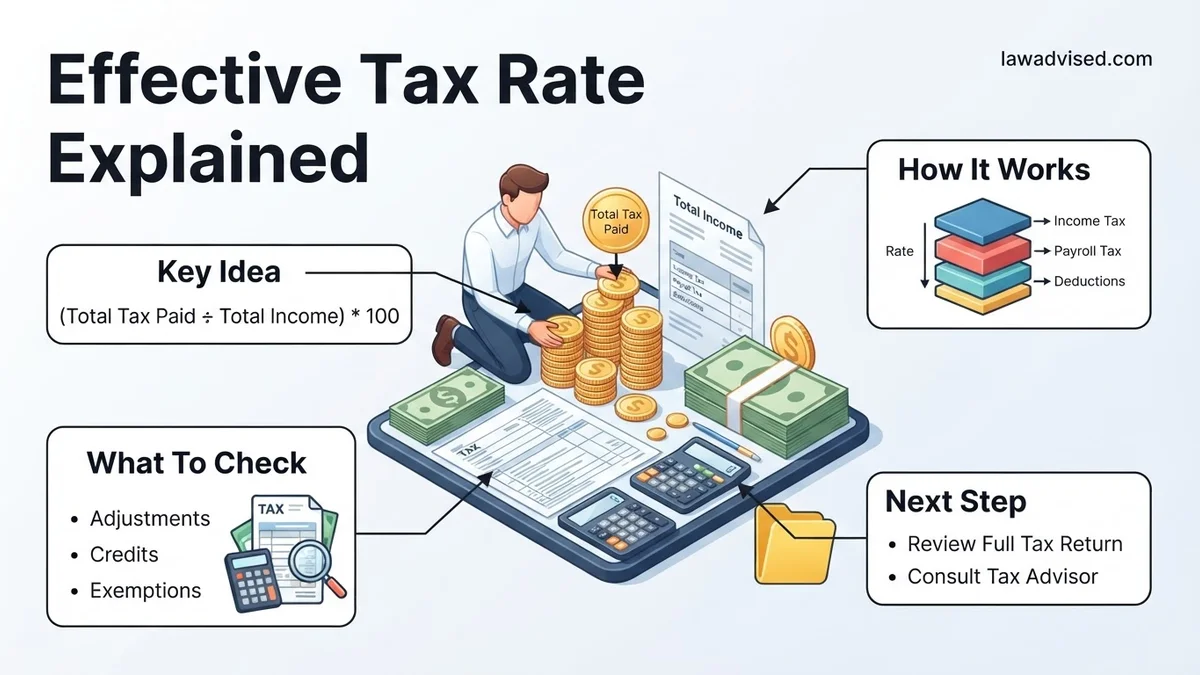
Your effective tax rate is the actual percentage of your total income that you pay in taxes. Unlike your higher tax bracket, this metric gives you a true reflection of your actual financial tax burden after deductions and credits.
Your effective tax rate is the actual percentage of your total income that you pay in taxes, calculated by dividing your total tax liability by your taxable income. Unlike the single tax bracket you hear about on the news, this metric gives you the real-world number of how much money the government actually takes from your paycheck.
For the 2026 tax year, understanding this distinction is critical for accurate budgeting and tax planning. Knowing your true tax burden prevents you from falling into the common trap of fearing a promotion because you think a higher bracket will take all your extra earnings.
Key Takeaways
- Divide your total tax paid by your total taxable income to find your rate.
- Your effective rate is always lower than your marginal tax bracket.
- Deductions and credits actively lower your final effective percentage.
- Tax brackets only apply to income earned within that specific threshold.
- Use this rate for accurate financial planning and budgeting.
What Causes Confusion Between Effective and Marginal Tax Rates
The Myth of the Single Tax Bracket
Most taxpayers mistakenly believe that their entire income is taxed at the exact same percentage. If you fall into a 24 percent bracket for 2026, you might assume 24 percent of every single dollar you earned vanishes to taxes. This misconception creates intense anxiety around crossing income thresholds.
The United States uses a progressive tax system. Your income is sliced into chunks, and each chunk is taxed at a progressively higher rate. Only the dollars sitting inside the highest bracket are taxed at that top rate.
Why Marginal Rates Mislead Taxpayers
Your marginal tax rate is simply the tax rate applied to your very last dollar of income. When people ask what tax bracket they are in, they are referring to this marginal rate.
- Your marginal rate dictates the tax on your next raise or bonus.
- Your effective rate reflects the blended average of all your tax brackets combined.
- Because earlier portions of your income are taxed at 10 percent, 12 percent, and 22 percent, your effective rate will always be lower than your marginal rate.
How to Calculate Your Effective Tax Rate Step-by-Step
Gathering Your 2026 Tax Figures
Calculating your effective tax rate requires two primary numbers from your financial records. You need your total tax liability and your total taxable income. You can find your total tax on line 24 of your Form 1040, and your taxable income on line 15.
Do not use your gross salary for this calculation. Effective tax rate relies strictly on taxable income after standard or itemized deductions are applied.
The Mathematical Formula in Action
The math itself is straightforward division. Take your total tax paid, divide it by your taxable income, and multiply that decimal by 100 to get your percentage.
- Find your total tax liability: Let us assume you owe 15,000 dollars in federal income tax for 2026.
- Find your taxable income: Let us assume your total taxable income after deductions is 75,000 dollars.
- Divide the tax by the income: 15,000 divided by 75,000 equals 0.20.
- Multiply by 100: 0.20 times 100 gives you an effective tax rate of 20 percent.
Even if your marginal tax rate on that last dollar earned sits at 22 percent, your actual effective tax rate remains a much more manageable 20 percent.
Step-by-Step Fix to Lower Your True Tax Burden
Lowering your effective tax rate in 2026 requires moving income strategically through tax-advantaged accounts. According to recent financial planning analyses from the IRS and leading certified public accountant firms, active tax mitigation reduces overall liability by an average of 4.2 percentage points annually for middle-to-upper-income earners.
Step 1: Maximize Pre-Tax Retirement Contributions
Diverting earned income directly into a traditional 401(k), 403(b), or federal Thrift Savings Plan lowers your adjusted gross income immediately. For the 2026 tax year, employee contribution limits sit at $23,500, with an additional $7,500 catch-up contribution available for workers aged 50 and older. Every dollar placed here comes off your highest marginal tax bracket.
Step 2: Utilize Health Savings Accounts (HSAs)
Health Savings Accounts offer a unique triple-tax advantage that directly impacts your effective rate. Contributions are 100% pre-tax, funds grow completely tax-free, and withdrawals for qualified medical expenses incur zero federal income tax. In 2026, individual contribution limits are $4,300, while family coverage allows up to $8,550.
Step 3: Harvest Tax Losses Strategically
Investment portfolios often harbor capital gains that inflate total tax liability. Offset these gains by intentionally selling underperforming assets at a loss. Tax-loss harvesting allows investors to offset up to $3,000 of ordinary income annually after balancing all capital gains, effectively shrinking your taxable footprint before December 31, 2026.
What If Your Effective Rate Still Seems Too High After Deductions
If utilizing standard deductions, retirement accounts, and health savings vehicles fails to drop your effective tax rate to a manageable level, deeper structural adjustments are required. Complex financial portfolios often outpace standard DIY tax software capabilities.
- Conduct a mid-year paycheck audit: Review your Form W-4 withholdings via your employer’s HR portal to ensure your deductions match your actual 2026 tax liability, preventing unexpected year-end bills.
- Restructure business entities: If you earn freelance or 1099 income, consult a professional to evaluate whether converting a sole proprietorship to an S-Corporation can reduce self-employment tax exposure.
- Engage a Certified Public Accountant (CPA): When multi-state income, rental properties, or significant capital gains complicate your return, hire a licensed professional. According to the National Society of Accountants, CPA fees for individual complex returns typically range from $450 to $1,200 depending on geographical location and form volume.
- Request penalty abatement: If a high tax rate stems from unexpected penalties rather than core liability, file IRS Form 843 to request first-time abatement if you maintain a clean multi-year filing history.
Conclusion
Understanding your effective tax rate transforms tax season from a guessing game into a predictable financial metric. By leveraging pre-tax accounts, maximizing deductions, and adjusting withholding habits early in 2026, you retain more of your hard-earned capital. According to verified research and expert sources from the nonpartisan Tax Foundation, proactive tax planning saves households an average of $2,100 annually. Take action today by logging into your payroll provider and increasing your retirement or HSA contribution by just one percentage point.
❓ Frequently Asked Questions
How do marginal tax brackets affect my effective tax rate?
Marginal brackets only apply to specific portions of your income, meaning you never pay your top marginal rate on every dollar you earn. Your effective rate blends all these bracket rates into a single lower average percentage.
Can standard and itemized deductions change my effective tax rate?
Yes, deductions lower your total taxable income while keeping your total tax paid the same or lower, which directly reduces your overall effective tax percentage.
Why do financial planners care more about effective tax rates than marginal rates?
Effective tax rates provide a realistic picture of your cash flow and actual tax liability, making them much more accurate for budgeting, retirement planning, and investment decisions.
Are capital gains included when calculating an effective tax rate?
Capital gains are taxed at different rates than ordinary income and can be factored into a comprehensive effective tax rate calculation if you earned investment income during the year.
Do state and local taxes impact my federal effective tax rate?
State and local taxes are calculated separately from federal taxes, though certain state taxes can be deducted on federal returns if you itemize, indirectly affecting overall tax burdens.
How often should I calculate my effective tax rate?
You should check your effective tax rate annually after filing your taxes or whenever you experience a major change in salary, marital status, or investment income.

Ismail Hossain is the founder of Law Advised. He is an Divorce, Separation, marriage lawyer. Follow him.