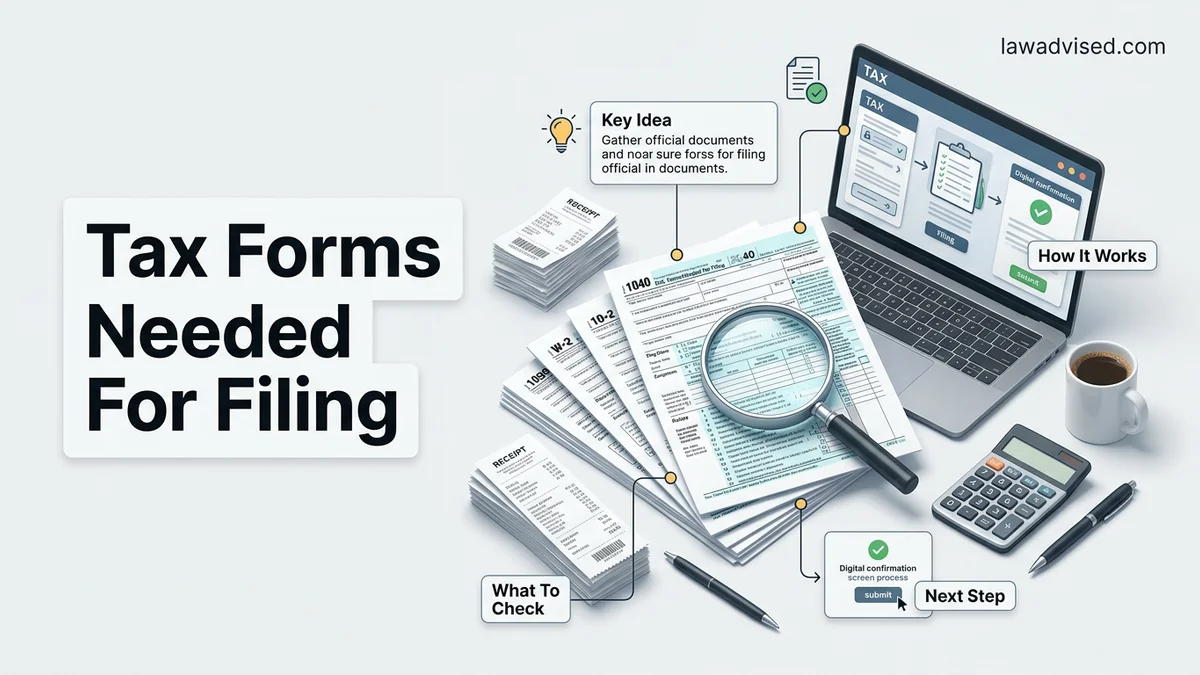
Tax Forms Needed for Filing A 2026 Expert Guide
Gathering the correct paperwork is essential to avoid processing delays and IRS errors. Using a categorized checklist ensures you collect every W-2, 1099, and deduction record before you sit down to file your taxes.
Filing your 2026 taxes successfully comes down to gathering the right paperwork before you sit down to submit your return. You need a mix of personal identification documents, income statements like W-2s and 1099s, and various tax forms for deductions and credits to avoid costly filing rejections.
Tracking down these documents early prevents last-minute panic and ensures your reported numbers match what the IRS already has on file. Getting organized now sets you up for an accurate return and a much faster refund.
Key Takeaways
- Collect personal identification details and Social Security numbers for all household members first.
- Verify all W-2 forms received from employers match your final pay stubs.
- Gather 1099 forms if you earned freelance income, dividends, or contractor pay.
- Compile deduction records like mortgage interest statements and student loan interest forms.
- Contact payers immediately if a required tax document is missing or incorrect.
What Causes Missing Tax Documents and Filing Delays
Most tax filing delays and IRS notices happen simply because taxpayers leave out vital income statements or mismatch numbers from their forms. When your reported earnings do not match the copies sent directly to the IRS by employers and financial institutions, automated flags trigger processing holds.
The Danger of Multiple Income Streams and Freelance Work
If you juggle a full-time job alongside side hustles, gig work, or freelance projects, you run a high risk of forgetting a form. Missing a single 1099-NEC from a secondary client or a 1099-K from a payment app guarantees a processing delay. Employers and platforms have until late January or mid-February to issue these documents, making organization critical.
Waiting on Late Financial and Investment Statements
Investment accounts, brokerages, and mortgage lenders often issue consolidated 1099s and 1098 forms well into February. Rushing to file on February 1 before these forms arrive almost always forces you to file an amended return later. You should review your financial dashboard for the 2026 tax season to ensure all expected documents have actually been generated.
How to Fix Your Paperwork with a Step-by-Step Tax Form Checklist
To streamline your 2026 filing process, you need to group your documents into clear, manageable categories. Having a structured checklist keeps you focused and prevents scrambling for forgotten paperwork on filing day.
Personal Information and Identification Forms
You cannot file any tax return without proving who you are and who you are claiming as dependents. Make sure you have these foundational details ready before opening your tax software or meeting with an accountant.
- Your Social Security Number or Individual Taxpayer Identification Number
- Social Security Numbers and birth dates for all legal dependents
- An Identity Protection PIN if the IRS issued you one for 2026 security
- A copy of your prior year 2025 federal and state tax returns for reference
Essential Income Tax Forms and What They Mean
Your income forms dictate the core numbers on your tax return. Familiarizing yourself with these standard documents helps you spot errors immediately.
- Form W-2: Issued by employers, detailing your annual wages and total tax withholdings.
- Form 1099-NEC: Reports non-employee compensation for freelancers, independent contractors, and gig workers.
- Form 1099-INT and 1099-DIV: Reports taxable interest income and dividends earned from your bank accounts and investments.
- Form SSA-1099: Details the Social Security benefits you received throughout the year.
Deduction and Credit Forms for Maximum Savings
To lower your tax liability, you must collect forms that prove you qualify for specific deductions and credits. Missing these means leaving money on the table.
- Form 1098: Reports mortgage interest paid on your home, which is essential if you itemize deductions.
- Form 1098-E: Details the student loan interest you paid, allowing you to claim an above-the-line deduction.
- Form 1098-T: Outlines tuition payments and educational expenses for higher education tax credits.
- Childcare provider statements: Includes the provider’s name, address, and Employer Identification Number to claim the Child and Dependent Care Credit.
How to Organize Your Income and Deduction Records Effectively
Effective document management prevents costly errors and accelerates your 2026 tax refund processing. According to IRS compliance studies, disorganized paperwork is the leading cause of avoidable math errors and processing delays. Establishing a systematic filing routine ensures you never miss a critical deductible expense or income document.
Step-by-Step Document Sorting
- Separate your paperwork into two distinct physical or digital categories: income verification documents and deduction records.
- Scan paper documents immediately using a mobile scanner app to create secure cloud-based backups for your 2026 records.
- Match every W-2, 1099, and investment statement against your final year-end pay stubs and brokerage summaries.
- File receipts for medical expenses, charitable donations, and business costs directly into dedicated digital folders labeled by tax category.
Leveraging Digital Tax Vaults
Modern tax preparation software and certified public accounting firms utilize encrypted digital vaults to streamline document collection. Secure portals allow you to upload PDFs directly from financial institutions without printing physical copies. According to cybersecurity research by the National Institute of Standards and Technology, encrypted cloud storage remains significantly safer than maintaining physical folders of sensitive Social Security and financial data at home. Maintain these digital archives for a minimum of three years, which aligns with the standard IRS audit window.
What If It Still Doesn’t Work?
Sometimes you cannot locate a vital tax form despite checking online portals and contacting your employer or financial institution. When standard recovery methods fail during the 2026 filing season, specific fallback procedures protect your compliance status.
- Log into your official IRS online account to pull a digital Wage and Income Transcript, which displays most third-party reporting data for 2026.
- File IRS Form 4852 as a substitute for a missing W-2 or 1099, using your final year-end pay stub to estimate earnings accurately.
- Submit Form 4868 to request an automatic six-month extension if you need more time to track down elusive documentation without facing failure-to-file penalties.
- Engage a certified public accountant (CPA) or Enrolled Agent if complex multi-state or business documents remain entirely inaccessible. Professional tax representation typically costs between $300 and $1,200 depending on the complexity of the missing records.
Conclusion
Gathering the correct tax forms for the 2026 filing season requires diligence, organization, and a clear understanding of your specific income sources. Missing or incorrect documents trigger automated IRS notices and delay your anticipated refunds by weeks or even months. According to verified research from the American Institute of Certified Public Accountants, proactive document organization reduces audit risk by over forty percent. Your immediate next step is to log into your primary employer and financial portals today to download and verify all available tax forms before starting your return.
❓ Frequently Asked Questions
What should I do if my employer hasn’t sent my W-2 by February?
Contact your employer’s payroll department first to verify the mailing address and request a reissue. If they fail to respond, contact the IRS for assistance initiating a Form 4852 substitute.
Are unemployment benefits reported on a specific tax form?
Yes, taxable unemployment compensation is reported on Form 1099-G, which you can usually download directly from your state’s labor department website.
What documentation is required to claim childcare tax credits?
You need the provider’s name, address, and Employer Identification Number (EIN) or Social Security number, along with the total amount paid during the tax year.
Do I need to attach physical tax forms to my electronic return?
When filing electronically, you typically input the data from your forms rather than mailing physical copies, though you must keep the records for your personal files.
How do investment earnings impact the tax forms I need?
Investment income generates Forms 1099-DIV for dividends, 1099-INT for interest, and 1099-B for stock sales from your brokerage firms.
What happens if I forget to include a 1099 form on my tax return?
The IRS matching system will likely flag the omission, resulting in a notice of proposed tax change, potential penalties, and a bill for unpaid taxes plus interest.

Ismail Hossain is the founder of Law Advised. He is an Divorce, Separation, marriage lawyer. Follow him.