How Progressive Taxation Works Step-by-Step Guide for 2026
Many taxpayers misunderstand how progressive taxation works, falsely believing that entering a higher tax bracket reduces their overall take-home pay. In reality, a progressive tax system applies increasing tax rates only to the portion of income that falls within each specific bracket. Understanding marginal versus effective rates clarifies your true tax liability.
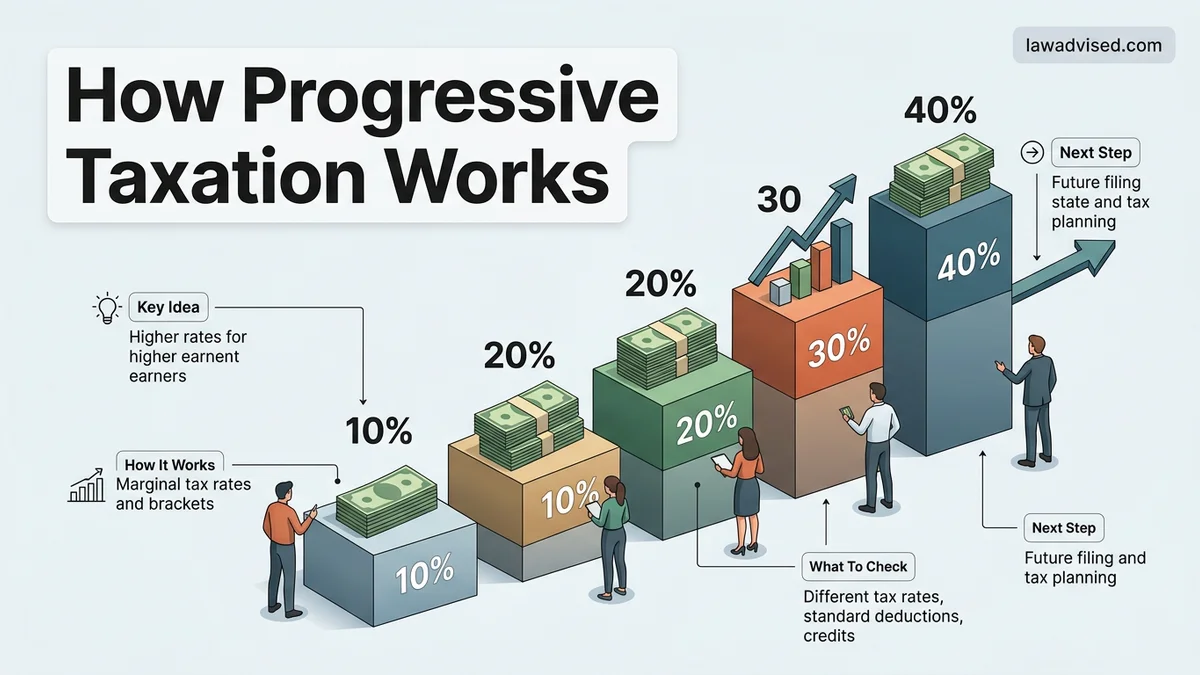
A progressive tax system means your tax rate increases as your taxable income goes up, but higher rates only apply to the dollars that fall within specific income thresholds, known as brackets. When you cross into a higher bracket, you do not pay that higher rate on all your money—only on the portion that exceeds the previous threshold.
Understanding this math prevents a very common and costly financial misunderstanding: the fear that getting a raise or moving into a higher tax bracket will somehow leave you with less take-home pay. By breaking down how marginal tax rates and effective rates actually function for the 2026 tax year, you can make smarter financial decisions about your salary, bonuses, and investments.
Key Takeaways
- Progressive tax brackets tax income incrementally, not all at once.
- Your marginal tax rate is only applied to your highest dollars earned.
- An effective tax rate represents your true average tax burden.
- Earning more money always results in higher total take-home pay.
- Flat and regressive systems contrast sharply with progressive structures.
What Causes the Confusion About Progressive Tax Brackets
The Myth of the Single Tax Bracket
Many people assume that once their total income hits a certain threshold, their entire income is taxed at that single high percentage. This misconception leads to the false belief that earning an extra dollar could push your entire paycheck into a higher tier, resulting in a net loss of income. In reality, the 2026 U.S. federal income tax system chops your income into slices, and each slice is taxed independently.
How Marginal Rates Prevent Penalties
- Your income is taxed in progressive layers, starting from the first dollar you earn.
- Entering a new bracket only changes the tax rate for the money falling specifically inside that new bracket.
- It is mathematically impossible to take home less money overall by earning a higher gross salary.
How to Calculate Your Taxes Using Marginal Brackets Step-by-Step
The Step-by-Step Mathematical Breakdown
To calculate your 2026 federal income tax, you must fill each progressive bracket sequentially up to your total taxable income level. Imagine the tax brackets as buckets that hold specific amounts of money. As you earn money, you fill the first bucket completely before any money spills over into the next, higher-rate bucket.
- Determine your total taxable income after standard or itemized deductions for 2026.
- Apply the lowest tax rate (such as 10 percent) to the first slice of income that fits into the initial bracket.
- Move up to the next bracket, applying that specific rate only to the dollars that fall strictly within that higher range.
- Repeat this process for each subsequent bracket until you account for every dollar of your taxable income.
- Add the tax amounts calculated from each individual bracket together to find your total tax liability.
A Practical 2026 Example
Suppose your single filer taxable income for 2026 is 60,000 dollars. You do not pay 22 percent on the entire 60,000 dollars just because you sit in the 22 percent bracket. Instead, the first portion of your income is taxed at 10 percent, the next slice at 12 percent, and only the final portion above the 22 percent threshold is taxed at that 22 percent rate. This layered application is what makes the progressive system fair and predictable.
What If Your Income Pushes You Into a Higher Bracket
One of the most persistent financial myths is that entering a higher tax bracket reduces your take-home pay. According to economic research from the Tax Foundation, crossing a threshold only subjects the additional dollars earned to the higher rate, not your entire income. Understanding how these thresholds operate prevents needless anxiety about earning more money in 2026.
Step-by-Step Breakdown of Bracket Spanning
When your salary increases and crosses a federal threshold, follow this systematic approach to track your actual earnings:
- Identify your exact taxable income after standard deductions for the 2026 tax year.
- Locate the specific tier where your income crosses the threshold line.
- Calculate the tax owed on every dollar that falls strictly below that threshold using the lower historical percentages.
- Apply the new higher percentage rate exclusively to the dollars sitting above that specific cutoff line.
- Sum these figures to find your total tax liability, confirming that your net income always increases alongside a raise.
How to Determine Your Effective Tax Rate Versus Marginal Rate
Tax literacy requires distinguishing between your marginal tax rate and your effective tax rate. Your marginal rate represents the top percentage tier applied to your very last dollar earned. Conversely, your effective tax rate reflects the true, blended average percentage of tax you pay across your total income.
Calculating Your True Tax Burden
Financial experts at the Internal Revenue Service recommend computing both metrics annually to evaluate your true financial standing. Use this sequential method to find your rates:
- Locate your top marginal tax bracket based on your filing status for 2026.
- Retrieve your total tax liability from your final tax calculation worksheet.
- Divide your total tax liability by your total gross income to find your decimal ratio.
- Multiply that result by 100 to yield your true effective tax percentage, which will always sit lower than your marginal rate.
What If It Still Doesn’t Work?
Tax computations can become overwhelming when factoring in state laws, investment yields, and shifting deductions. If your personal calculations continue to yield confusing results, apply these troubleshooting steps:
- Re-verify your gross income figures against your final year-end W-2 or 1099 forms.
- Utilize updated 2026 tax software calculators to run a secondary automated audit of your bracket thresholds.
- Consult a Certified Public Accountant (CPA) or Enrolled Agent (EA) if you manage complex multi-state or self-employment earnings. Professional tax advisory services typically cost between $300 and $1,200 depending on filing complexity.
Conclusion
Navigating progressive taxation requires understanding that higher brackets apply only to incremental earnings, ensuring your net income always rises with a pay increase. According to verified research and expert sources from leading fiscal policy institutes, mastering the distinction between marginal and effective rates empowers better financial planning. Your immediate actionable next step is to review your current paystub or 2026 tax withholding to verify you are properly accounting for your tax brackets today.
❓ Frequently Asked Questions
How do tax brackets actually divide up your annual income?
Tax brackets slice your income into tiers, where the first tier is taxed at the lowest rate, the second tier at the next rate, and so on up to your highest bracket.
Why is the myth about making less money in a higher bracket so common?
People often confuse marginal tax rates with average tax rates, assuming a single higher rate applies retroactively to all earnings rather than just new earnings.
How do standard deductions interact with progressive tax brackets?
Standard deductions lower your total taxable income first, effectively shielding your lowest potential earnings from being taxed at all before brackets are applied.
What happens to my taxes if I get a raise that crosses a bracket threshold?
Only the exact amount of money that exceeds the threshold is taxed at the new higher rate, meaning your overall net income still increases.
How do state progressive taxes differ from federal progressive taxes?
While both use marginal brackets, state tax systems feature completely different income thresholds and rate percentages separate from federal rules.
Can tax credits change how progressive taxation affects me?
Yes, tax credits directly reduce your final tax bill dollar-for-dollar, acting independently of the marginal bracket calculation process.

Ismail Hossain is the founder of Law Advised. He is an Divorce, Separation, marriage lawyer. Follow him.