Tax Rates for Single Filers 2026 Expert Guide to Brackets
Navigating your federal obligations requires knowing the exact tax rates for single filers for the current year. Your total taxable income determines which marginal tax brackets apply to your earnings. Reviewing these thresholds helps you properly calculate your liability and plan your annual financial strategy.
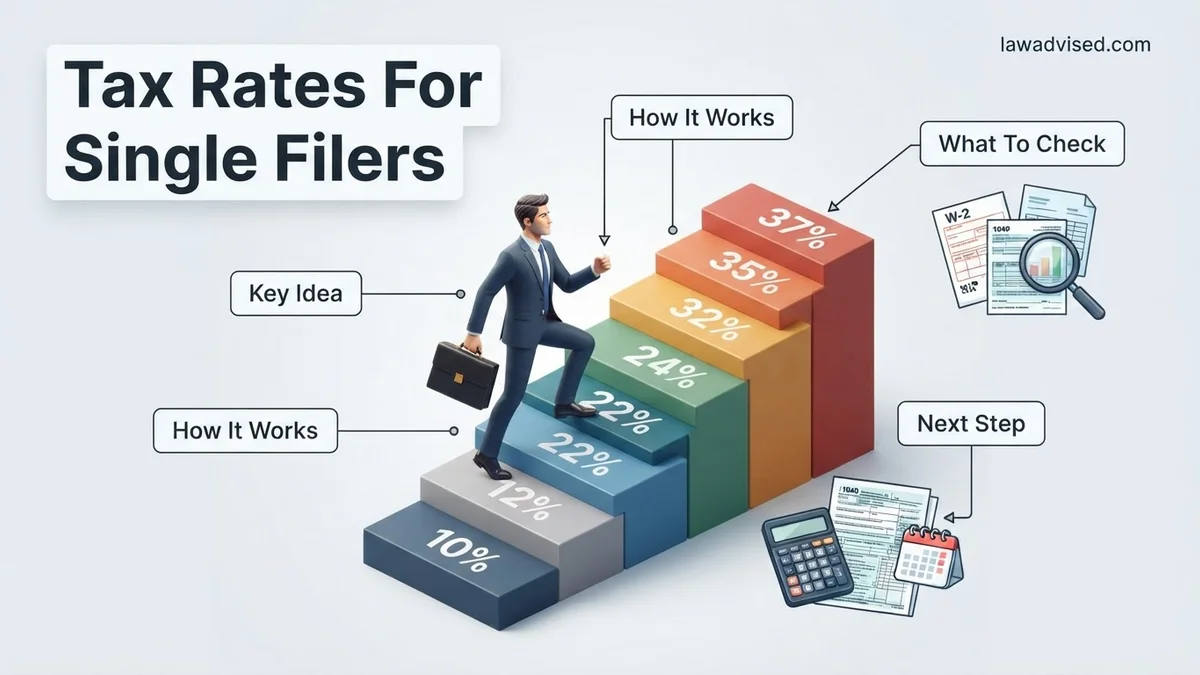
For the 2026 tax year, federal income tax brackets for single filers span seven distinct marginal rates: 10%, 12%, 22%, 24%, 32%, 35%, and 37%. Your exact placement within these tiers depends entirely on your taxable income after taking standard or itemized deductions. Because single filers do not share the doubled thresholds available to married couples filing jointly, crossing into a higher bracket happens at lower income levels.
Understanding these thresholds matters because the tax code uses a marginal system. Only the income falling inside a specific bracket is taxed at that rate, rather than your entire salary. Getting a clear picture of the 2026 single brackets helps you forecast your take-home pay, evaluate job offers, and make informed choices about pre-tax retirement contributions before the year closes.
Key Takeaways
- Identify your exact marginal tax bracket based on current single filer thresholds.
- Factor in the standard deduction to accurately calculate your total taxable income.
- Distinguish between marginal tax rates and your overall effective tax rate.
- Implement tax-advantaged accounts to reduce your overall taxable income bracket.
- Review your income adjustments before filing to ensure maximum potential savings.
What Causes Tax Bracket Creep for Single Filers
Bracket creep happens when your income pushes you into a higher marginal tax bracket. For single filers, this often sneaks up faster than expected during inflationary periods or career growth.
Nominal Raises Versus Real Purchasing Power
When you get a raise that only matches inflation, your nominal income increases. This extra cash can elevate your taxable income enough to cross a 2026 bracket threshold. Even though your actual purchasing power stayed the same, a larger slice of your earnings faces a higher tax rate.
Side Hustles and Capital Gains
- Adding freelance work or gig economy income directly increases your Adjusted Gross Income.
- Realizing profits from selling stocks or crypto in taxable accounts adds to your total annual earnings.
- Even a modest side income stream can trigger bracket creep by pushing you past the edge of your current tax tier.
How to Fix Your Withholdings and Optimize Tax Brackets Step-by-Step
Taking control of your tax brackets requires proactive adjustments to how much tax your employer withholds from each paycheck throughout 2026.
Recalculate Using the IRS Tax Estimator
- Gather your most recent paystubs and your prior year tax return.
- Navigate to the official IRS Tax Withholding Estimator online tool.
- Input your projected 2026 earnings, deductions, and any side hustle revenue to see if you are on track.
Submit an Updated Form W-4
If the estimator reveals you are under-withholding or risking an unexpected jump into a higher bracket, you need to act. Complete a new Form W-4 and submit it to your employer’s payroll department. You can specify an extra dollar amount to withhold from each paycheck. This eliminates surprise tax bills and keeps your cash flow optimized for the 2026 tax year.
What If Your Income Pushes You Into a Higher Tax Bracket
A common misconception is that entering a higher tax bracket means your entire income is taxed at that elevated rate. Under the United States progressive tax system for single filers in 2026, only the specific portion of your income that falls above the threshold is taxed at the higher percentage.
Understanding how marginal rates operate prevents unnecessary panic when a raise or bonus increases your gross earnings. Your initial dollars remain taxed at the lower historical rates established for that tax year.
Understanding Marginal Rate Mechanics
Financial experts emphasize that gross income crossing a threshold only impacts the dollars sitting in that specific tier. For instance, if a single filer’s income edges into the 24 percent bracket, only the earnings exceeding the previous bracket limit face the 24 percent assessment. The lower segments of income retain their respective 10, 12, or 22 percent rates.
Calculating Effective Versus Marginal Rates
Tax analysts recommend tracking your effective tax rate rather than focusing solely on your top marginal bracket. Your effective rate represents the true percentage of your total income paid to the government. This metric is invariably lower than your top marginal rate, offering a realistic view of your annual tax liability.
Proven Strategies to Lower Your Taxable Income Effectively
Proactive financial planning allows single filers to reduce their adjusted gross income (AGI) legally and strategically before the 2026 tax year concludes. Utilizing tax-advantaged accounts and deductions keeps more capital in your possession.
- Maximize Retirement Contributions: Direct pre-tax dollars into a traditional 401(k) or IRA to directly lower your taxable income for the year. Single filers can contribute up to the maximum annual limits set for 2026, shielding those funds from immediate federal taxation.
- Utilize Health Savings Accounts (HSAs): Fund a qualified HSA if you maintain a high-deductible health plan. Contributions offer a triple tax advantage, reducing your current-year AGI while growing completely tax-free for medical expenses.
- Harvest Investment Losses: Offset capital gains by selling underperforming taxable investments at a loss. Single filers can use up to $3,000 of excess losses to reduce ordinary income annually.
What If It Still Doesn’t Work?
If self-managed tax planning strategies fail to adequately lower your bracket or you face complex filing scenarios involving self-employment and investments, alternative measures are required. According to certified public accountant data, professional intervention ensures compliance while uncovering hidden deductions.
- Consult a Certified Public Accountant (CPA): Engage a licensed tax professional to review your complete financial profile. Typical consultation and filing fees range from $300 to $1,000+ depending on return complexity.
- Utilize Enrolled Agent Services: Hire an IRS-licensed tax practitioner who specializes in taxation defense and strategic reduction planning.
- Request an IRS Payment Plan: If unexpected tax liabilities arise, apply immediately for an online payment agreement or installment plan to manage balances and minimize penalties.
Conclusion
Navigating tax rates for single filers in 2026 requires a firm grasp of progressive brackets and proactive deduction management. Failing to plan can leave hundreds of dollars on the table unnecessarily. According to verified research and expert financial sources, utilizing pre-tax accounts remains the single most effective defense against high tax liabilities. Take your next step today by calculating your projected 2026 AGI and adjusting your retirement contributions accordingly.
❓ Frequently Asked Questions
How are federal income tax brackets for single filers structured?
Federal tax brackets operate on a progressive system, meaning different portions of your income are taxed at progressively higher rates as your earnings increase. For single filers, these brackets span from a starting rate of 10% to a maximum rate of 37%.
What is the standard deduction amount for single filers?
The standard deduction for single filers is adjusted annually for inflation by the IRS. This dollar amount is subtracted directly from your gross income to determine your final taxable income.
How do I calculate my effective tax rate as a single filer?
To find your effective tax rate, divide your total calculated tax liability by your total gross income and multiply the result by 100. This percentage is usually lower than your top marginal bracket rate.
What income sources are included when calculating tax rates for single filers?
All forms of earned and unearned income count toward your total taxable income, including wages, salaries, tips, investment dividends, capital gains, and freelance earnings.
How can I check if my employer is withholding enough taxes for a single filer?
You can review your recent pay stubs and cross-reference them with the IRS Tax Withholding Estimator online. Submitting a new Form W-4 to your employer allows you to adjust your withholding amount.
Do state income tax rates affect single filers differently than federal rates?
State income taxes are completely separate from federal income taxes and follow distinct bracket structures and rules set by each individual state government.

Ismail Hossain is the founder of Law Advised. He is an Divorce, Separation, marriage lawyer. Follow him.