Standard Deduction for Blind Taxpayers 2026 Expert Guide
Blind taxpayers qualify for an additional standard deduction that significantly lowers their taxable income for the 2026 tax year. Knowing your exact filing status allows you to accurately combine the basic and additional amounts on your tax return. Meeting IRS blindness criteria requires proper medical documentation or certification.
For the 2026 tax year, blind taxpayers qualify for an additional standard deduction of $1,600 if filing as Single or Head of Household, or $1,300 per qualifying condition if filing Married or a Qualifying Surviving Spouse. When you combine this additional amount with your basic standard deduction, you significantly lower your taxable income without the hassle of itemizing deductions.
Tax regulations provide this extra financial cushion to offset the distinct living and working expenses associated with vision loss. Whether you experience total blindness or partial sight meeting specific clinical definitions, knowing these exact 2026 figures ensures you claim every dollar of tax savings you deserve on your upcoming federal return.
Key Takeaways
- Blind taxpayers receive an additional standard deduction amount added to their basic deduction.
- The exact dollar amount varies depending on your official IRS filing status.
- Combine the basic standard deduction with the blind addition to calculate your total.
- A physician or optometrist must certify your visual acuity meets IRS legal blindness standards.
- Taxpayers aged 65 or older can claim both the senior and blind additional deductions simultaneously.
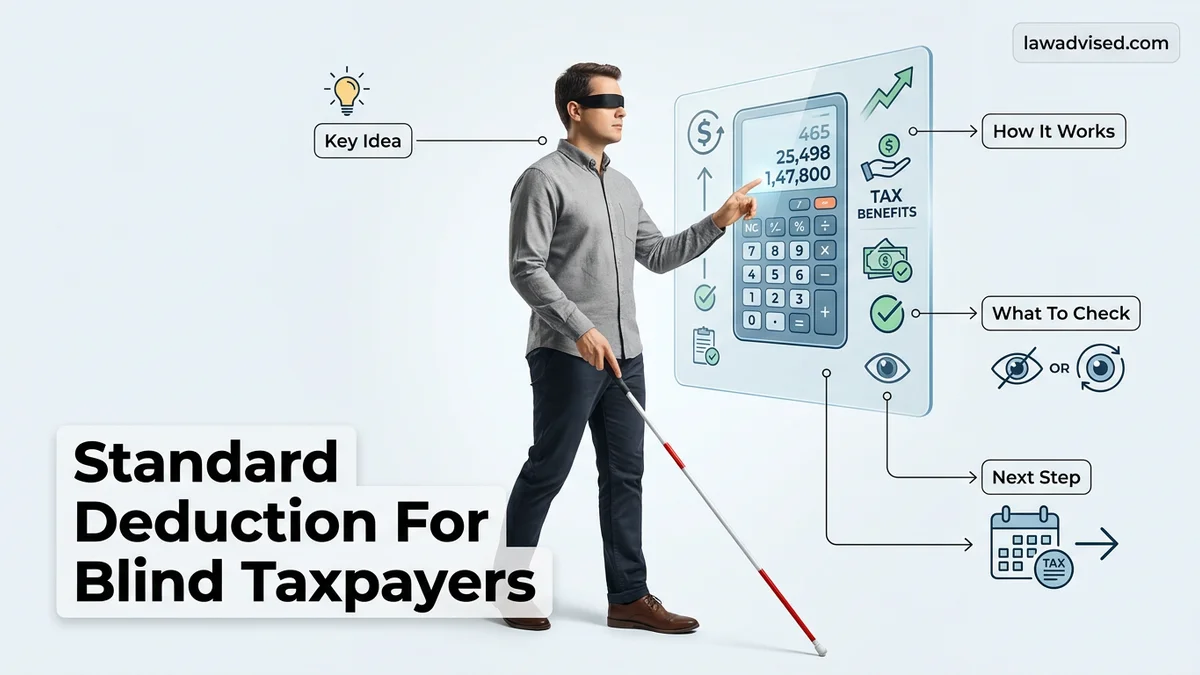
What Defines the Standard Deduction for Blind Taxpayers
The 2026 Additional Blind Standard Deduction Amounts
The IRS increases the standard deduction for taxpayers who are legally blind as of the end of the 2026 tax year. The exact dollar addition depends entirely on your official filing status:
- Single: $1,600 additional deduction
- Head of Household: $1,600 additional deduction
- Married Filing Jointly: $1,300 additional deduction per qualifying spouse
- Married Filing Separately: $1,300 additional deduction
- Qualifying Surviving Spouse: $1,300 additional deduction
Medical Criteria and Age Interactions
To claim this extra amount on your 2026 return, your central visual acuity must not exceed 20/200 in the better eye with corrective lenses, or your visual field must be no greater than 20 degrees. If you also happen to be age 65 or older by the end of 2026, you can stack the blind addition on top of the senior standard deduction. For instance, an unmarried taxpayer who is both blind and at least 65 years old receives two separate additional increments on top of their basic standard deduction.
How to Calculate Your Total 2026 Standard Deduction Step-by-Step
Basic Plus Additional Calculation Mechanics
Calculating your total 2026 standard deduction requires a simple addition problem. You take the baseline standard deduction for your specific filing status and add the $1,600 or $1,300 blind increment. If you qualify for both the age 65-or-older addition and the blindness addition, you must add both extra amounts to your baseline total.
- Identify your base 2026 standard deduction amount based on your filing status.
- Determine if you meet the IRS definition of blindness before December 31, 2026.
- Add the appropriate blind standard deduction amount ($1,300 or $1,600) to your base figure.
- Include any applicable senior citizen additional deductions if you are 65 or older.
Practical Calculation Examples
Consider a single filer who is legally blind and under age 65 in 2026. Assuming a projected basic standard deduction of $15,000 for a single filer, you add the $1,600 blind adjustment, bringing your total standard deduction to $16,600. Now, consider a married couple filing jointly where one spouse is blind and both are over age 65. They take their base joint standard deduction, add $1,300 for the blindness, and add two separate $1,550 senior increments, maximizing their tax-free income threshold efficiently.
What Medical Documentation You Need to File Your Claim
The IRS does not require you to attach a doctor’s note or medical certificate to your 2026 tax return when claiming the additional standard deduction for blindness. However, rigorous record-keeping is essential because the IRS retains the legal authority to audit your return and request verification later.
Acceptable Proof of Central Visual Acuity
Taxpayers claiming this deduction must secure documentation confirming their visual impairment meets the statutory definition. According to IRS guidelines and ophthalmological standards, acceptable proof includes:
- An official statement from a licensed doctor of medicine or a practicing optometrist.
- Clinical records explicitly stating that your corrected central visual acuity does not exceed 20/200 in your better eye.
- Documentation proving your visual field is restricted to 20 degrees or less, regardless of visual acuity.
Storage and Retention Best Practices
Do not mail your medical records with Form 1040 unless specifically instructed by an IRS notice. Instead, store the documentation securely alongside your tax papers for a minimum of three years from the date you file your 2026 return. Certified documentation protects you entirely against potential substantiation inquiries.
What If Your Blindness Status Changes During the Tax Year
Taxpayers often experience vision changes mid-year, creating uncertainty regarding whether they qualify for the additional 2026 standard deduction. The IRS determines eligibility based on your status as of the final day of the tax year, which is December 31, 2026.
Mid-Year Vision Loss Scenarios
If you meet the statutory definition of blindness on or before December 31, 2026, you are entitled to claim the full additional standard deduction for the entire tax year. You do not need to prorate the amount based on the specific month your vision deteriorated.
Recovery of Sight Scenarios
Conversely, if your vision successfully improves and you no longer meet the clinical definition of blindness by December 31, 2026, you cannot claim the additional standard deduction for that tax year. Eligibility relies strictly on your medical condition on the final day of the accounting period.
What If It Still Doesn’t Work?
If your tax preparation software rejects your blindness claim or you encounter calculation errors regarding your 2026 standard deduction, utilize these troubleshooting steps:
- Double-check your birthdate and checkbox entries on Form 1040, as software frequently misroutes disability indicators based on initial data entry errors.
- Manually calculate your total standard deduction using the official IRS Publication 501 worksheets to verify your software’s automated math.
- Consult a certified public accountant (CPA) or an Enrolled Agent specializing in disability tax provisions if the electronic filing rejection persists. Professional assistance fees for individual returns generally range from $200 to $500 depending on complexity.
- Contact the IRS dedicated helpline for individuals with disabilities or schedule an appointment at your local Taxpayer Assistance Center for direct guidance.
Conclusion
Claiming the additional standard deduction for blind taxpayers in 2026 provides vital financial relief by lowering your overall taxable income. Securing this benefit requires validating your visual acuity against IRS standards and verifying your status as of December 31. According to verified research and expert tax sources, maintaining accurate medical documentation ensures seamless compliance and protects your filing integrity. Take your next actionable step today by consulting with a licensed optometrist to update your clinical records before starting your tax preparation.
❓ Frequently Asked Questions
What exact dollar amounts apply to the blind standard deduction for the 2026 tax year?
The IRS adjusts the additional standard deduction amount annually based on inflation. For 2026, the specific extra amount depends on whether you file as single, married filing jointly, or head of household.
How does the IRS officially define legal blindness for tax purposes?
The IRS defines legal blindness as having corrected vision of 20/200 or worse in your better eye, or a visual field defect where the widest diameter subtends an angular distance no greater than 20 degrees.
What steps should I take if my eye doctor provides a statement certifying my blindness?
Keep the signed statement from your optometrist or ophthalmologist with your tax records in case the IRS audits your return or requests verification of your eligibility.
Can a dependent claim the additional standard deduction for blindness?
Yes, dependents who are blind can claim an additional standard deduction on their own tax return, though the calculation follows specific dependency income rules.
What happens if I turn legally blind halfway through the tax year?
You are considered blind for the entire tax year if you meet the clinical definition on the final day of the tax year, allowing you to claim the full additional deduction.
How do electronic tax filing software programs handle the blind standard deduction?
Most tax software programs will ask a series of questions regarding your vision and automatically add the correct dollar amount to your basic standard deduction when you check the appropriate box.

Ismail Hossain is the founder of Law Advised. He is an Divorce, Separation, marriage lawyer. Follow him.